Division of Cardiology, Johns Hopkins University, Baltimore, Maryland; Longitudinal Studies Section, Translational Gerontology Branch, National Institute on Aging, National Institute of Health, Baltimore, Maryland; Division of Cardiology, Research Center of Cardiovascular Biology, University of Genova, Italy.
Am J Cardiol. 2013 Oct 15;112(8):1182-9. doi: 10.1016/j.amjcard.2013.05.070.
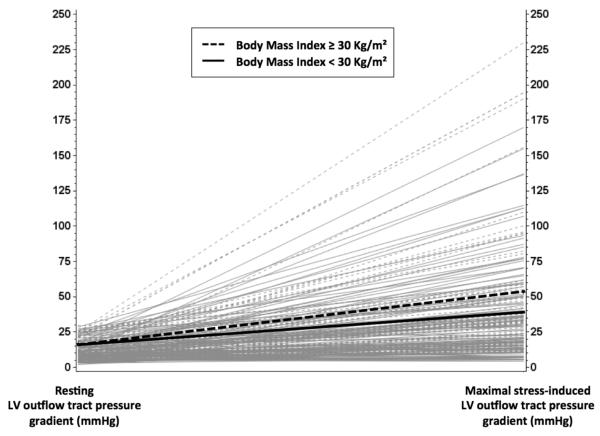
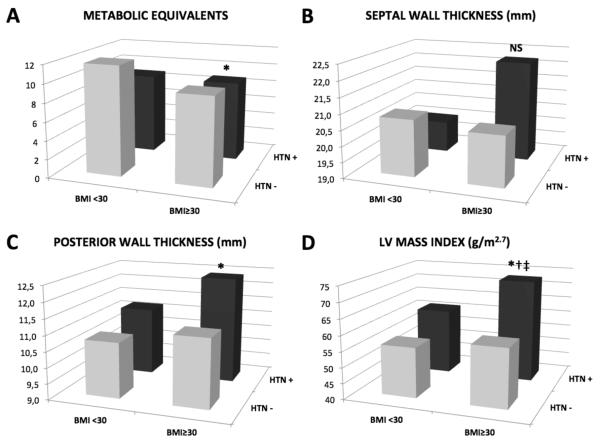
Obesity is independently associated with left ventricular (LV) hypertrophy and thus may be an important modifier of the hypertrophic cardiomyopathy (HC) phenotype. We examined if obesity modifies the clinical presentation, LV morphology, outflow hemodynamics, and exercise tolerance in HC. In this cross-sectional study, 88 obese (body mass index [BMI] ≥30 kg/m(2)) and 154 nonobese (BMI <30 kg/m(2)) patients from the Johns Hopkins HC clinic were compared with respect to a variety of clinical and LV echocardiographic measurements. Obese patients (36.4%) were more likely to report exertional dyspnea (p = 0.04) and chest pain (p = 0.002) and had greater prevalence of hypertension (p = 0.008). LV posterior wall thickness (p = 0.01) but not the septal wall (p ≥0.21) was significantly greater in obese patients, resulting in an increased LV mass index (p = 0.003). No significant differences in LV systolic and diastolic functions were observed, but obesity was associated with higher LV stroke volume (p = 0.03), inducible LV outflow tract gradients (p = 0.045), and chance of developing LV outflow tract obstruction during stress (p = 0.035). In multivariate analysis, BMI was associated with increased posterior (but not septal) wall thickness (β = 0.15, p = 0.02) and LV mass index (β = 0.18, p = 0.005), particularly in those with hypertension. Obesity was also associated with reduced exercise time and functional capacity, and BMI independently correlated with reduced exercise tolerance. In conclusion, obesity is associated with larger LV mass, worse symptoms, lower exercise tolerance, and labile obstructive hemodynamics in HC. The association with increased outflow tract gradients has particular importance as contribution of obesity to the pressure gradients may influence clinical decisions in labile obstructive HC.
肥胖与左心室(LV)肥大独立相关,因此可能是肥厚型心肌病(HC)表型的重要修饰因子。我们研究了肥胖是否会改变 HC 患者的临床表现、LV 形态、流出道血流动力学和运动耐量。在这项横断面研究中,比较了约翰霍普金斯 HC 诊所的 88 名肥胖(体重指数 [BMI]≥30 kg/m²)和 154 名非肥胖(BMI<30 kg/m²)患者的各种临床和 LV 超声心动图测量值。肥胖患者(36.4%)更可能报告劳力性呼吸困难(p=0.04)和胸痛(p=0.002),高血压的患病率更高(p=0.008)。肥胖患者的 LV 后壁厚度(p=0.01)而非室间隔壁厚度(p≥0.21)显著增加,导致 LV 质量指数增加(p=0.003)。未观察到 LV 收缩和舒张功能的显著差异,但肥胖与更高的 LV 心搏量(p=0.03)、可诱导的 LV 流出道梯度(p=0.045)和压力下发生 LV 流出道梗阻的机会(p=0.035)相关。多变量分析显示,BMI 与 LV 后壁厚度(β=0.15,p=0.02)和 LV 质量指数(β=0.18,p=0.005)的增加相关,尤其是在合并高血压的患者中。肥胖也与运动时间和功能容量减少相关,且 BMI 与运动耐量降低独立相关。总之,肥胖与更大的 LV 质量、更差的症状、更低的运动耐量和不稳定的阻塞性血流动力学相关。肥胖对流出道梯度的影响尤其重要,因为肥胖对压力梯度的贡献可能会影响不稳定型阻塞性 HC 的临床决策。