State Key Laboratory of Medical Genetics, Central South University, Changsha, Hunan Province, China.
BMC Med Genomics. 2013 Sep 30;6:36. doi: 10.1186/1755-8794-6-36.
Intracranial aneurysm (IA) is one of the most lethal forms of cerebrovascular diseases characterized by endothelial dysfunction, vascular smooth muscle cell phenotypic modulation, inflammation and consequently loss of vessel cells and extracellular matrix degradation. Besides environmental factors, genetics seem to be a very important factor in the genesis of this disease. Previous mRNA expression studies revealed a large number of differentially expressed genes between IA and control tissue. However, microRNAs (miRNA), small non-coding RNAs which are post-transcriptional regulators of gene expression, have been barely studied. Studying miRNAs could provide a hypothetical mechanism underlying rupture of IA.
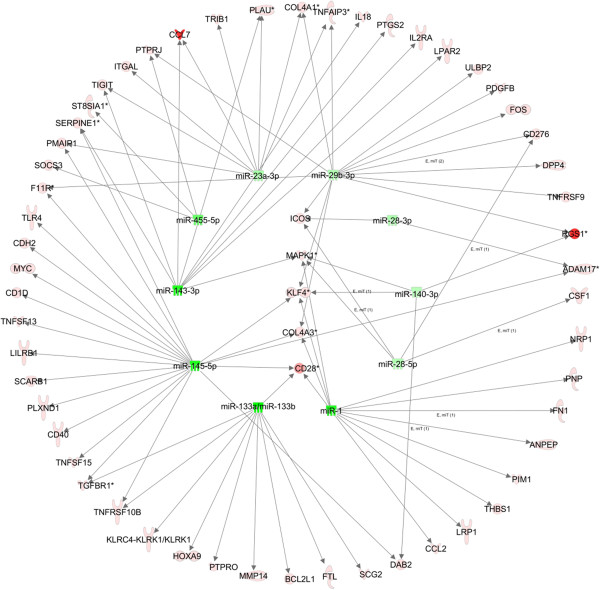
A microarray study was carried out to determine difference in microRNAs and mRNA between patients' IA tissues and controls. Quantitative RT-PCR assay compared the expression level between two groups (14 IA domes vs. 14 controls) were used for validation. Validated miRNAs were analyzed using Ingenuity Pathway Analysis (IPA) to identify the networks and pathways.
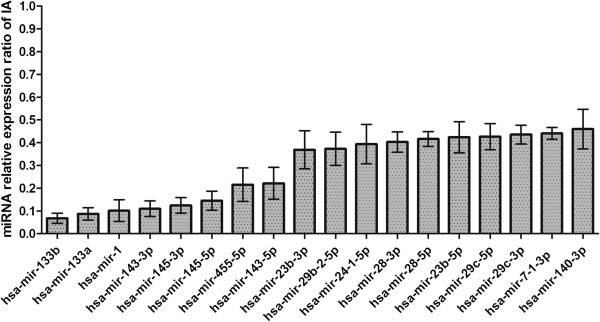
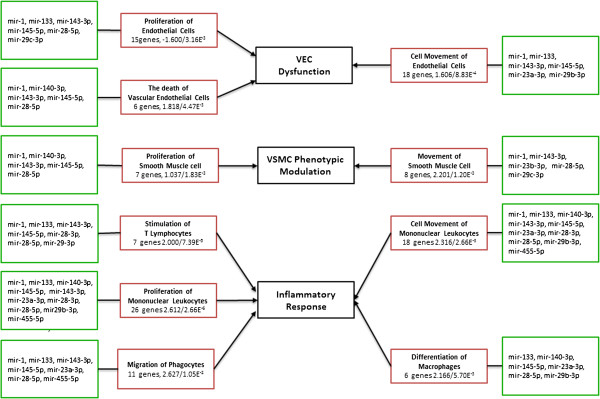
18 miRNAs were confirmed by qPCR to be robustly down-regulated in 14 ruptured IA patients including hsa-mir-133b, hsa-mir-133a, hsa-mir-1, hsa-mir-143-3p, hsa-mir-145-3p, hsa-mir-145-5p, hsa-mir-455-5p, hsa-mir-143-5p, hsa-mir-23b-3p etc., of which 11 miRNAs are clusters: hsa-mir-1/has-mir-133a, hsa-mir-143/hsa-mir-145, hsa-mir-23b/hsa-mir-24-1, and hsa-mir-29b-2/hsa-mir-29c. 12 predicted functions were generated using IPA which showed significant associations with migration of phagocytes, proliferation of mononuclear leukocytes, cell movement of mononuclear leukocytes, cell movement of smooth muscle cells etc.
These data support common disease mechanisms that may be under miRNA control and provide exciting directions for further investigations aimed at elucidating the miRNA mechanisms and targets that may yield new therapies for IA.
颅内动脉瘤(IA)是最致命的脑血管疾病之一,其特征为内皮功能障碍、血管平滑肌细胞表型调节、炎症,进而导致血管细胞和细胞外基质降解丢失。除了环境因素外,遗传似乎是这种疾病发生的一个非常重要的因素。之前的信使 RNA 表达研究表明,IA 与对照组织之间存在大量差异表达的基因。然而,miRNA(miRNA)作为基因表达的转录后调控因子,其研究甚少。研究 miRNA 可以为 IA 破裂的潜在机制提供假设。
进行了微阵列研究,以确定患者 IA 组织与对照之间的 miRNA 和 mRNA 差异。使用定量 RT-PCR 测定比较两组(14 个 IA 穹窿与 14 个对照)之间的表达水平,用于验证。使用 Ingenuity 通路分析(IPA)对验证的 miRNA 进行分析,以确定网络和途径。
通过 qPCR 证实 18 个 miRNA 在 14 例破裂的 IA 患者中稳健地下调,包括 hsa-mir-133b、hsa-mir-133a、hsa-mir-1、hsa-mir-143-3p、hsa-mir-145-3p、hsa-mir-145-5p、hsa-mir-455-5p、hsa-mir-143-5p、hsa-mir-23b-3p 等,其中 11 个 miRNA 是簇:hsa-mir-1/hsa-mir-133a、hsa-mir-143/hsa-mir-145、hsa-mir-23b/hsa-mir-24-1 和 hsa-mir-29b-2/hsa-mir-29c。IPA 生成了 12 个预测功能,这些功能与吞噬细胞的迁移、单核白细胞的增殖、单核白细胞的细胞运动、平滑肌细胞的细胞运动等显著相关。
这些数据支持可能受 miRNA 控制的常见疾病机制,并为进一步阐明可能为 IA 提供新治疗方法的 miRNA 机制和靶点的研究提供了令人兴奋的方向。