Boatta Emanuele, Corona Mario, Cannavale Alessandro, Fanelli Fabrizio, Cirelli Carlo, de Medici Lorenzo
Department of Radiological Sciences, Vascular and Interventional Radiology Unit, University of Rome "Sapienza", Rome, Italy.
Indian J Radiol Imaging. 2013 Apr;23(2):126-33. doi: 10.4103/0971-3026.116564.
Our aim was to assess the efficacy and tolerability of drug-eluting beads-transarterial chemoembolization (DEB-TACE) in the treatment of hepatocellular carcinoma (HCC), evaluating the response to the treatment after 1, 6, 12, and 24 months with multidetector computed tomography (MDCT) comparing European Association for the study of the Liver (EASL) and modified Response Evaluation Criteria in Solid Tumors (mRECIST) criteria.
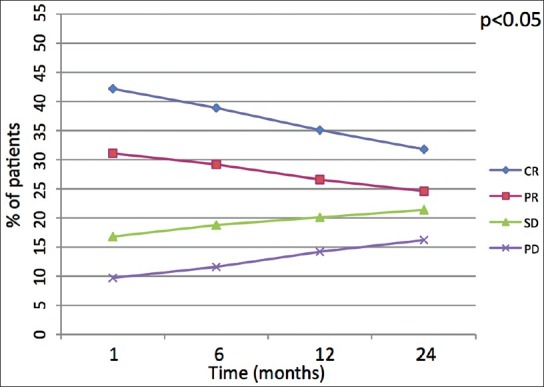
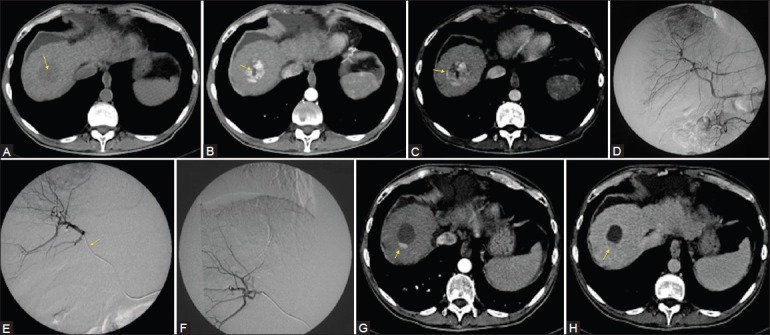
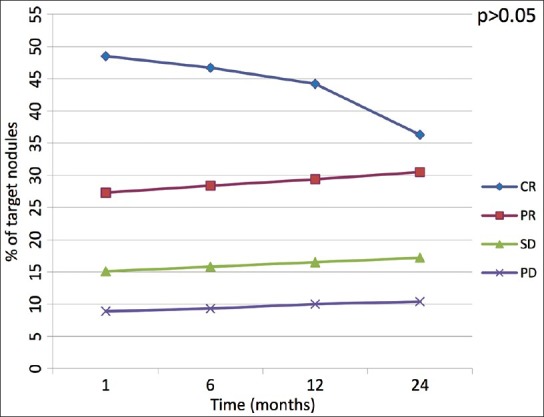
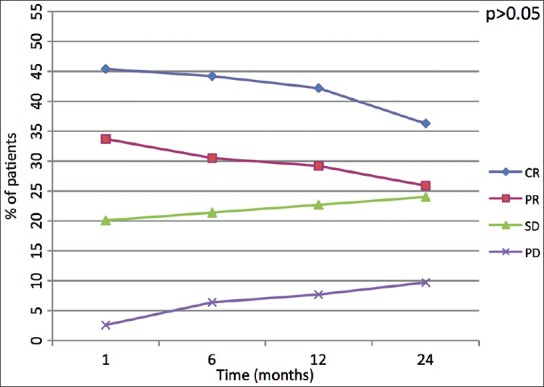
We enrolled 154 patients with uni- or multifocal HCC who underwent a DEB-TACE. A total of 278 HCC nodules were treated. CT follow-up was performed at 1, 6, 12, and 24 months after the procedure according to the EASL and RECIST criteria evaluating overall target and target nodule response. We also analyzed the shrinking of nodules in relation to response to treatment.
A total of 278 nodules of HCC underwent TACE by using DC-Beads: At 24, months complete response was similar for EASL and RECIST criteria (112 vs. 121 nodules) with optimal accordance between methods and readers with k = 0.9. Partial Response resulted significantly different among the two methods within the first month, otherwise was similar after 24-month follow-up. Similar results in both methods were found for nodules classified as Stable Disease (P > 0.05). Progressive Disease results were similar in both the groups according to both the classification criteria without any significant difference (P > 0.05).
Our study confirmed that EASL and mRECIST criteria are both effective methods for patient follow-up, however with some technical differences.
我们的目的是评估载药微球经动脉化疗栓塞术(DEB-TACE)治疗肝细胞癌(HCC)的疗效和耐受性,使用多排螺旋计算机断层扫描(MDCT)在1、6、12和24个月后评估治疗反应,并比较欧洲肝脏研究协会(EASL)和改良实体瘤疗效评价标准(mRECIST)。
我们纳入了154例接受DEB-TACE的单灶或多灶HCC患者。共治疗了278个HCC结节。根据EASL和RECIST标准,在术后1、6、12和24个月进行CT随访,评估总体靶标和靶结节反应。我们还分析了结节缩小与治疗反应的关系。
共有278个HCC结节使用DC微球进行了TACE:在24个月时,EASL和RECIST标准的完全缓解相似(分别为112个和121个结节),方法与阅片者之间的一致性最佳,k = 0.9。在第一个月内,两种方法的部分缓解有显著差异,而在24个月随访后相似。两种方法对稳定疾病分类的结节结果相似(P>0.05)。根据两种分类标准,两组的疾病进展结果相似,无显著差异(P>0.05)。
我们的研究证实,EASL和mRECIST标准都是患者随访的有效方法,但存在一些技术差异。