Department of Plant Protection Biology, Unit of Chemical Ecology, Swedish University of Agricultural Sciences, Alnarp, Sweden.
Malar J. 2013 Oct 2;12:350. doi: 10.1186/1475-2875-12-350.
Development strategies in Ethiopia have largely focused on the expansion of irrigated agriculture in the last decade to reduce poverty and promote economic growth. However, such irrigation schemes can worsen the socio-economic state by aggravating the problem of mosquito-borne diseases. In this study, the effect of agro-ecosystem practices on malaria prevalence and the risk of malaria transmission by the primary vector mosquito, Anopheles arabiensis, in Ethiopia were investigated.
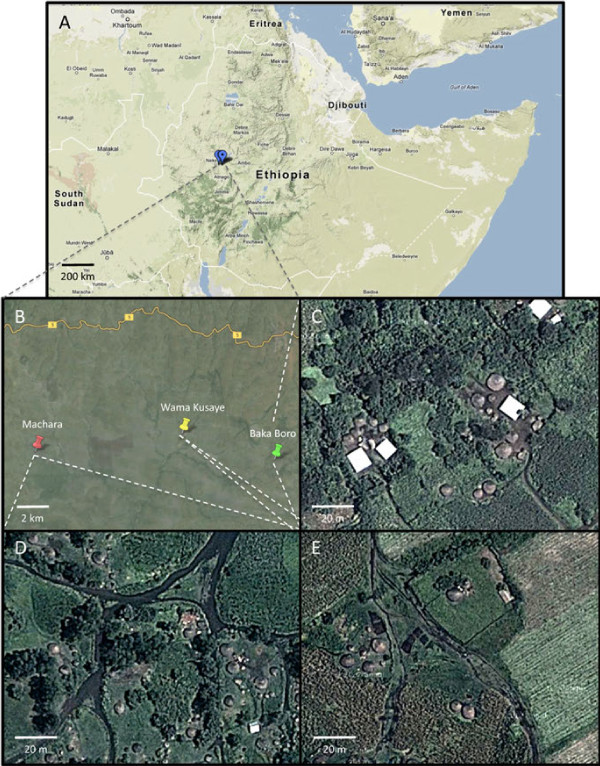
In three villages in western Ethiopia practising large-scale sugarcane irrigation, traditional smallholder irrigation and non-irrigated farming, cross-sectional parasitological surveys were conducted during the short rains, after the long rains and during the dry season. Entomological surveys were undertaken monthly (February 2010-January 2011) in each village using light traps, pyrethrum spray collections and artificial pit shelters.
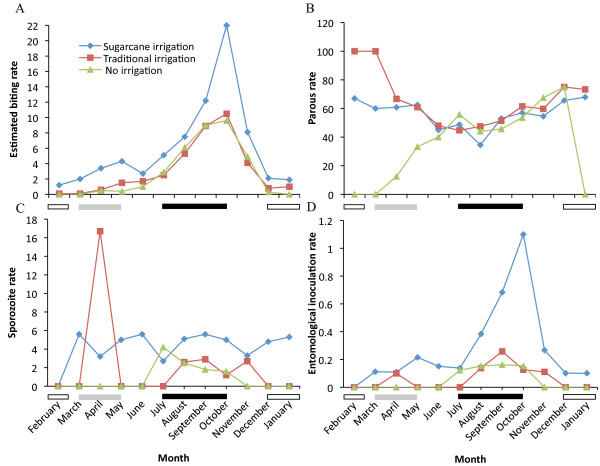
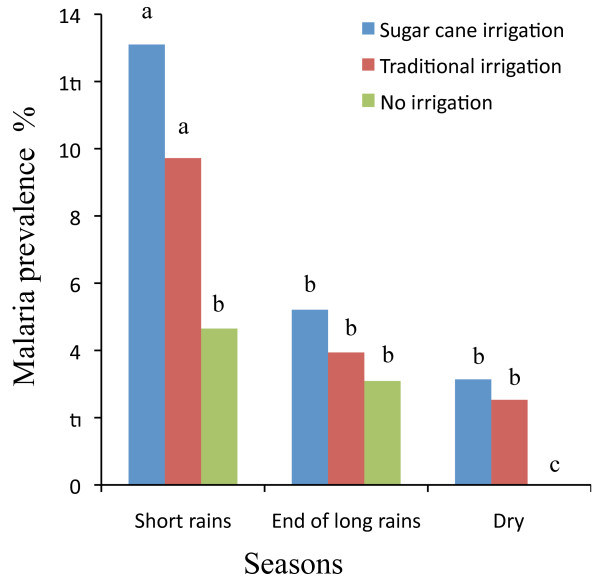
Malaria prevalence and the risk of transmission by An. arabiensis assessed by the average human biting rate, mean sporozoite rate and estimated annual entomological inoculation rate were significantly higher in the irrigated sugarcane agro-ecosystem compared to the traditionally irrigated and non-irrigated agro-ecosystems. The average human biting rate was significantly elevated by two-fold, while the mean sporozoite rate was 2.5-fold higher, and the annual entomological inoculation rate was 4.6 to 5.7-fold higher in the irrigated sugarcane compared to the traditional and non-irrigated agro-ecosystems. Active irrigation clearly affected malaria prevalence by increasing the abundance of host seeking Anopheles mosquitoes year-round and thus increasing the risk of infective bites. The year-round presence of sporozoite-infected vectors due to irrigation practices was found to strengthen the coupling between rainfall and risk of malaria transmission, both on- and off-season.
This study demonstrates the negative impact of large-scale irrigation expansion on malaria transmission by increasing the abundance of mosquito vectors and indicates the need for effective vector monitoring and control strategies in the implementation of irrigation projects.
在过去十年中,埃塞俄比亚的发展战略主要侧重于扩大灌溉农业,以减少贫困并促进经济增长。然而,这种灌溉计划可能会通过加剧蚊子传播疾病的问题而使社会经济状况恶化。在这项研究中,研究了农业生态系统实践对疟疾流行和主要媒介蚊子阿拉伯按蚊传播疟疾的风险的影响。
在埃塞俄比亚西部的三个村庄进行了大规模的甘蔗灌溉,传统的小规模灌溉和非灌溉农业,在短雨季,长雨季和旱季进行了横断面寄生虫学调查。在每个村庄每月(2010 年 2 月至 2011 年 1 月)进行了昆虫学调查,使用了诱蚊灯,除虫菊酯喷雾收集和人工坑棚。
在灌溉甘蔗农业生态系统中,疟疾的流行率和通过阿拉伯按蚊传播的风险,评估为平均人类叮咬率,平均孢子虫率和估计的年昆虫学接种率,明显高于传统灌溉和非灌溉农业生态系统。与传统和非灌溉农业生态系统相比,灌溉甘蔗中的平均人类叮咬率高出两倍,平均孢子虫率高出 2.5 倍,而年昆虫学接种率高出 4.6 至 5.7 倍。主动灌溉显然通过全年增加宿主寻找按蚊的数量而影响疟疾的流行率,从而增加了感染性叮咬的风险。由于灌溉实践,全年存在感染孢子虫的媒介,这加强了降雨和疟疾传播风险之间的耦合,无论是在雨季还是淡季。
这项研究表明,大规模灌溉扩张通过增加蚊子媒介的数量,对疟疾传播产生了负面影响,并表明在实施灌溉项目时需要有效的媒介监测和控制策略。