Department of Pharmacology, Emory University School of Medicine, Atlanta, GA, USA.
Skelet Muscle. 2013 Oct 1;3(1):23. doi: 10.1186/2044-5040-3-23.
The nuclear poly(A) binding protein 1 (PABPN1) is a ubiquitously expressed protein that plays critical roles at multiple steps in post-transcriptional regulation of gene expression. Short expansions of the polyalanine tract in the N-terminus of PABPN1 lead to oculopharyngeal muscular dystrophy (OPMD), which is an adult onset disease characterized by eyelid drooping, difficulty in swallowing, and weakness in the proximal limb muscles. Why alanine-expanded PABPN1 leads to muscle-specific pathology is unknown. Given the general function of PABPN1 in RNA metabolism, intrinsic characteristics of skeletal muscle may make this tissue susceptible to the effects of mutant PABPN1.
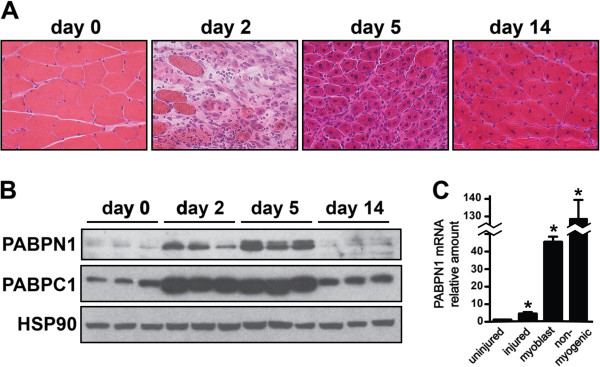
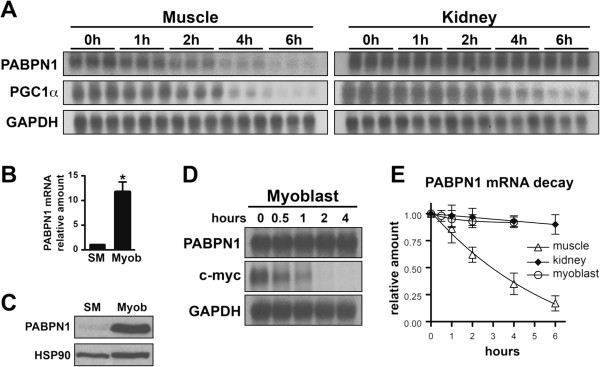
To begin to understand the muscle specificity of OPMD, we investigated the steady-state levels of PABPN1 in different tissues of humans and mice. Additionally, we analyzed the levels of PABPN1 during muscle regeneration after injury in mice. Furthermore, we assessed the dynamics of PABPN1 mRNA decay in skeletal muscle compared to kidney.
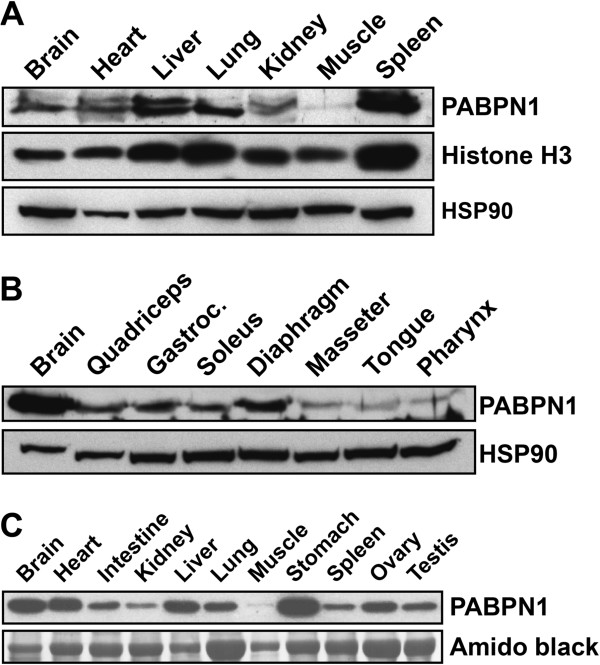
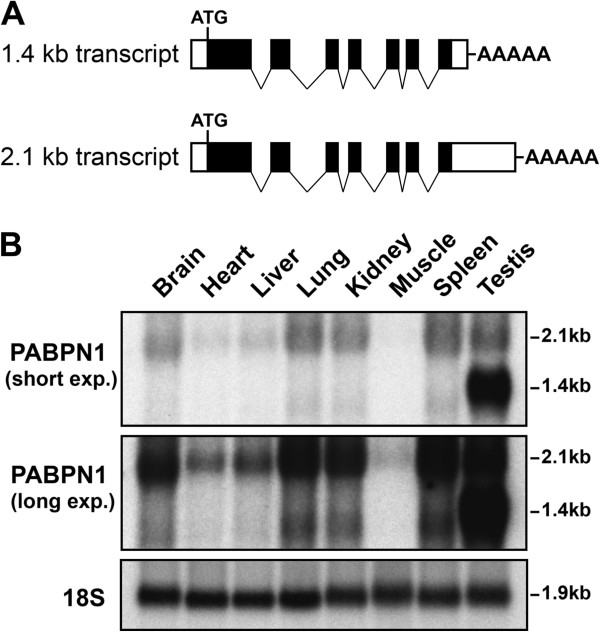
Here, we show that the steady-state levels of both PABPN1 mRNA and protein are drastically lower in mouse and human skeletal muscle, particularly those impacted in OPMD, compared to other tissues. In contrast, PABPN1 levels are increased during muscle regeneration, suggesting a greater requirement for PABPN1 function during tissue repair. Further analysis indicates that modulation of PABPN1 expression is likely due to post-transcriptional mechanisms acting at the level of mRNA stability.
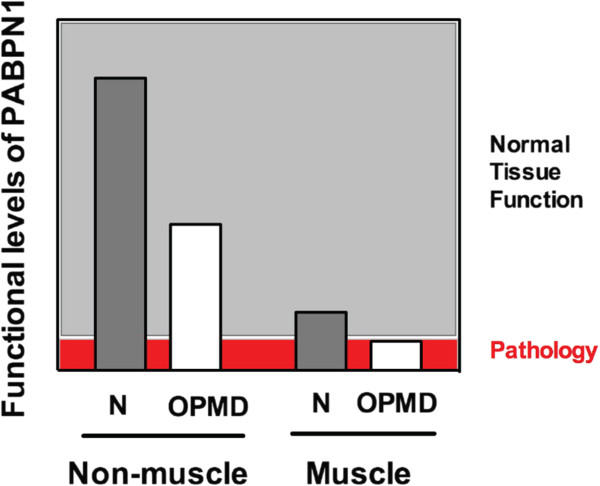
Our results demonstrate that PABPN1 steady-state levels and likely control of expression differ significantly in skeletal muscle as compared to other tissues, which could have important implications for understanding the muscle-specific nature of OPMD.
核多聚(A)结合蛋白 1(PABPN1)是一种广泛表达的蛋白质,在基因表达的转录后调控的多个步骤中发挥关键作用。PABPN1 氨基端多聚丙氨酸序列的短扩展导致眼咽型肌营养不良症(OPMD),这是一种以眼睑下垂、吞咽困难和近端肢体肌肉无力为特征的成人发病疾病。为什么丙氨酸扩展的 PABPN1 导致肌肉特异性病理学尚不清楚。鉴于 PABPN1 在 RNA 代谢中的一般功能,骨骼肌的固有特性可能使该组织易受突变 PABPN1 的影响。
为了开始了解 OPMD 的肌肉特异性,我们研究了人类和小鼠不同组织中 PABPN1 的稳态水平。此外,我们分析了小鼠肌肉损伤后再生过程中 PABPN1 的水平。此外,我们评估了与肾脏相比,骨骼肌中 PABPN1 mRNA 衰变的动力学。
在这里,我们表明与其他组织相比,无论是在小鼠还是人类骨骼肌中,PABPN1 mRNA 和蛋白质的稳态水平都明显较低,尤其是在 OPMD 中受影响的骨骼肌。相比之下,在肌肉再生过程中 PABPN1 水平增加,表明在组织修复过程中对 PABPN1 功能的需求更大。进一步的分析表明,PABPN1 表达的调节可能是由于在 mRNA 稳定性水平上的转录后机制。
我们的研究结果表明,与其他组织相比,PABPN1 的稳态水平和表达的可能控制在骨骼肌中存在显著差异,这可能对理解 OPMD 的肌肉特异性具有重要意义。