Department of Mechanical Engineering, National Chiao Tung University, 1001 University Road, Hsinchu 30010, Taiwan.
BMC Musculoskelet Disord. 2013 Oct 2;14:281. doi: 10.1186/1471-2474-14-281.
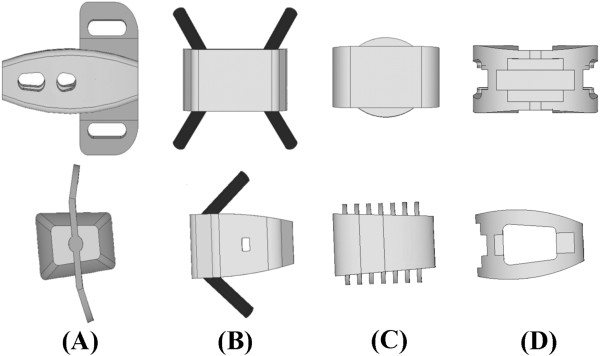
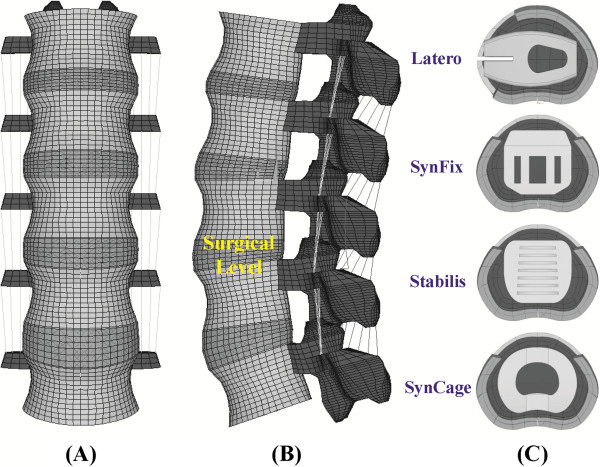
For anterior lumbar interbody fusion (ALIF), stand-alone cages can be supplemented with vertebral plate, locking screws, or threaded cylinder to avoid the use of posterior fixation. Intuitively, the plate, screw, and cylinder aim to be embedded into the vertebral bodies to effectively immobilize the cage itself. The kinematic and mechanical effects of these integrated components on the lumbar construct have not been extensively studied. A nonlinearly lumbar finite-element model was developed and validated to investigate the biomechanical differences between three stand-alone (Latero, SynFix, and Stabilis) and SynCage-Open plus transpedicular fixation. All four cages were instrumented at the L3-4 level.
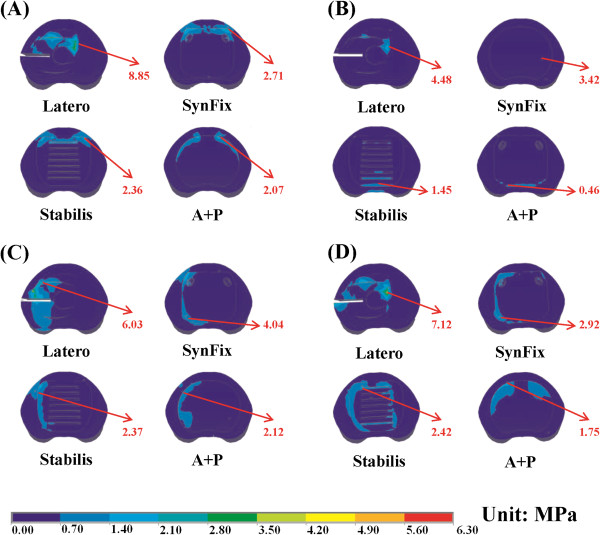
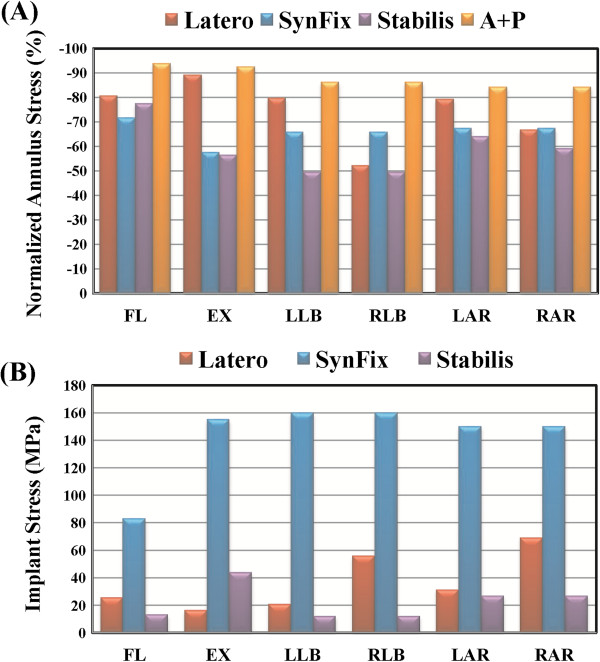
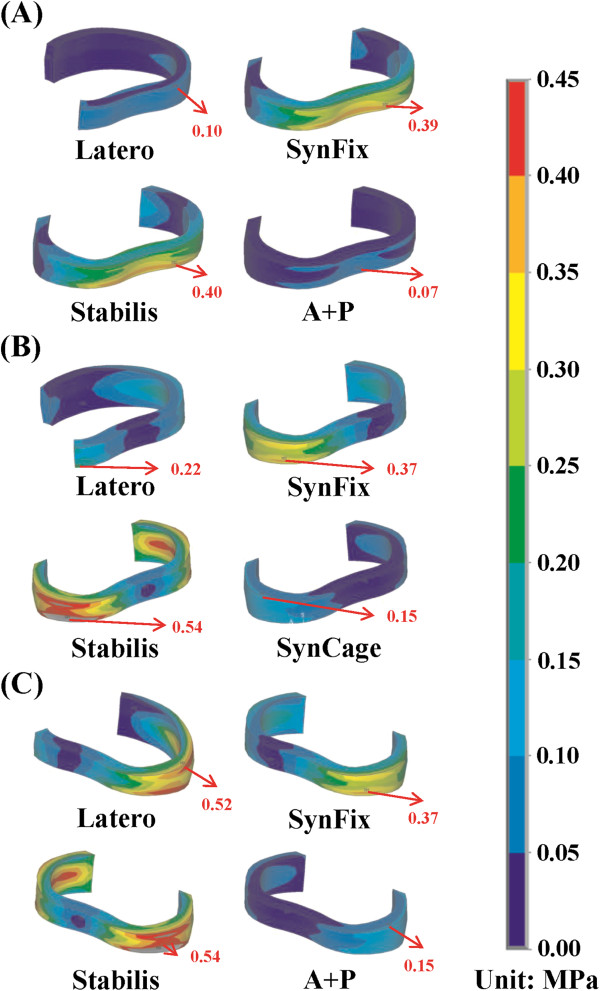
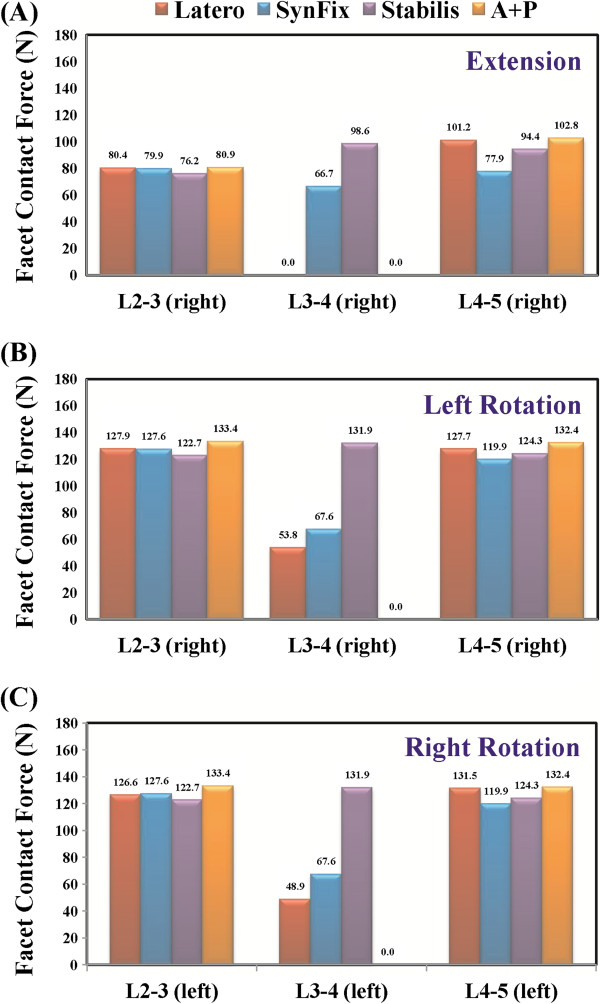
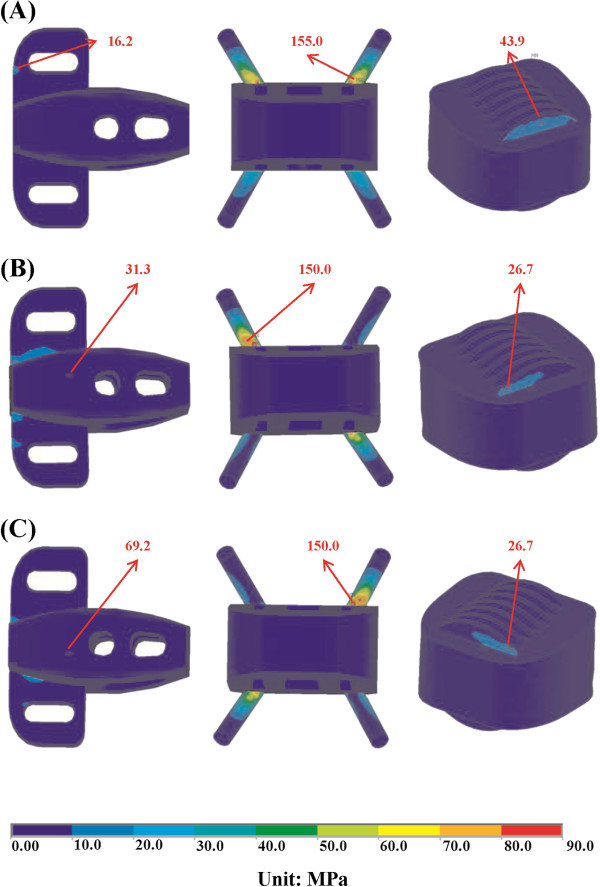
The lumbar models were subjected to the follower load along the lumbar column and the moment at the lumbar top to produce flexion (FL), extension (EX), left/right lateral bending (LLB, RLB), and left/right axial rotation (LAR, RAR). A 10 Nm moment was applied to obtain the six physiological motions in all models. The comparison indices included disc range of motion (ROM), facet contact force, and stresses of the annulus and implants.
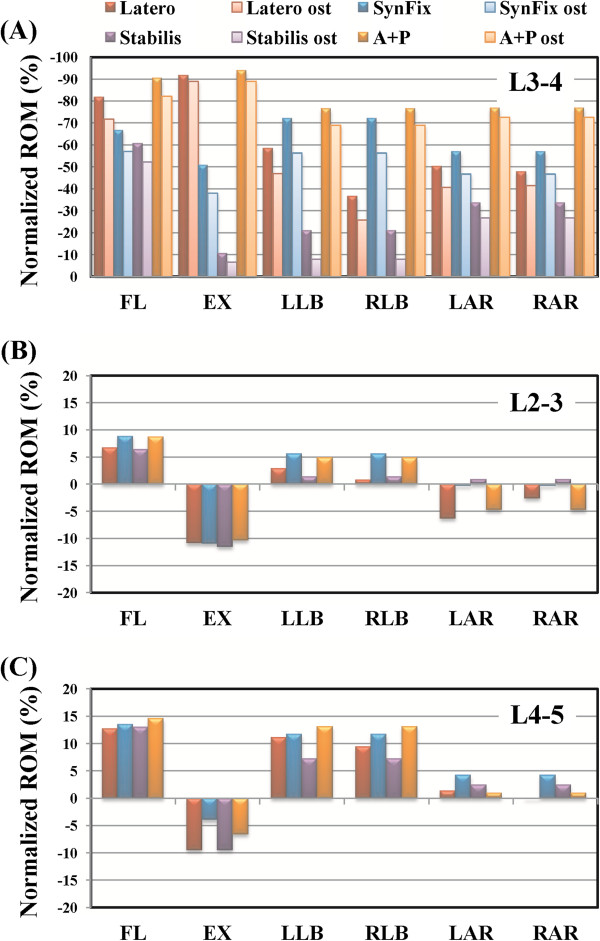
At the surgical level, the SynCage-open model supplemented with transpedicular fixation decreased ROM (>76%) greatly; while the SynFix model decreased ROM 56-72%, the Latero model decreased ROM 36-91%, in all motions as compared with the INT model. However, the Stabilis model decreased ROM slightly in extension (11%), lateral bending (21%), and axial rotation (34%). At the adjacent levels, there were no obvious differences in ROM and annulus stress among all instrumented models.
ALIF instrumentation with the Latero or SynFix cage provides an acceptable stability for clinical use without the requirement of additional posterior fixation. However, the Stabilis cage is not favored in extension and lateral bending because of insufficient stabilization.
对于前路腰椎间融合术(ALIF),独立的椎间融合器可以补充使用椎板、锁定螺钉或螺纹筒,以避免使用后路固定。直观地说,这些板、螺钉和筒旨在嵌入椎体中,以有效地固定融合器本身。这些组合部件对腰椎结构的运动学和力学影响尚未得到广泛研究。本研究建立了一个非线性腰椎有限元模型,以研究三种独立椎间融合器(LATERO、SynFix 和 Stabilis)和 SynCage-Open 加经皮固定的生物力学差异。所有四个融合器均在 L3-4 水平进行器械固定。
腰椎模型沿腰椎柱施加跟随力和腰椎顶部的力矩,以产生屈伸(FL)、伸展(EX)、左右侧屈(LLB、RLB)和左右轴向旋转(LAR、RAR)。在所有模型中,施加 10 Nm 的力矩以获得六种生理运动。比较指标包括椎间盘活动范围(ROM)、小关节接触力以及椎间盘和植入物的应力。
在手术节段,SynCage-Open 模型加经皮固定后,ROM 明显减小(>76%);而 SynFix 模型减小 ROM 56-72%,LATERO 模型减小 ROM 36-91%,在所有运动中与 INT 模型相比。然而,Stabilis 模型在伸展(11%)、侧屈(21%)和轴向旋转(34%)中 ROM 减小较小。在相邻节段,所有器械固定模型的 ROM 和椎间盘应力无明显差异。
LATERO 或 SynFix 椎间融合器的 ALIF 器械固定为临床应用提供了可接受的稳定性,无需额外的后路固定。然而,由于稳定性不足,Stabilis 融合器在伸展和侧屈时不被推荐使用。