Institute of Wildlife Biology and Game Management, University of Natural Resources and Life Sciences, , Vienna 1180, Austria.
Biol Lett. 2013 Oct 2;9(5):20130624. doi: 10.1098/rsbl.2013.0624. Print 2013 Oct 23.
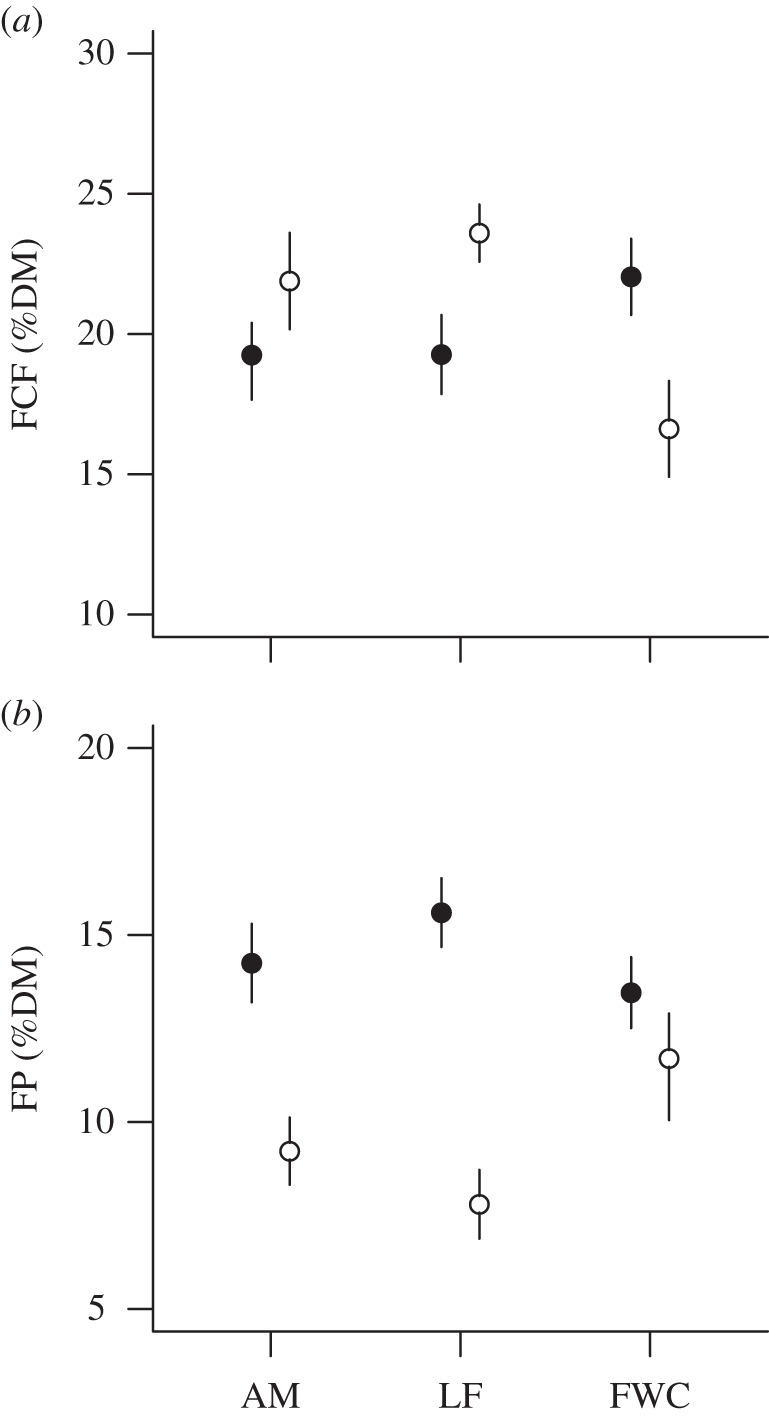
Behavioural strategies to reduce predation risk can incur costs, which are often referred to as risk effects. A common strategy to avoid predation is spatio-temporal avoidance of predators, in which prey typically trade optimal resources for safety. Analogous with predator-prey theory, risk effects should also arise in species with sexually selected infanticide (SSI), in which females with dependent offspring avoid infanticidal males. SSI can be common in brown bear (Ursus arctos) populations and explains spatio-temporal segregation among reproductive classes. Here, we show that in a population with SSI, females with cubs-of-the-year had lower quality diets than conspecifics during the SSI high-risk period, the mating season. After the mating season, their diets were of similar quality to diets of their conspecifics. Our results suggest a nutritive risk effect of SSI, in which females with cubs-of-the-year alter their resource selection and trade optimal resources for offspring safety. Such risk effects can add to female costs of reproduction and may be widespread among species with SSI.
为降低被捕食风险而采取的行为策略可能会产生成本,这些成本通常被称为风险效应。避免被捕食的一种常见策略是时空回避捕食者,在此策略中,猎物通常为了安全而牺牲最佳资源。类似捕食者-猎物理论,具有性选择杀婴行为(SSI)的物种也应该会出现风险效应,在这种行为中,有后代依赖的雌性会回避杀婴雄性。SSI 在棕熊(Ursus arctos)种群中很常见,并解释了繁殖群体之间的时空分离。在这里,我们表明在一个具有 SSI 的种群中,在 SSI 高风险期(交配季节),育幼的雌性棕熊的饮食质量低于同物种的其他雌性。交配季节过后,它们的饮食质量与同物种的雌性相似。我们的研究结果表明,SSI 存在营养风险效应,即育幼的雌性棕熊改变了资源选择,为后代安全而牺牲了最佳资源。这种风险效应可能会增加雌性的繁殖成本,并且在具有 SSI 的物种中可能很普遍。