1] Evolution and Ecology Program, International Institute for Advanced System Analysis, Schlossplatz 1, A-2361 Laxenburg, Austria [2] Parmenides Center for the Conceptual Foundations of Science, Kirchplatz 1, D-82049 Munich/Pullach, Germany [3] Department of Plant Systematics, Ecology and Theoretical Biology, Institute of Biology, Eötvös University, Pázmány Péter sétány 1/C, 1117 Budapest, Hungary [4] Research Group of Theoretical Biology and Evolutionary Ecology, Eötvös University and The Hungarian Academy of Sciences, Pázmány P. sétány 1/C, H-1117 Budapest, Hungary.
Nat Commun. 2013;4:2453. doi: 10.1038/ncomms3453.
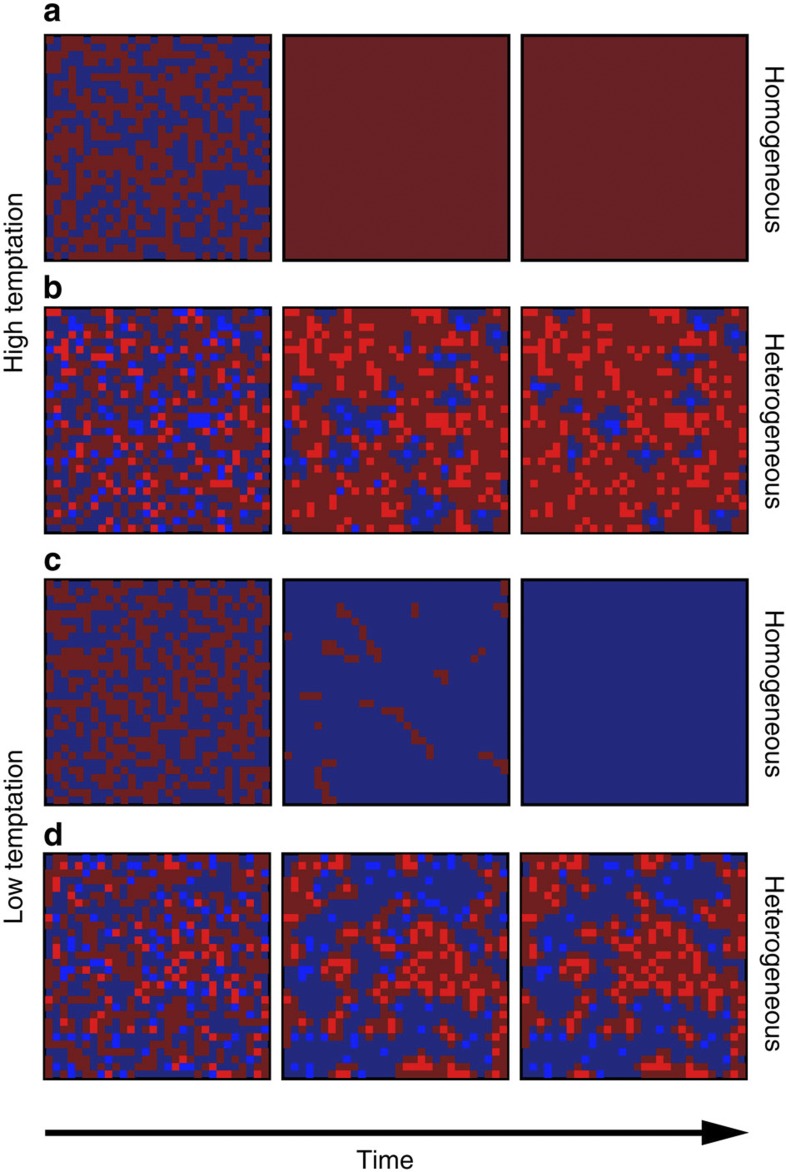
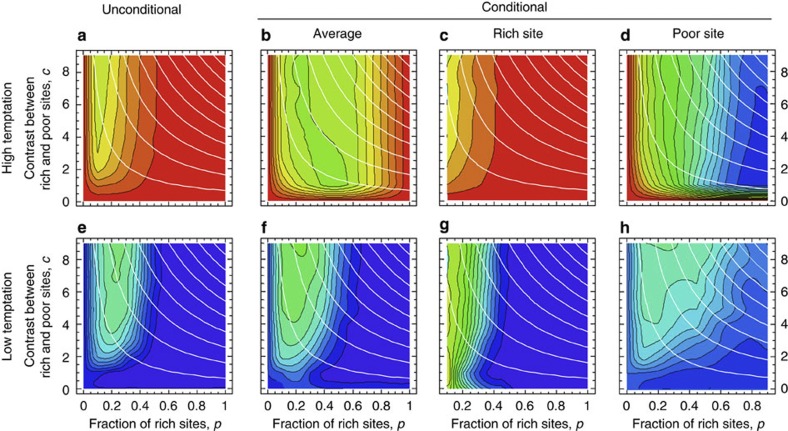
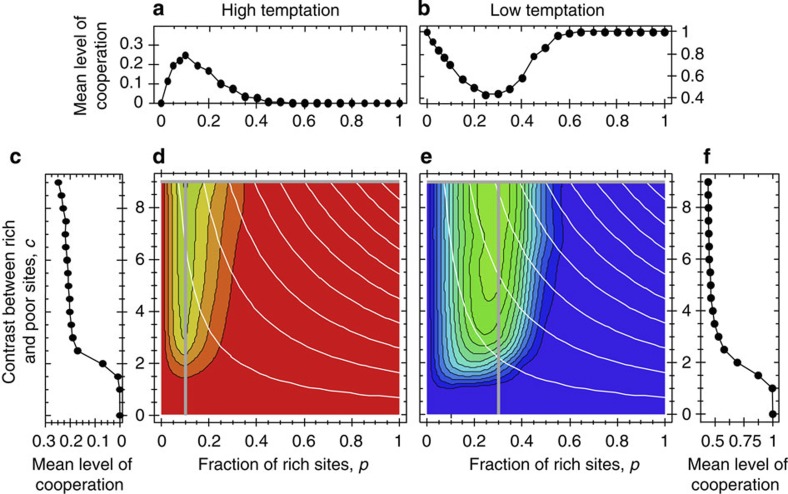
Although social structure is known to promote cooperation, by locally exposing selfish agents to their own deeds, studies to date assumed that all agents have access to the same level of resources. This is clearly unrealistic. Here we find that cooperation can be maintained when some agents have access to more resources than others. Cooperation can then emerge even in populations in which the temptation to defect is so strong that players would act fully selfishly if their resources were distributed uniformly. Resource heterogeneity can thus be crucial for the emergence and maintenance of cooperation. We also show that resource heterogeneity can hinder cooperation once the temptation to defect is significantly lowered. In all cases, the level of cooperation can be maximized by managing resource heterogeneity.
虽然社会结构被认为可以促进合作,但迄今为止的研究假设所有参与者都可以获得相同水平的资源,这使得他们通过局部暴露于自己的行为而受到影响。这显然是不现实的。在这里,我们发现当一些参与者可以获得比其他人更多的资源时,合作仍然可以维持。因此,即使在诱惑非常强烈的情况下,即如果资源分配均匀,参与者会完全自私地行事,合作也可以在人群中出现。因此,资源异质性对于合作的出现和维持至关重要。我们还表明,一旦缺陷的诱惑明显降低,资源异质性就会阻碍合作。在所有情况下,通过管理资源异质性都可以最大限度地提高合作水平。