Dubofsky E A, Simpson S D, Chabot Christopher C, Watson Winsor H
Department of Biological Sciences, University of New Hampshire, Durham, New Hampshire 03824; and.
Biol Bull. 2013 Sep;225(1):42-9. doi: 10.1086/BBLv225n1p42.
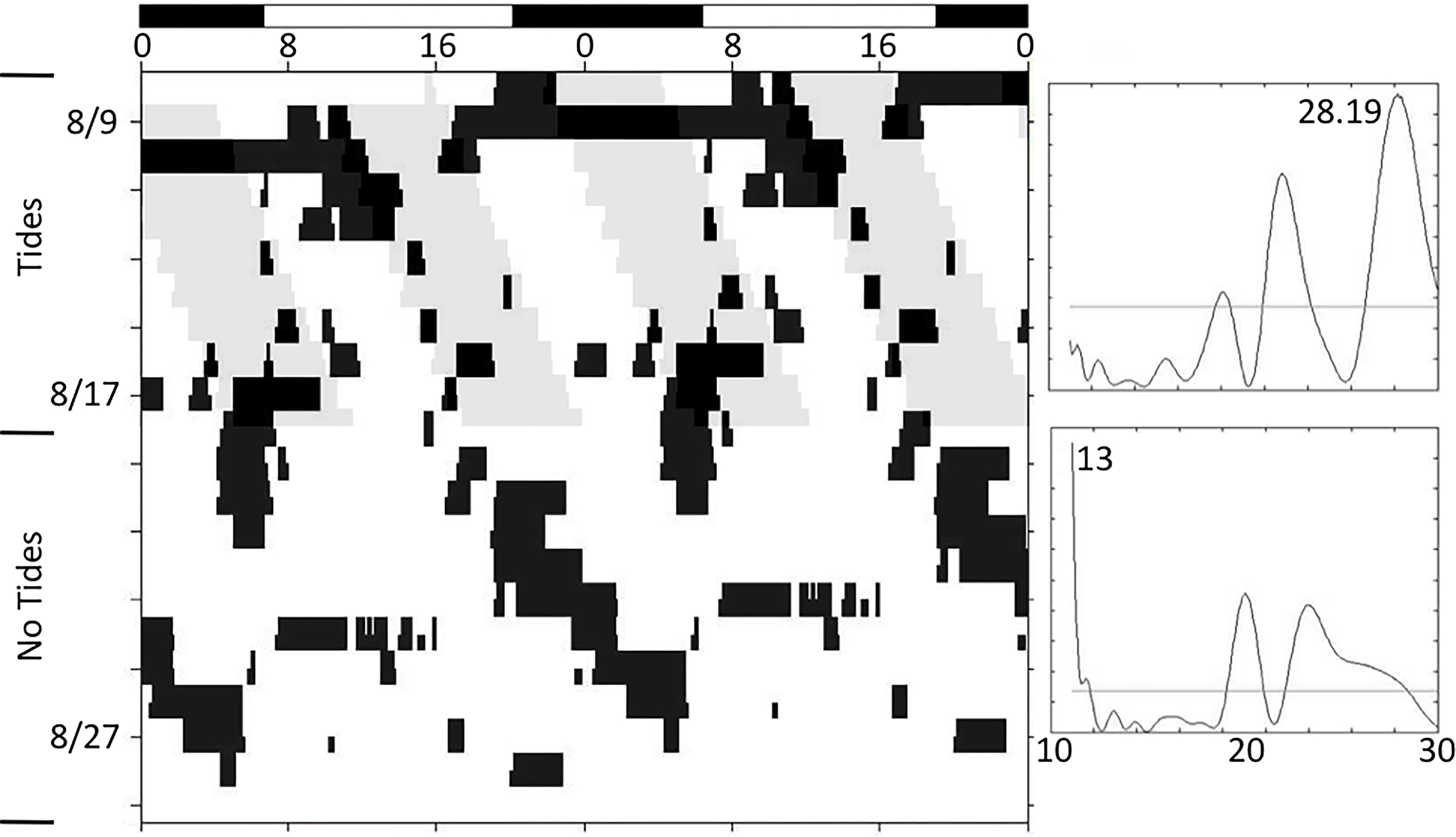
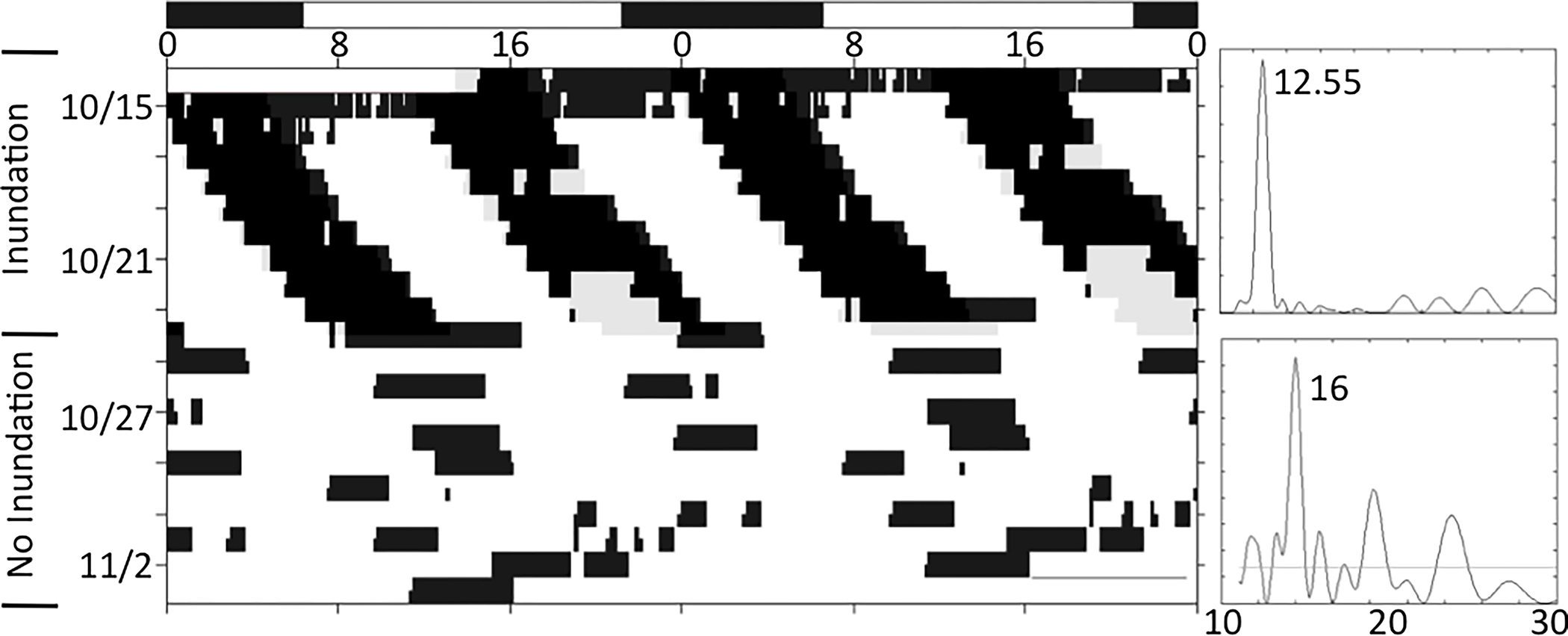
Adult American horseshoe crabs, Limulus polyphemus, possess endogenous circadian and circatidal clocks controlling visual sensitivity and locomotion, respectively. The goal of this study was to determine the types of activity rhythms expressed by juvenile horseshoe crabs (n = 24) when exposed to a 14:10 light/dark cycle (LD) for 10 days, followed by 10 days of constant darkness (DD). Horseshoe crab activity was recorded with a digital time-lapse video system that used an infrared-sensitive camera so animals could be monitored at night. In LD, 15 animals expressed daily patterns of activity, 6 displayed a circatidal pattern, and the remaining 3 were arrhythmic. Of the 15 animals with daily patterns of locomotion, 7 had a significant preference (P < 0.05) for diurnal activity and 3 for nocturnal activity; the remainder did not express a significant preference for day or night activity. In DD, 13 horseshoe crabs expressed circatidal rhythms and 8 maintained a pattern of about 24 h. Although these results suggest the presence of a circadian clock influencing circatidal patterns of locomotion, these apparent circadian rhythms may actually represent the expression of just one of the two bouts of activity driven by the putative circalunidian clocks that control their tidal rhythms. Overall, these results indicate that, like adults, juvenile horseshoe crabs express both daily and tidal patterns of activity and that at least one, and maybe both, of these patterns is driven by endogenous clocks.
成年美洲鲎(Limulus polyphemus)拥有内源性昼夜节律和潮汐节律时钟,分别控制视觉敏感度和运动。本研究的目的是确定幼年鲎(n = 24)在14:10光/暗周期(LD)下暴露10天,随后在持续黑暗(DD)中暴露10天时所表现出的活动节律类型。使用配备红外敏感相机的数字延时视频系统记录鲎的活动,以便在夜间对动物进行监测。在LD条件下,15只动物表现出每日活动模式,6只表现出潮汐模式,其余3只无节律。在15只具有每日运动模式的动物中,7只对白天活动有显著偏好(P < 0.05),3只对夜间活动有显著偏好;其余动物对白天或夜间活动没有显著偏好。在DD条件下,13只鲎表现出潮汐节律,8只保持约24小时的模式。尽管这些结果表明存在一个昼夜节律时钟影响运动的潮汐模式,但这些明显的昼夜节律实际上可能仅代表由假定的控制其潮汐节律的太阴日时钟驱动的两个活动时段之一的表达。总体而言,这些结果表明,与成年鲎一样,幼年鲎也表现出每日和潮汐活动模式,并且这些模式中的至少一种,也许两种,是由内源性时钟驱动的。