
犬转铁蛋白受体可溶性形式抑制犬细小病毒在体內和体外的感染。
Soluble form of canine transferrin receptor inhibits canine parvovirus infection in vitro and in vivo.
机构信息
Laboratory of Molecular Virology and Immunology, College of Veterinary Medicine, Agricultural University of Hebei, Baodiing 071001, China ; Hebei Engineering and Technology Research Center of Veterinary Biological Products, North China Research Center of Animal Epidemic Pathogen Biology, China Agriculture Ministry, Baoding 071001, China.
出版信息
Biomed Res Int. 2013;2013:172479. doi: 10.1155/2013/172479. Epub 2013 Sep 8.
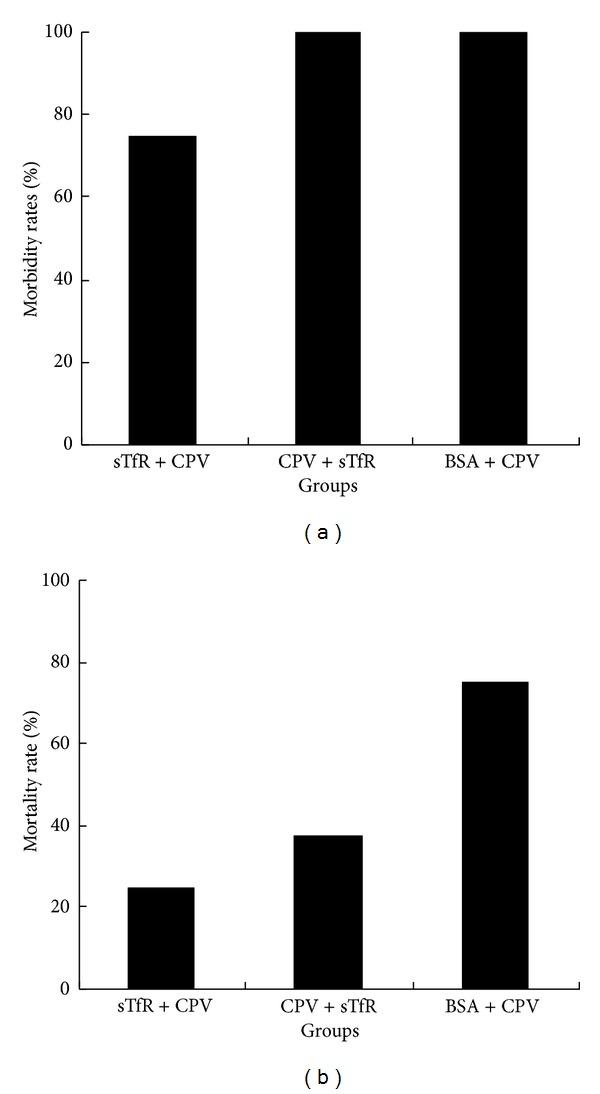
Canine parvovirus (CPV) disease is an acute, highly infectious disease threatening the dog-raising industry. So far there are no effective therapeutic strategies to control this disease. Although the canine transferrin receptor (TfR) was identified as a receptor for CPV infection, whether extracellular domain of TfR (called soluble TfR (sTfR)) possesses anti-CPV activities remains elusive. Here, we used the recombinant sTfR prepared from HEK293T cells with codon-optimized gene structure to investigate its anti-CPV activity both in vitro and in vivo. Our results indicated that codon optimization could significantly improve sTfR expression in HEK293T cells. The prepared recombinant sTfR possessed a binding activity to both CPV and CPV VP2 capsid proteins and significantly inhibited CPV infection of cultured feline F81 cells and decreased the mortality of CPV-infected dogs, which indicates that the sTfR has the anti-CPV activity both in vitro and in vivo.
犬细小病毒(CPV)病是一种急性、高度传染性疾病,威胁着养犬业。到目前为止,还没有有效的治疗策略来控制这种疾病。虽然犬转铁蛋白受体(TfR)已被鉴定为 CPV 感染的受体,但 TfR 的细胞外结构域(称为可溶性 TfR(sTfR))是否具有抗 CPV 活性尚不清楚。在这里,我们使用从用密码子优化基因结构的 HEK293T 细胞制备的重组 sTfR 来研究其在体外和体内的抗 CPV 活性。我们的结果表明,密码子优化可以显著提高 HEK293T 细胞中 sTfR 的表达。制备的重组 sTfR 对 CPV 和 CPV VP2 衣壳蛋白均具有结合活性,并显著抑制 CPV 对培养的猫 F81 细胞的感染,降低 CPV 感染犬的死亡率,这表明 sTfR 具有体外和体内的抗 CPV 活性。


 Zotero 插件