Department of Health and Sport Sciences, The University of Memphis, 161 Roane Fieldhouse, 38152 Memphis, TN, USA.
BMC Pharmacol Toxicol. 2013 Oct 4;14:52. doi: 10.1186/2050-6511-14-52.
1,3-dimethylamylamine (DMAA) has been a component of dietary supplements and is also used within "party pills," often in conjunction with alcohol and other drugs. Ingestion of higher than recommended doses results in untoward effects including cerebral hemorrhage. To our knowledge, no studies have been conducted to determine both the pharmacokinetic profile and physiologic responses of DMAA.
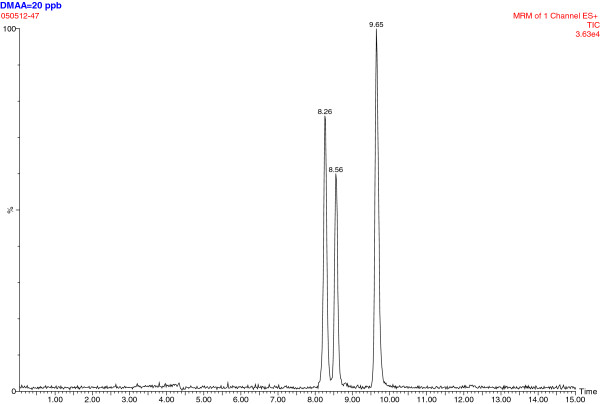
Eight men reported to the lab in the morning following an overnight fast and received a single 25 mg oral dose of DMAA. Blood samples were collected before and through 24 hours post-DMAA ingestion and analyzed for plasma DMAA concentration using high-performance liquid chromatography-mass spectrometry. Resting heart rate, blood pressure, and body temperature was also measured.
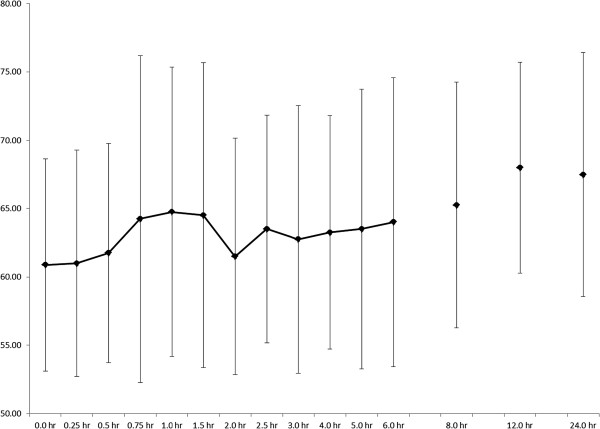
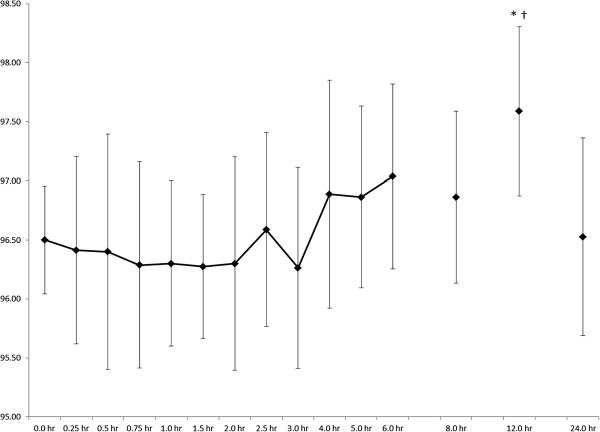
One subject was excluded from the data analysis due to abnormal DMAA levels. Analysis of the remaining seven participants showed DMAA had an oral clearance of 20.02 ± 5 L∙hr⁻¹, an oral volume of distribution of 236 ± 38 L, and terminal half-life of 8.45 ± 1.9 hr. Lag time, the delay in appearance of DMAA in the circulation following extravascular administration, varied among participants but averaged approximately 8 minutes (0.14 ± 0.13 hr). The peak DMAA concentration for all subjects was observed within 3-5 hours following ingestion and was very similar across subjects, with a mean of ~70 ng∙mL⁻¹. Heart rate, blood pressure, and body temperature were largely unaffected by DMAA treatment.
These are the first data to characterize the oral pharmacokinetic profile of DMAA. These findings indicate a consistent pattern of increase across subjects with regards to peak DMAA concentration, with peak values approximately 15-30 times lower than those reported in case studies linking DMAA intake with adverse events. Finally, a single 25 mg dose of DMAA does not meaningfully impact resting heart rate, blood pressure, or body temperature.
NCT01765933.
1,3-二甲基戊胺(DMAA)曾是膳食补充剂的成分,也用于“派对药丸”中,通常与酒精和其他药物一起使用。摄入高于推荐剂量会导致不良反应,包括脑出血。据我们所知,尚未进行研究来确定 DMAA 的药代动力学特征和生理反应。
8 名男性在禁食过夜后于早上到实验室报到,并接受单次 25 毫克口服 DMAA 剂量。在 DMAA 摄入前和摄入后 24 小时内采集血样,并使用高效液相色谱-质谱法分析血浆 DMAA 浓度。还测量了静息心率、血压和体温。
由于 DMAA 水平异常,一名受试者被排除在数据分析之外。对其余 7 名参与者的分析表明,DMAA 的口服清除率为 20.02±5 L·hr⁻¹,口服分布容积为 236±38 L,终末半衰期为 8.45±1.9 小时。在静脉外给药后 DMAA 出现在循环中的滞后时间(lag time)在参与者之间有所不同,但平均约为 8 分钟(0.14±0.13 小时)。所有受试者的 DMAA 峰值浓度均在摄入后 3-5 小时内观察到,且在受试者之间非常相似,平均约为 70 ng·mL⁻¹。DMAA 治疗对心率、血压和体温的影响不大。
这些是首次描述 DMAA 口服药代动力学特征的数据。这些发现表明,在 DMAA 浓度峰值方面,所有受试者都呈现出一致的增加模式,峰值值约为与 DMAA 摄入与不良事件相关的病例研究中报告的峰值值的 15-30 倍。最后,单次 25 毫克 DMAA 剂量不会显著影响静息心率、血压或体温。
NCT01765933。