General Medical Disciplines, Stanford University School of Medicine, Palo Alto, CA, USA.
BMC Public Health. 2013 Oct 3;13:921. doi: 10.1186/1471-2458-13-921.
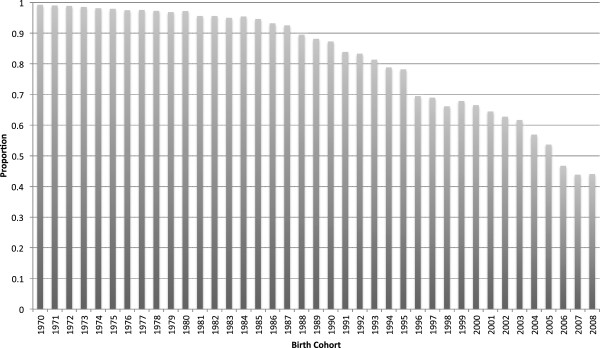
There has been a large decline in female genital circumcision (FGC) in Egypt in recent decades. Understanding how this change has occurred so rapidly has been an area of particular interest to policymakers and public health officials alike who seek to further discourage the practice elsewhere.
We document the trends in this decline in the newest cohorts of young girls and explore the influences of three pathways--socioeconomic development, social media messages, and women's empowerment--for explaining the observed trends. Using the 2005 and 2008 Egypt Demographic and Health Surveys, we estimate several logistic regression models to (1) examine individual and household determinants of circumcision, (2) assess the contributions of different pathways through which these changes may have occurred, and (3) assess the robustness of different pathways when unobserved community differences are taken into account.
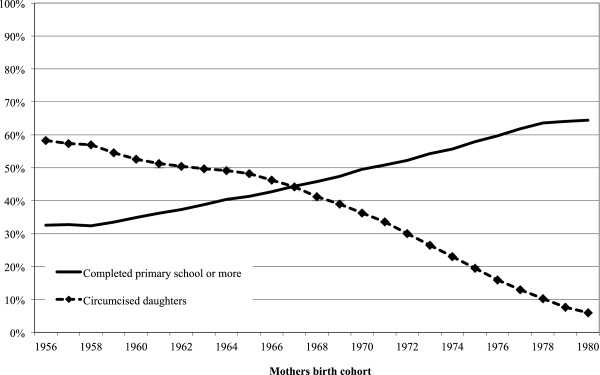
Across all communities, socioeconomic status, social media messages, and women's empowerment all have significant independent effects on the risk of circumcision. However, after accounting for unobserved differences across communities, only mother's education and household wealth significantly predict circumcision outcomes. Additional analyses of maternal education suggest that increases in women's education may be causally related to the reduction in FGC prevalence.
Women's empowerment and social media appear to be more important in explaining differences across communities; within communities, socioeconomic status is a key driver of girls' circumcision risk. Further investigation of community-level women's educational attainment for mothers suggests that investments made in female education a generation ago may have had echo effects on girls' FGC risk a generation later.
近几十年来,埃及女性生殖器切割(FGC)的比例大幅下降。这种快速变化的原因引起了政策制定者和公共卫生官员的极大兴趣,他们希望在其他地方进一步阻止这种做法。
我们记录了最近几批年轻女孩中这种下降趋势,并探讨了三种途径——社会经济发展、社交媒体信息和妇女赋权——对解释观察到的趋势的影响。利用 2005 年和 2008 年埃及人口与健康调查,我们估计了几个逻辑回归模型,以(1)检验割礼的个人和家庭决定因素,(2)评估这些变化可能通过的不同途径的贡献,以及(3)在考虑到未观察到的社区差异时,评估不同途径的稳健性。
在所有社区中,社会经济地位、社交媒体信息和妇女赋权都对割礼风险有显著的独立影响。然而,在考虑到社区之间未观察到的差异后,只有母亲的教育程度和家庭财富才显著预测割礼结果。对母亲教育程度的进一步分析表明,女性教育程度的提高可能与 FGC 患病率的降低有关。
妇女赋权和社交媒体似乎在解释社区之间的差异方面更为重要;在社区内部,社会经济地位是女孩割礼风险的关键驱动因素。对社区一级母亲教育程度的进一步调查表明,上一代人对女性教育的投资可能在一代人之后对女孩的 FGC 风险产生了回声效应。