Dipartimento di Scienze della Sanità Pubblica e Pediatriche, Università di Torino, Torino, Italy.
AMB Express. 2013 Oct 4;3(1):59. doi: 10.1186/2191-0855-3-59.
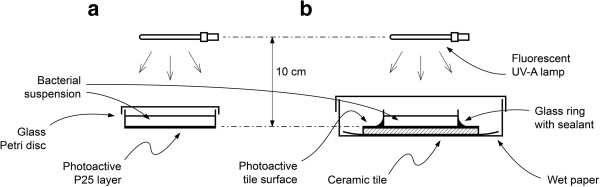
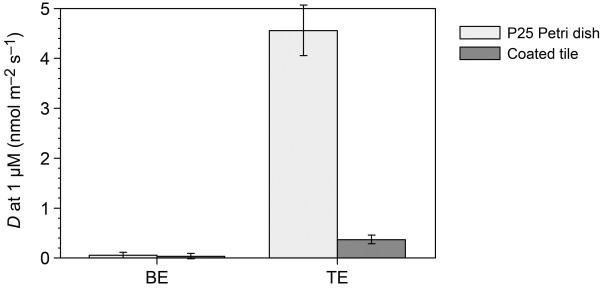
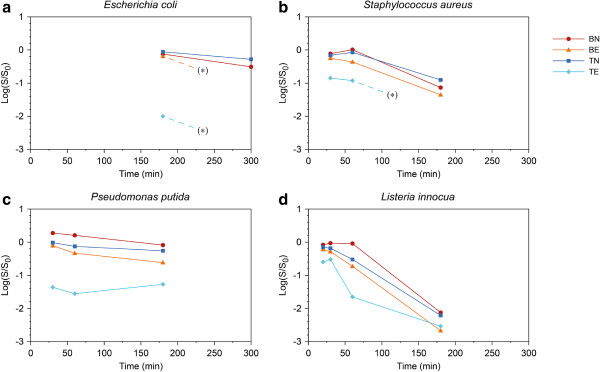
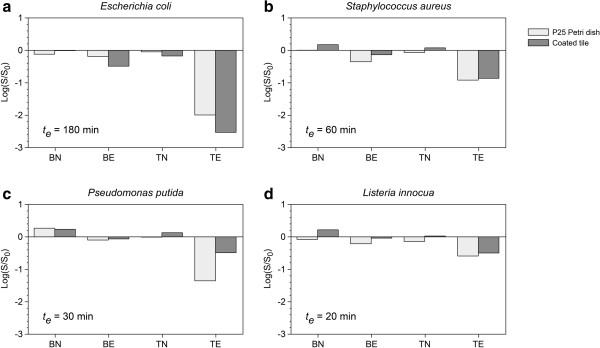
The aim of this study was the evaluation of the photoactivated antibacterial activity of titanium dioxide (TiO2)-coated surfaces. Bacterial inactivation was evaluated using TiO2-coated Petri dishes. The experimental conditions optimized with Petri dishes were used to test the antibacterial effect of TiO2-coated ceramic tiles. The best antibacterial effect with Petri dishes was observed at 180, 60, 30 and 20 min of exposure for Escherichia coli, Staphylococcus aureus, Pseudomonas putida and Listeria innocua, respectively. The ceramic tiles demonstrated a photoactivated bactericidal effect at the same exposure time. In general, no differences were observed between the antibacterial effect obtained with Petri dishes and tiles. However, the photochemical activity of Petri dishes was greater than the activity of the tiles.Results obtained indicates that the TiO2-coated surfaces showed a photoactivated bactericidal effect with all bacteria tested highlighting that the titania could be used in the ceramic and building industry for the production of coated surfaces to be placed in microbiologically sensitive environments, such as the hospital and food industry.
本研究旨在评估二氧化钛(TiO2)涂层表面的光激活抗菌活性。使用 TiO2 涂层培养皿评估细菌失活。使用培养皿优化的实验条件来测试 TiO2 涂层瓷砖的抗菌效果。在用培养皿观察到的最佳抗菌效果分别为大肠杆菌、金黄色葡萄球菌、铜绿假单胞菌和无害李斯特菌暴露 180、60、30 和 20 分钟。瓷砖在相同的暴露时间表现出光激活杀菌作用。一般来说,在培养皿和瓷砖获得的抗菌效果之间没有观察到差异。然而,培养皿的光化学反应活性大于瓷砖的活性。结果表明,TiO2 涂层表面对所有测试细菌均表现出光激活杀菌作用,这突出表明钛白粉可用于陶瓷和建筑行业,以生产用于放置在微生物敏感环境中的涂层表面,如医院和食品工业。