Dunst Beate, Benedek Mathias, Bergner Sabine, Athenstaedt Ursula, Neubauer Aljoscha C
Department of Psychology, University of Graz, Austria.
Pers Individ Dif. 2013 Oct;55(7):744-749. doi: 10.1016/j.paid.2013.06.007.
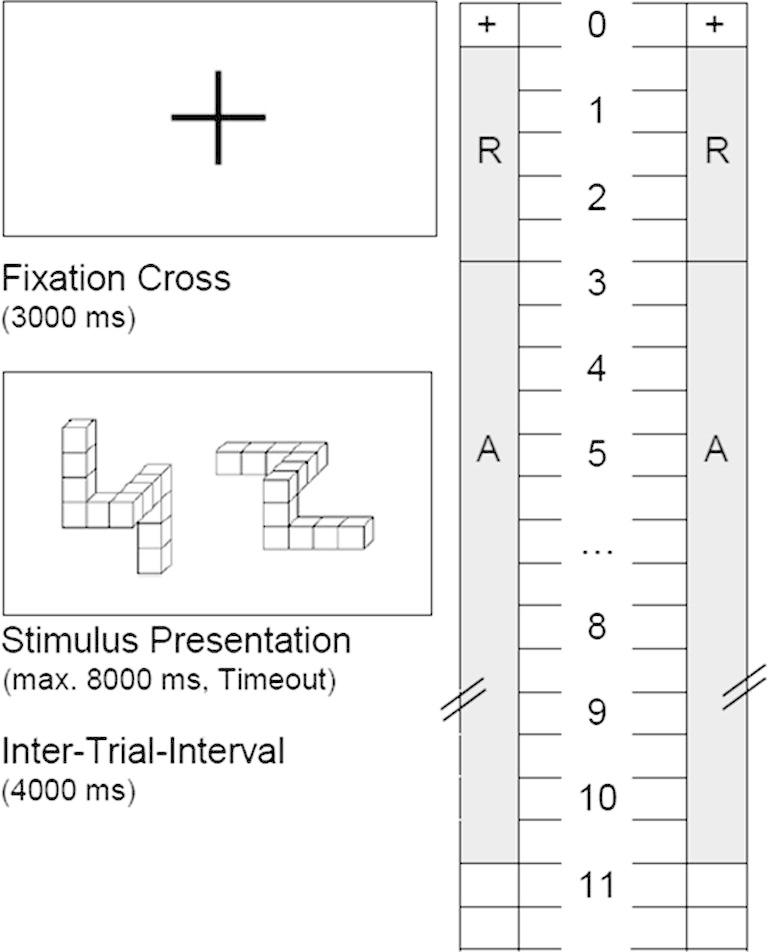
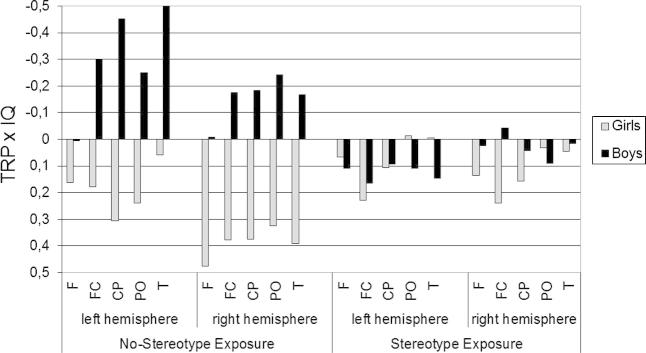
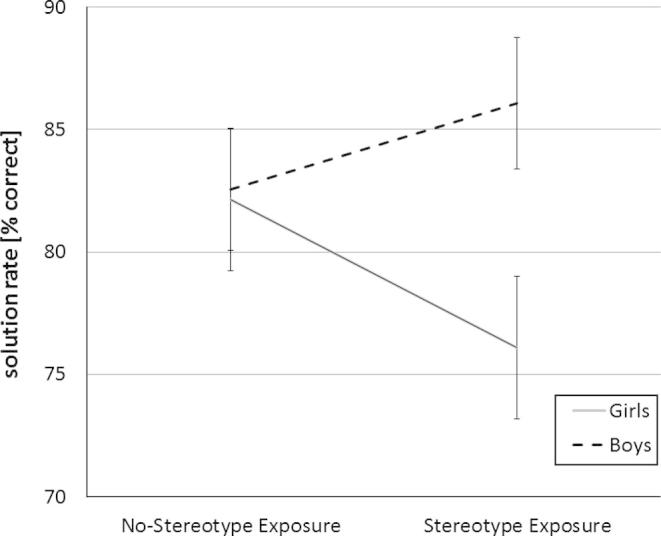
The neural efficiency hypothesis postulates a more efficient use of brain resources in more intelligent people as compared to less intelligent ones. However, this relationship was found to be moderated by sex and task content. While the phenomenon of neural efficiency was previously supported for men when performing visuo-spatial tasks it occurred for women only when performing verbal tasks. One possible explanation for this finding could be provided by the well-studied phenomenon called stereotype threat. Stereotype threat arises when a negative stereotype of one's own group is made salient and can result in behavior that confirms the stereotype. Overall, 32 boys and 31 girls of varying intellectual ability were tested with a mental rotation task, either under a stereotype exposure or a no-stereotype exposure condition while measuring their EEG. The behavioral results show that an activated negative stereotype not necessarily hampers the performance of girls. Physiologically, a confirmation of the neural efficiency phenomenon was only obtained for boys working under a no-stereotype exposure condition. This result pattern replicates previous findings without threat and thus suggests that sex differences in neural efficiency during visuo-spatial tasks may not be due to the stereotype threat effect.
神经效率假说假定,与智力较低者相比,智力较高者能更有效地利用大脑资源。然而,研究发现这种关系会受到性别和任务内容的调节。虽然之前在男性执行视觉空间任务时支持神经效率现象,但女性只有在执行语言任务时才会出现这种现象。对此发现的一种可能解释可以由一个经过充分研究的现象——刻板印象威胁来提供。当自身群体的负面刻板印象变得突出时,就会出现刻板印象威胁,并且可能导致证实该刻板印象的行为。总体而言,对32名智力水平各异的男孩和31名女孩进行了心理旋转任务测试,在测量他们脑电图的同时,分别处于刻板印象暴露或无刻板印象暴露条件下。行为结果表明,激活的负面刻板印象不一定会妨碍女孩的表现。从生理角度来看,只有在无刻板印象暴露条件下工作的男孩才证实了神经效率现象。这一结果模式重复了之前无威胁情况下的研究发现,因此表明在视觉空间任务中神经效率的性别差异可能并非由于刻板印象威胁效应。