Department of Stem Cell Transplantation and Cellular Therapy, University of Texas M.D. Anderson Cancer Center, Houston, Texas, USA.
Department of Stem Cell Transplantation and Cellular Therapy, University of Texas M.D. Anderson Cancer Center, Houston, Texas, USA.
Cytotherapy. 2014 Jan;16(1):84-9. doi: 10.1016/j.jcyt.2013.07.003. Epub 2013 Oct 1.
Advantages associated with the use of cord blood (CB) transplantation include the availability of cryopreserved units, ethnic diversity and lower incidence of graft-versus-host disease compared with bone marrow or mobilized peripheral blood. However, poor engraftment remains a major obstacle. We and others have found that ex vivo fucosylation can enhance engraftment in murine models, and now ex vivo treatment of CB with fucosyltransferase (FT) VI before transplantation is under clinical evaluation (NCT01471067). However, FTVII appears to be more relevant to hematopoietic cells and may alter acceptor substrate diversity. The present study compared the ability of FTVI and FTVII to improve the rapidity, magnitude, multi-lineage and multi-tissue engraftment of human CB hematopoietic stem and progenitor cells (HSPCs) in vivo.
CD34-selected CB HSPCs were treated with recombinant FTVI, FTVII or mock control and then injected into immunodeficient mice and monitored for multi-lineage and multi-tissue engraftment.
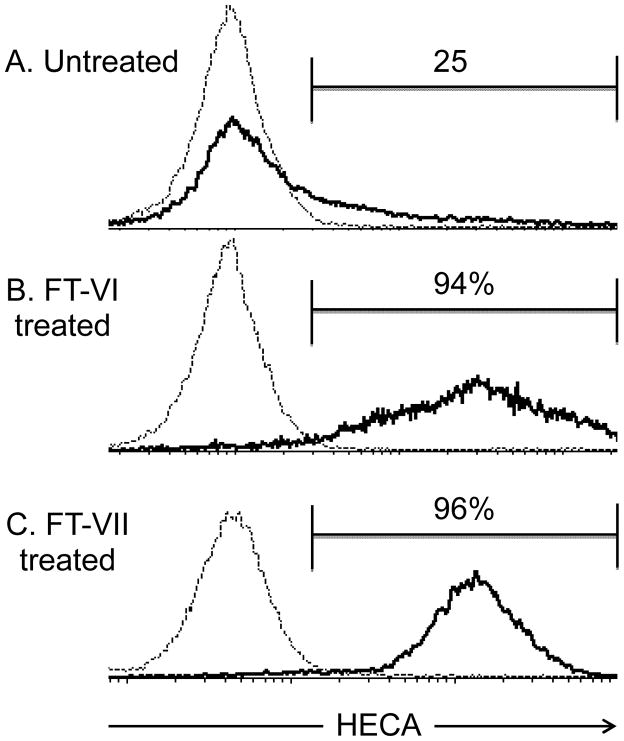
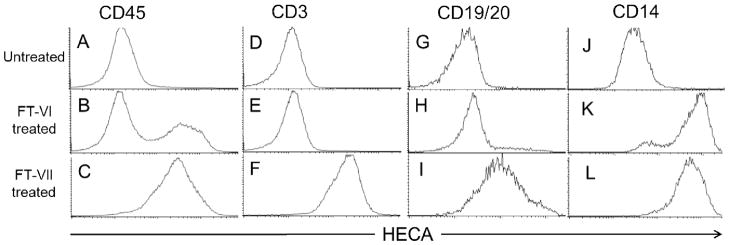
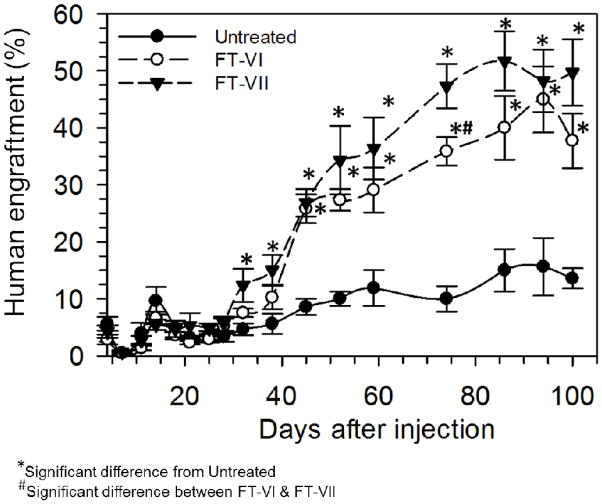
Both FTVI and FTVII fucosylated CB CD34⁺ cells in vitro, and both led to enhanced rates and magnitudes of engraftment compared with untreated CB CD34⁺ cells in vivo. Engraftment after treatment with either FT was robust at multiple time points and in multiple tissues with similar multi-lineage potential. In contrast, only FTVII was able to fucosylate T and B lymphocytes.
Although FTVI and FTVII were found to be similarly able to fucosylate and enhance the engraftment of CB CD34⁺ cells, differences in their ability to fucosylate lymphocytes may modulate graft-versus-tumor or graft-versus-host effects and may allow further optimization of CB transplantation.
与骨髓或动员外周血相比,使用脐带血(CB)移植具有可获得冷冻保存的单位、种族多样性和较低的移植物抗宿主病发生率等优势。然而,植入不良仍然是一个主要障碍。我们和其他人发现,体外岩藻糖化可以增强小鼠模型中的植入,现在正在进行临床评估(NCT01471067),即在移植前用岩藻糖基转移酶(FT)VI 对 CB 进行体外处理。然而,FTVII 似乎与造血细胞更相关,并且可能改变接受者底物的多样性。本研究比较了 FTVI 和 FTVII 改善体内人 CB 造血干细胞和祖细胞(HSPC)的快速性、幅度、多谱系和多组织植入的能力。
用重组 FTVI、FTVII 或模拟对照处理 CD34 分选的 CB HSPCs,然后注入免疫缺陷小鼠中,并监测多谱系和多组织植入。
FTVI 和 FTVII 均可在体外岩藻糖化 CB CD34 ⁺ 细胞,与未处理的 CB CD34 ⁺ 细胞相比,两者均导致体内植入的速度和幅度增加。在用任何一种 FT 处理后,在多个时间点和多个组织中都有强大的植入,具有相似的多谱系潜力。相比之下,只有 FTVII 能够岩藻糖化 T 和 B 淋巴细胞。
尽管 FTVI 和 FTVII 被发现能够同样地岩藻糖化和增强 CB CD34 ⁺ 细胞的植入,但它们岩藻糖化淋巴细胞的能力的差异可能调节移植物抗肿瘤或移植物抗宿主效应,并可能进一步优化 CB 移植。