Sir William Dunn School of Pathology, University of Oxford, South Parks Road, Oxford OX1 3RE, UK and CGAT, MRC Functional Genomics Unit, Department of Physiology, Anatomy and Genetics, University of Oxford, South Parks Road, Oxford OX1 3PT, UK.
Nucleic Acids Res. 2014 Jan;42(1):264-75. doi: 10.1093/nar/gkt892. Epub 2013 Oct 4.
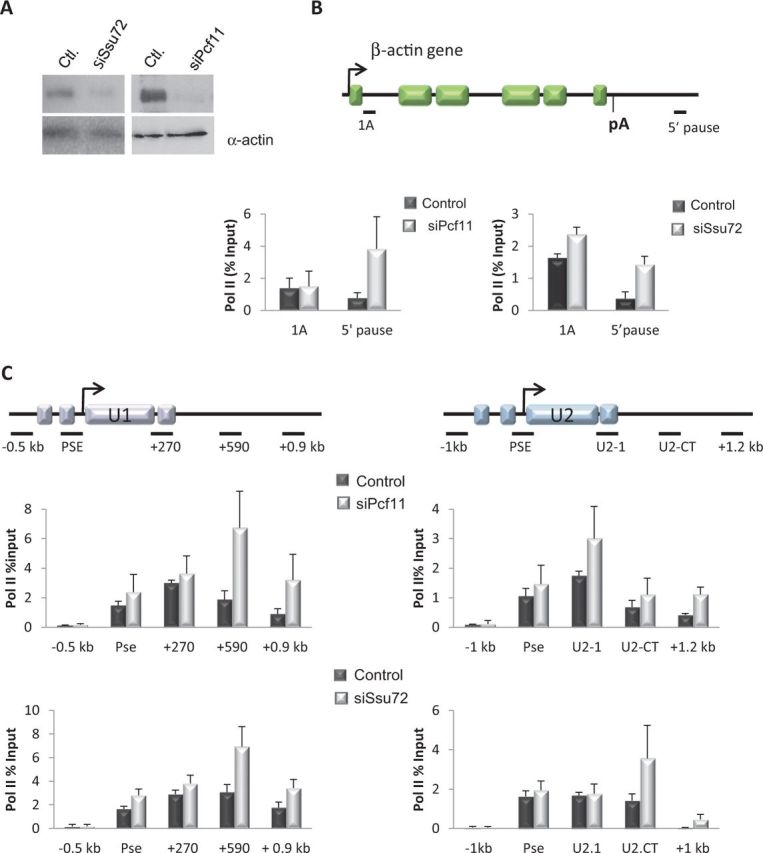
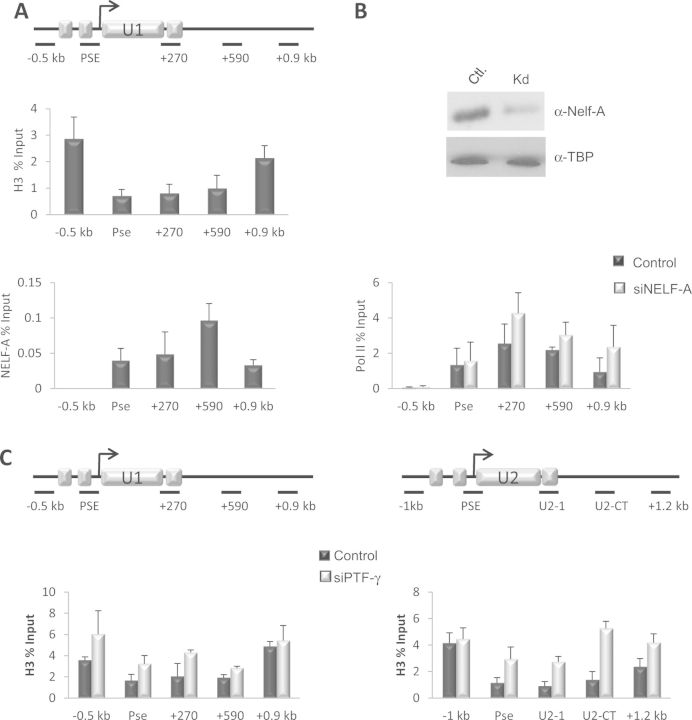
RNA polymerase II transcribes both protein coding and non-coding RNA genes and, in yeast, different mechanisms terminate transcription of the two gene types. Transcription termination of mRNA genes is intricately coupled to cleavage and polyadenylation, whereas transcription of small nucleolar (sno)/small nuclear (sn)RNA genes is terminated by the RNA-binding proteins Nrd1, Nab3 and Sen1. The existence of an Nrd1-like pathway in humans has not yet been demonstrated. Using the U1 and U2 genes as models, we show that human snRNA genes are more similar to mRNA genes than yeast snRNA genes with respect to termination. The Integrator complex substitutes for the mRNA cleavage and polyadenylation specificity factor complex to promote cleavage and couple snRNA 3'-end processing with termination. Moreover, members of the associated with Pta1 (APT) and cleavage factor I/II complexes function as transcription terminators for human snRNA genes with little, if any, role in snRNA 3'-end processing. The gene-specific factor, proximal sequence element-binding transcription factor (PTF), helps clear the U1 and U2 genes of nucleosomes, which provides an easy passage for pol II, and the negative elongation factor facilitates termination at the end of the genes where nucleosome levels increase. Thus, human snRNA genes may use chromatin structure as an additional mechanism to promote efficient transcription termination in vivo.
RNA 聚合酶 II 转录蛋白质编码和非编码 RNA 基因,在酵母中,两种基因类型的转录终止采用不同的机制。mRNA 基因的转录终止与切割和多聚腺苷酸化密切偶联,而小核仁(sno)/小核(sn)RNA 基因的转录则由 RNA 结合蛋白 Nrd1、Nab3 和 Sen1 终止。人类中是否存在 Nrd1 样途径尚未得到证实。我们以 U1 和 U2 基因为模型,表明与酵母 snoRNA 基因相比,人类 snoRNA 基因在终止方面与 mRNA 基因更相似。整合酶复合物替代了 mRNA 切割和多聚腺苷酸化特异性因子复合物,以促进切割并将 snoRNA 3'-末端加工与终止偶联。此外,与 Pta1 (APT) 和切割因子 I/II 复合物相关的成员作为人类 snoRNA 基因的转录终止子发挥作用,在 snoRNA 3'-末端加工中几乎没有作用。基因特异性因子,近端序列元件结合转录因子(PTF),有助于清除 U1 和 U2 基因中的核小体,为 pol II 提供了一个便捷的通道,而负延伸因子促进基因末端的终止,此时核小体水平增加。因此,人类 snoRNA 基因可能利用染色质结构作为一种额外的机制,在体内促进有效的转录终止。