Department of Cognitive and Motor Disabilities, Utrecht University Utrecht, Netherlands.
Front Psychol. 2013 Oct 1;4:679. doi: 10.3389/fpsyg.2013.00679. eCollection 2013.
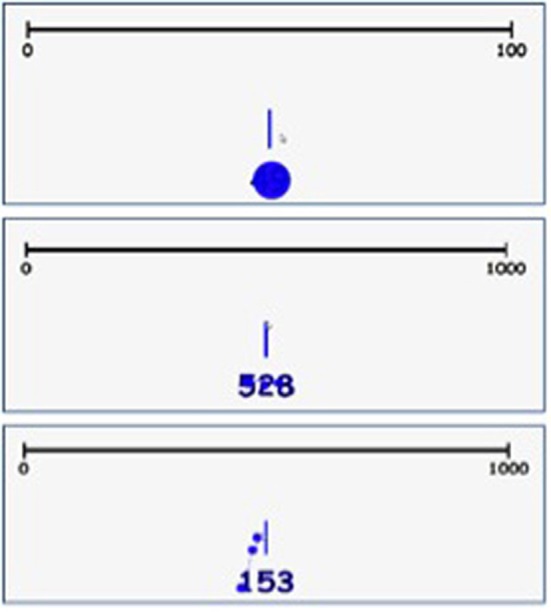
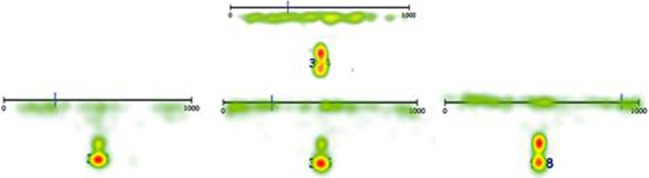
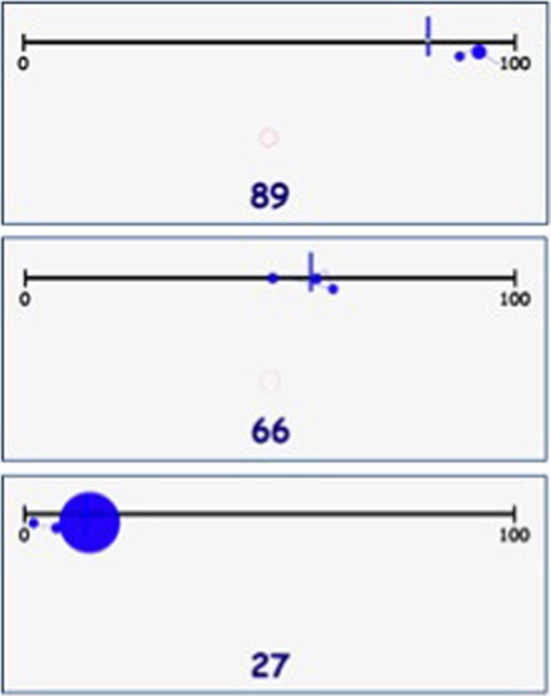
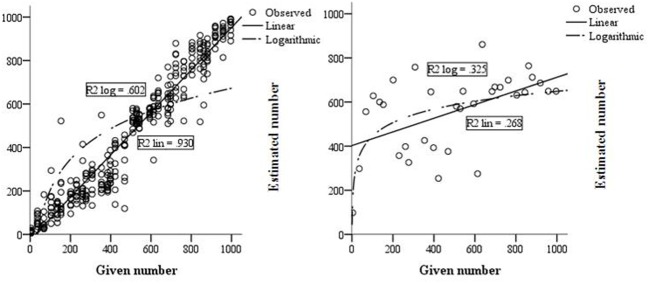
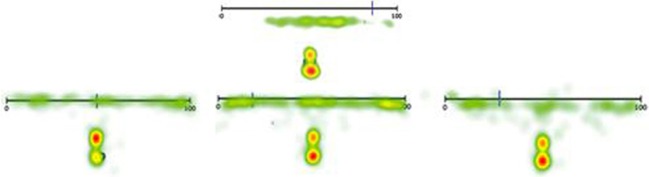
The present study compared eye movements and performance of a 9-year-old girl with Developmental Dyscalculia (DD) on a series of number line tasks to those of a group of typically developing (TD) children (n = 10), in order to answer the question whether eye-tracking data from number line estimation tasks can be a useful tool to discriminate between TD children and children with a number processing deficit. Quantitative results indicated that the child with dyscalculia performed worse on all symbolic number line tasks compared to the control group, indicated by a low linear fit (R (2)) and a low accuracy measured by mean percent absolute error. In contrast to the control group, her magnitude representations seemed to be better represented by a logarithmic than a linear fit. Furthermore, qualitative analyses on the data of the child with dyscalculia revealed more unidentifiable fixation patterns in the processing of multi-digit numbers and more dysfunctional estimation strategy use in one third of the estimation trials as opposed to ~10% in the control group. In line with her dyscalculia diagnosis, these results confirm the difficulties with spatially representing and manipulating numerosities on a number line, resulting in inflexible and inadequate estimation or processing strategies. It can be concluded from this case study that eye-tracking data can be used to discern different number processing and estimation strategies in TD children and children with a number processing deficit. Hence, eye-tracking data in combination with number line estimation tasks might be a valuable and promising addition to current diagnostic measures.
本研究通过一系列数字线任务比较了一位患有发育性计算障碍(DD)的 9 岁女孩和一组典型发育(TD)儿童的眼动和表现,以回答眼动追踪数据是否可以从数字线估计任务中作为区分 TD 儿童和具有数字处理缺陷的儿童的有用工具。定量结果表明,与对照组相比,患有计算障碍的儿童在所有符号数字线任务中的表现都较差,表现为线性拟合度低(R^2)和平均绝对误差的准确度低。与对照组相比,她的数量表示似乎更适合对数拟合而不是线性拟合。此外,对患有计算障碍的儿童的数据进行的定性分析表明,在处理多位数字时,其注视模式更难以识别,并且在三分之一的估计试验中使用了功能失调的估计策略,而对照组中约为 10%。与她的计算障碍诊断一致,这些结果证实了在数字线上空间表示和操作数量的困难,导致了不灵活和不充分的估计或处理策略。可以从这项案例研究中得出结论,眼动追踪数据可用于区分 TD 儿童和具有数字处理缺陷的儿童的不同数量处理和估计策略。因此,眼动追踪数据与数字线估计任务相结合可能是当前诊断措施的有价值和有前途的补充。