Department of Obstetrics and Gynecology, Kaohsiung Chang Gung Memorial Hospital and Chang Gung University College of Medicine, Kaohsiung, Taiwan ; Graduate Institute of Clinical Medical Sciences, Chang Gung University, Kaohsiung, Taiwan ; Hormone Research Center, Kaohsiung Chang Gung Memorial Hospital and Chang Gung University College of Medicine, Kaohsiung, Taiwan.
PLoS One. 2013 Oct 1;8(10):e76303. doi: 10.1371/journal.pone.0076303. eCollection 2013.
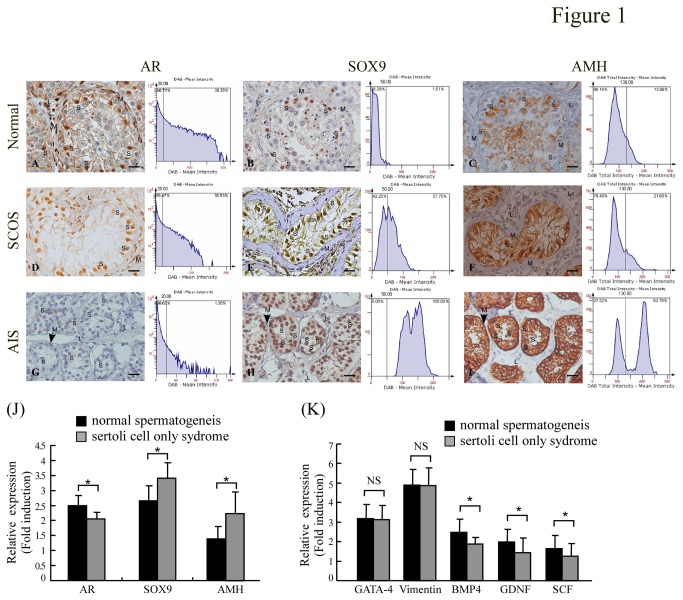
Testosterone provokes Sertoli cell maturation and represses AMH production. In adult patients with Sertoli-cells-only syndrome (SCOS) and androgen insensitivity syndrome (AIS), high level of AMH expression is detected in Sertoli cells due to defect of androgen/AR signaling.
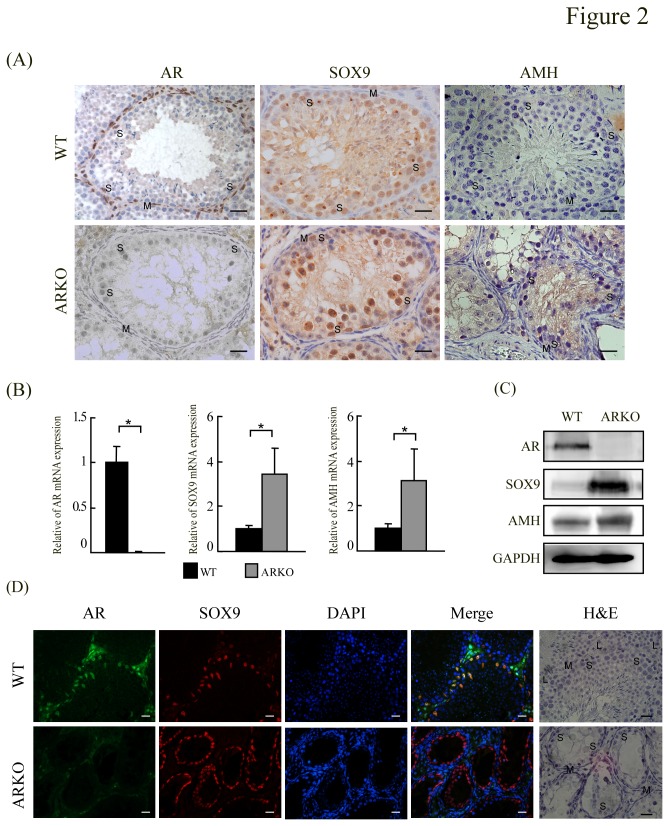
We postulated that up-regulation of SOX9 due to impairment of androgen/AR signaling in Sertoli cells might explain why high level of anti-Mullerian hormone (AMH) expression occur in these testiculopathic patients.
Biological research of testicular specimens from men with azoospermia or mouse. The serum hormone levels were studied in 23 men with obstructive azoospermia, 33 men with SCOS azoospermia and 21 volunteers with normal seminograms during a period of 4 years. Immunohistochemical staining and reverse-transcription PCR were used to examine the relationships among AR, SOX9 and AMH expression in adult human and mouse testes. The ability of AR to repress the expression of SOX9 and AMH was evaluated in vitro in TM4 Sertoli cells and C3H10T1/2 cells.
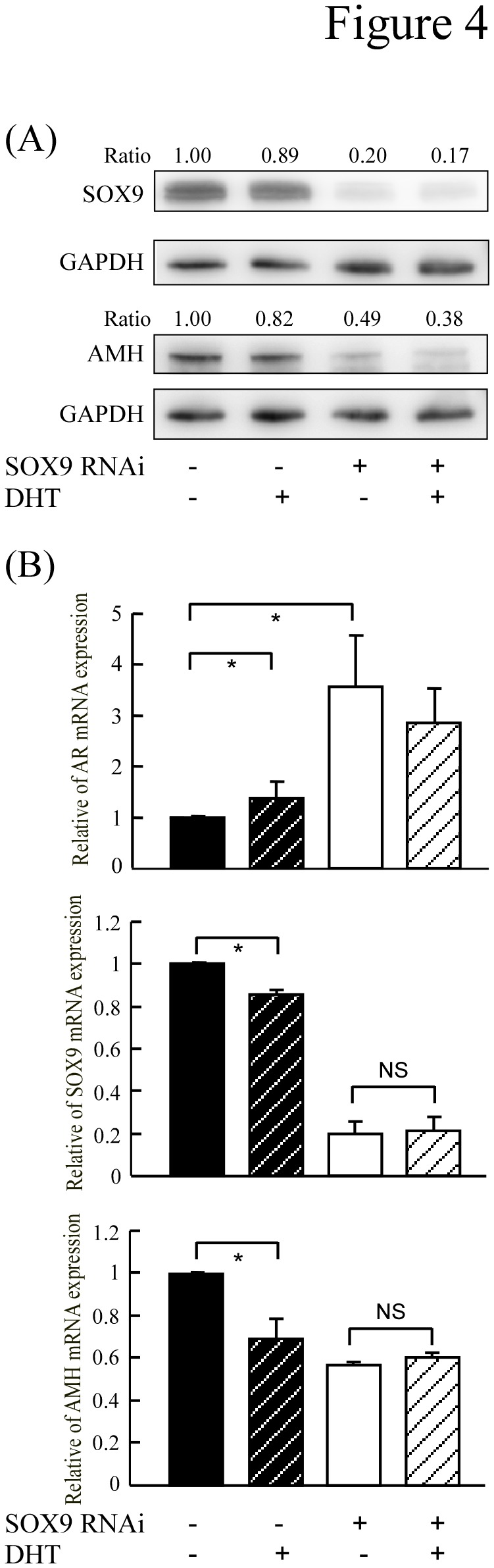
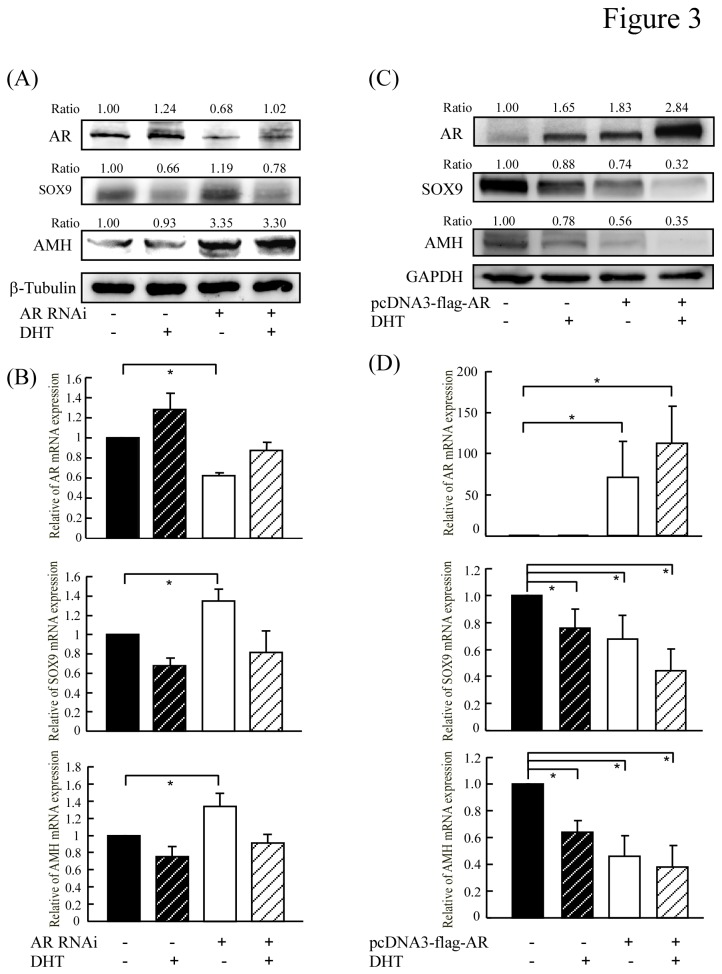
SCOS specimens showed up-regulation of SOX9 and AMH proteins but down-regulation of AR proteins in Sertoli cells. The mRNA levels of AR were significantly lower and the SOX9, AMH mRNA levels higher in all SCOS patients compared to controls (P< 0.05). The testosterone levels in the SCOS patients were within the normal range, but most were below the median of the controls. Furthermore, our in vitro cell line experiments demonstrated that androgen/AR signaling suppressed the gene and protein levels of AMH via repression of SOX9.
Our data show that the functional androgen/AR signaling to repress SOX9 and AMH expression is essential for Sertoli cell maturation. Impairment of androgen/AR signaling promotes SOX9-mediated AMH production, accounts for impairments of Sertoli cells in SCOS azoospermic patients.
睾酮可促进支持细胞成熟并抑制 AMH 的产生。在成年唯支持细胞综合征(SCOS)和雄激素不敏感综合征(AIS)患者中,由于雄激素/AR 信号缺陷,支持细胞中检测到 AMH 高表达。
我们假设,由于支持细胞中的雄激素/AR 信号受损,SOX9 的上调可能解释了为什么这些睾丸疾病患者中会出现高水平的抗缪勒管激素(AMH)表达。
对无精子症男性和小鼠的睾丸标本进行生物学研究。在 4 年期间,研究了 23 名梗阻性无精子症男性、33 名 SCOS 无精子症男性和 21 名正常精液分析志愿者的血清激素水平。免疫组织化学染色和逆转录 PCR 用于研究成人人类和小鼠睾丸中 AR、SOX9 和 AMH 表达之间的关系。在 TM4 支持细胞和 C3H10T1/2 细胞中评估 AR 抑制 SOX9 和 AMH 表达的能力。
SCOS 标本中支持细胞的 SOX9 和 AMH 蛋白表达上调,而 AR 蛋白表达下调。与对照组相比,所有 SCOS 患者的 AR mRNA 水平显著降低,SOX9、AMH mRNA 水平升高(P<0.05)。SCOS 患者的睾酮水平在正常范围内,但大多数低于对照组中位数。此外,我们的体外细胞系实验表明,雄激素/AR 信号通过抑制 SOX9 来抑制 AMH 的基因和蛋白表达。
我们的数据表明,功能性雄激素/AR 信号抑制 SOX9 和 AMH 表达对于支持细胞成熟是必需的。雄激素/AR 信号的损伤促进了 SOX9 介导的 AMH 产生,这解释了 SCOS 无精子症患者中支持细胞的损伤。