Murdoch Children's Research Institute, Parkville, Australia.
PLoS One. 2013 Oct 3;8(10):e77334. doi: 10.1371/journal.pone.0077334. eCollection 2013.
The Mycobacterium bovis Bacille Calmette-Guérin (BCG) vaccine is given to >120 million infants each year worldwide. Most studies investigating the immune response to BCG have focused on adaptive immunity. However the importance of TCR-gamma/delta (γδ) T cells and NK cells in the mycobacterial-specific immune response is of increasing interest.
Participants in four age-groups were BCG-immunized. Ten weeks later, in vitro BCG-stimulated blood was analyzed for NK and T cell markers, and intracellular IFNgamma (IFNγ) by flow cytometry. Total functional IFNγ response was calculated using integrated median fluorescence intensity (iMFI).
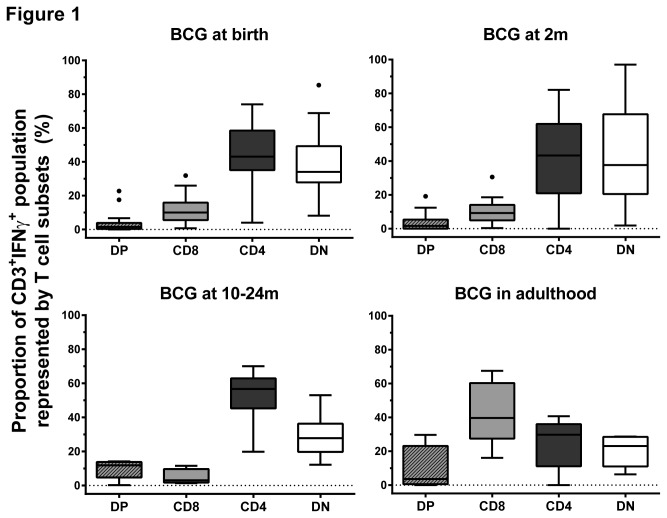
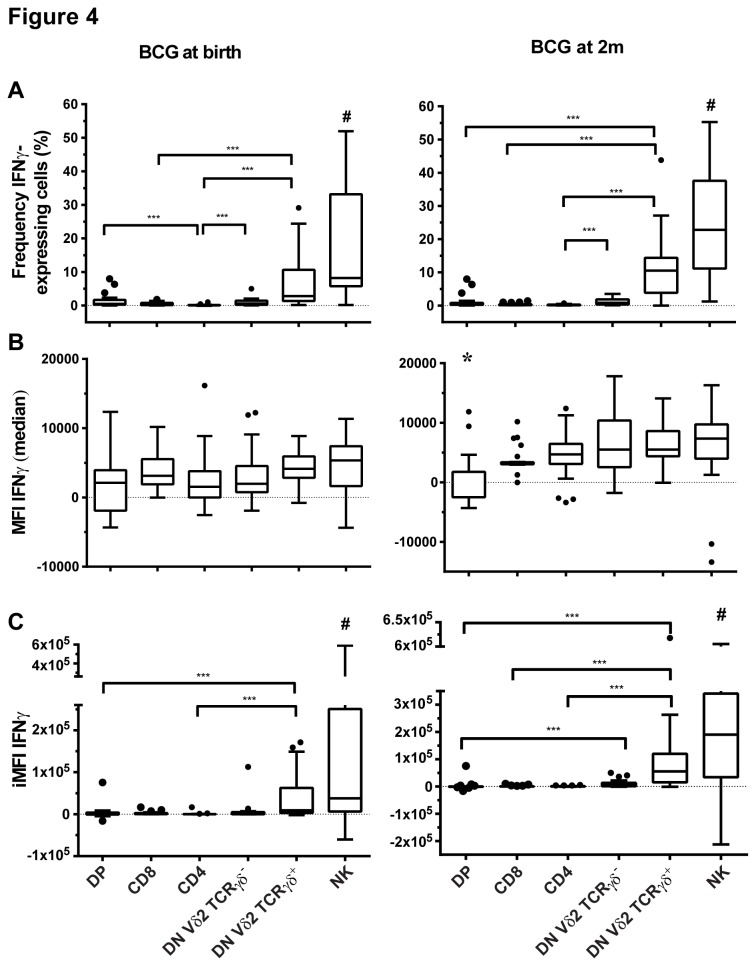
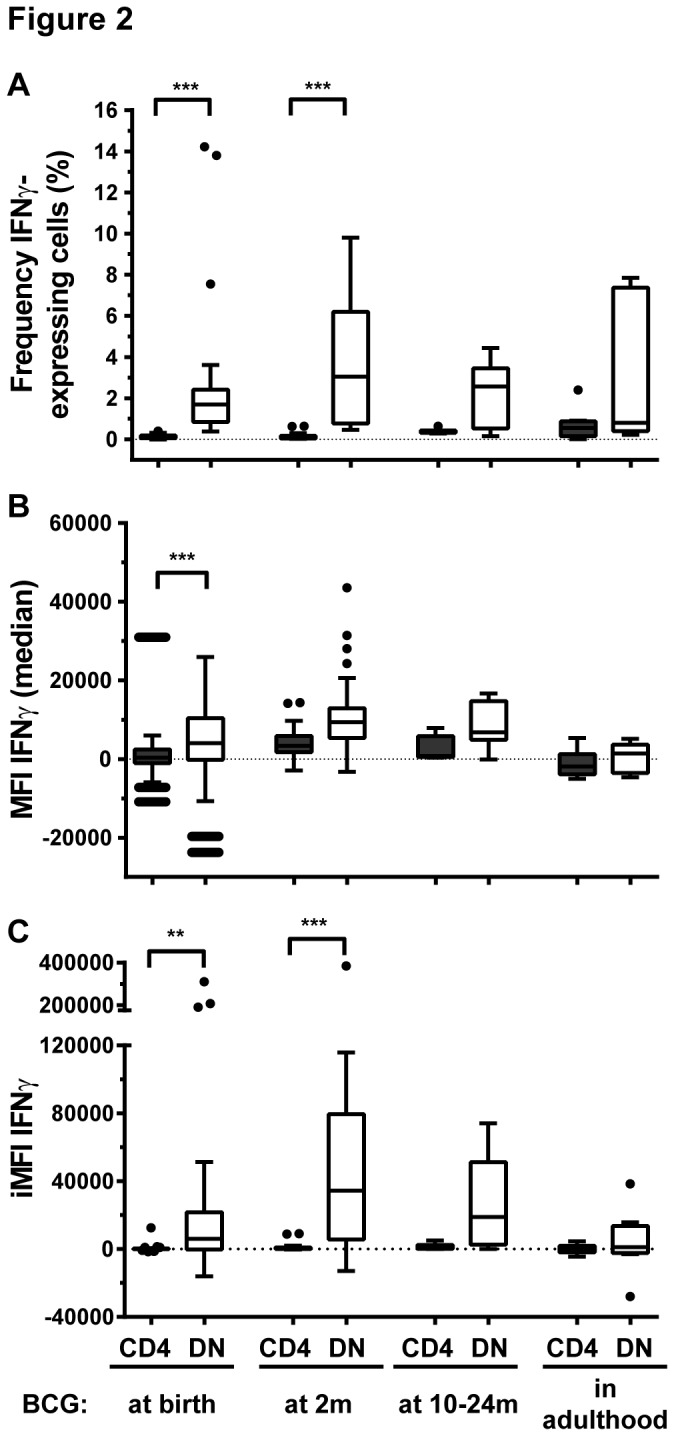
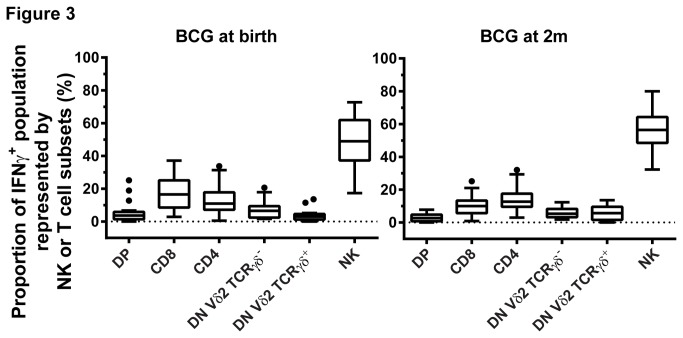
In infants and children, CD4 and CD4-CD8- (double-negative (DN)) T cells were the main IFNγ-expressing cells representing 43-56% and 27-37% of total CD3+ IFNγ+ T cells respectively. The iMFI was higher in DN T cells compared to CD4 T cells in all age groups, with the greatest differences seen in infants immunized at birth (p=0.002) or 2 months of age (p<0.0001). When NK cells were included in the analysis, they accounted for the majority of total IFNγ-expressing cells and, together with DN Vδ2 γδ T cells, had the highest iMFI in infants immunized at birth or 2 months of age.
In addition to CD4 T cells, NK cells and DN T cells, including Vδ2 γδ T cells, are the key populations producing IFNγ in response to BCG immunization in infants and children. This suggests that innate immunity and unconventional T cells play a greater role in the mycobacterial immune response than previously recognized and should be considered in the design and assessment of novel tuberculosis vaccines.
牛型分枝杆菌卡介苗(BCG)疫苗每年在全球范围内为>1.2 亿婴儿接种。大多数研究都集中在适应性免疫方面,以调查对 BCG 的免疫反应。然而,TCR-γ/δ(γδ)T 细胞和 NK 细胞在针对分枝杆菌的特异性免疫反应中的重要性越来越受到关注。
将四个年龄组的参与者进行 BCG 免疫接种。10 周后,通过流式细胞术分析体外 BCG 刺激后的血液中的 NK 和 T 细胞标志物以及细胞内 IFNγ(IFNγ)。使用整合的中荧光强度(iMFI)计算总功能性 IFNγ 反应。
在婴儿和儿童中,CD4 和 CD4-CD8-(双阴性(DN))T 细胞是主要的 IFNγ 表达细胞,分别占总 CD3+IFNγ+T 细胞的 43-56%和 27-37%。在所有年龄组中,DN T 细胞的 iMFI 均高于 CD4 T 细胞,在出生时或 2 个月时免疫接种的婴儿中差异最大(p=0.002)或 2 个月(p<0.0001)。当将 NK 细胞纳入分析时,它们占总 IFNγ 表达细胞的大部分,并且与 DN Vδ2 γδ T 细胞一起,在出生时或 2 个月时免疫接种的婴儿中具有最高的 iMFI。
除 CD4 T 细胞外,NK 细胞和 DN T 细胞(包括 Vδ2 γδ T 细胞)是婴儿和儿童对 BCG 免疫产生 IFNγ 的关键细胞群。这表明先天免疫和非常规 T 细胞在分枝杆菌免疫反应中比以前认识到的具有更大的作用,在设计和评估新型结核病疫苗时应予以考虑。