Kollins Scott H, Schoenfelder Erin, English Joseph S, McClernon F Joseph, Dew Rachel E, Lane Scott D
Duke ADHD Program, Department of Psychiatry, Duke University School of Medicine.
Exp Clin Psychopharmacol. 2013 Oct;21(5):375-84. doi: 10.1037/a0033851.
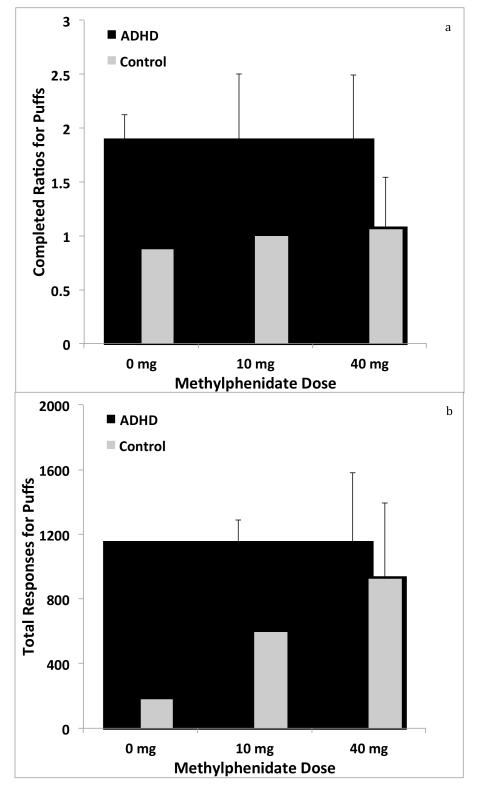
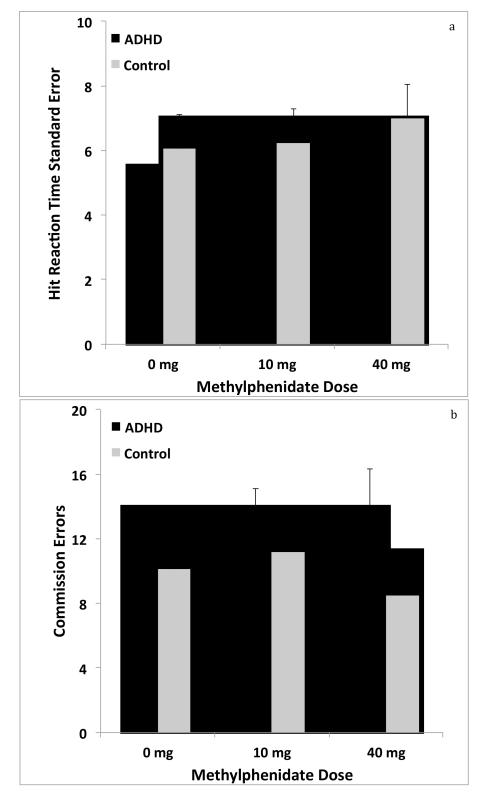
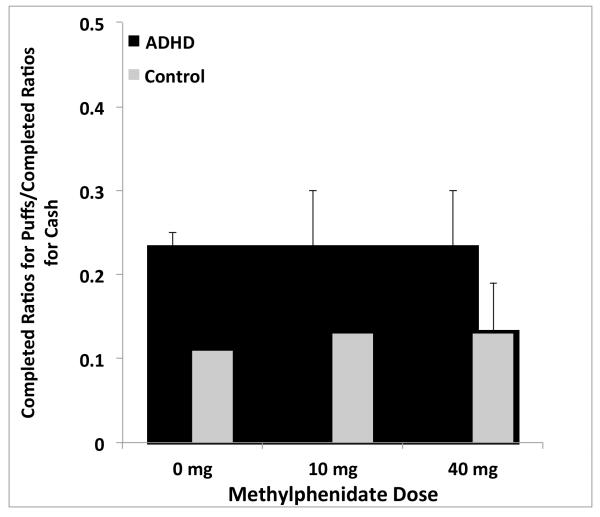
Individuals with Attention Deficit Hyperactivity Disorder (ADHD) smoke cigarettes at rates higher than the general population and questions have been raised about how stimulant drugs-the frontline pharmacological treatment for ADHD-influence smoking risk and behavior in those with ADHD. In the present study adult regular smokers with (n = 16) and without (n = 17) ADHD participated in 3 experimental sessions in which they completed a Progressive Ratio (PR) task to measure the relative reinforcing effects of cigarette smoking and money after oral administration of placebo and 2 active doses of methylphenidate (10 mg and 40 mg). We also measured attention and inhibitory control via a Continuous Performance Test (CPT). Methylphenidate had no effect on smoking-reinforced responding, attention, or inhibitory control in either group. Attention and inhibitory control were associated with smoking-reinforced responding, but unsystematically and only in the non-ADHD group. Several design features, such as the value of the monetary response option, the PR schedule, and the potential effects of smoking on attention and inhibitory control, could have contributed to the negative findings and are discussed as such. Although inconsistent with some previous human laboratory studies of stimulant drugs and smoking, results are consistent with recent trials of stimulant drugs as adjuncts for smoking cessation in adult smokers with ADHD. In general, methylphenidate at mild and moderate doses did not influence the relative reinforcing effects of cigarette smoking in adults with and without ADHD.
患有注意力缺陷多动障碍(ADHD)的个体吸烟率高于普通人群,人们对治疗ADHD的一线药物兴奋剂如何影响ADHD患者的吸烟风险和行为提出了疑问。在本研究中,患有ADHD(n = 16)和未患ADHD(n = 17)的成年常吸烟者参加了3次实验,在口服安慰剂和2种有效剂量的哌甲酯(10毫克和40毫克)后,他们完成了一个累进比率(PR)任务,以测量吸烟和金钱的相对强化作用。我们还通过持续操作测试(CPT)测量了注意力和抑制控制。哌甲酯对两组的吸烟强化反应、注意力或抑制控制均无影响。注意力和抑制控制与吸烟强化反应相关,但无系统性关联,且仅在非ADHD组中存在。一些设计特点,如金钱反应选项的价值、PR时间表以及吸烟对注意力和抑制控制的潜在影响,可能导致了这些阴性结果,并在此进行了讨论。尽管与之前一些关于兴奋剂药物和吸烟的人体实验室研究结果不一致,但本研究结果与最近将兴奋剂药物作为患有ADHD的成年吸烟者戒烟辅助药物的试验结果一致。总体而言,轻度和中度剂量的哌甲酯不会影响患有和未患ADHD的成年人吸烟的相对强化作用。