Hong Seung-Hyun, Goh Sung-Ho, Lee Sang Jin, Hwang Jung-Ah, Lee Jieun, Choi Il-Ju, Seo Hyehyun, Park Jong-Hoon, Suzuki Hiromu, Yamamoto Eiichiro, Kim In-Hoo, Jeong Jin Sook, Ju Mi Ha, Lee Dong-Hee, Lee Yeon-Su
Cancer Genomics Branch, Research Institute, National Cancer Center, Republic of Korea.
Oncotarget. 2013 Oct;4(10):1791-803. doi: 10.18632/oncotarget.1324.
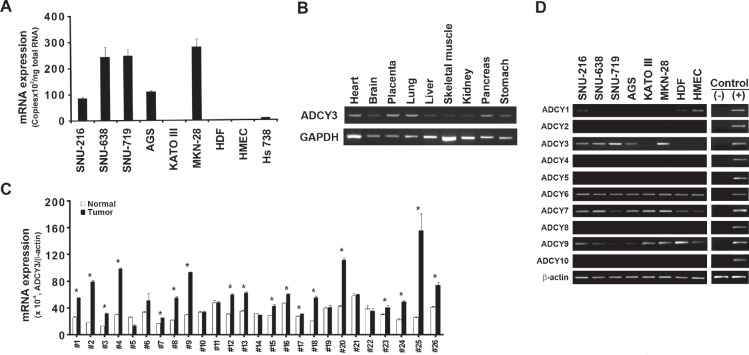
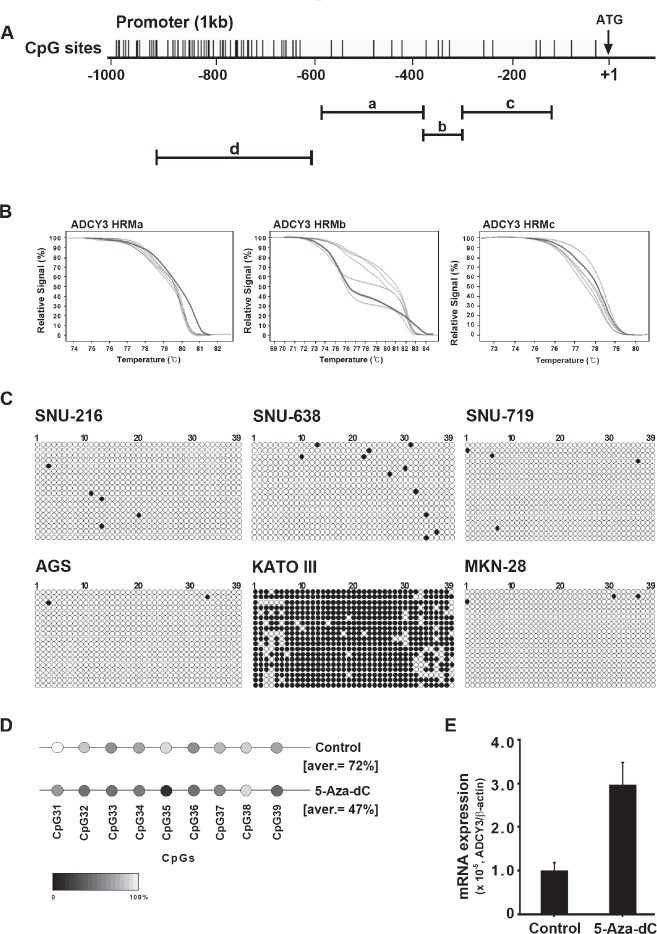
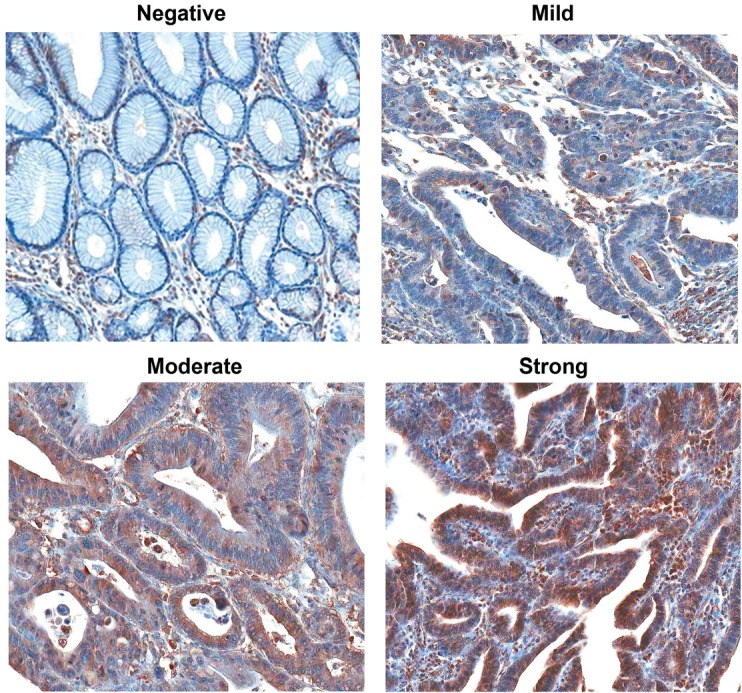
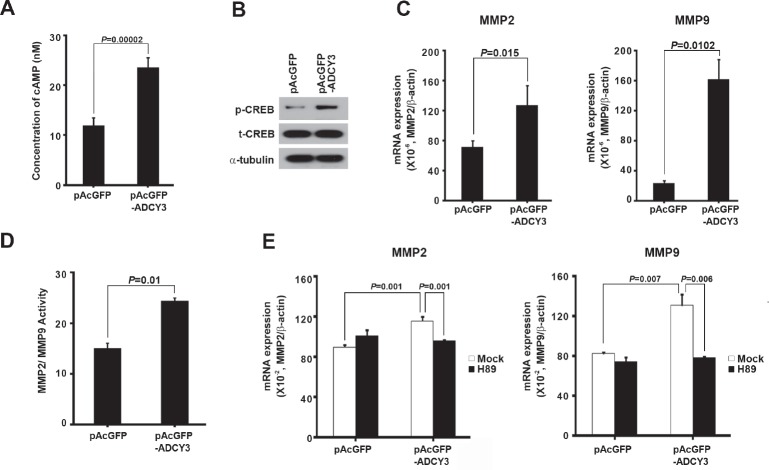
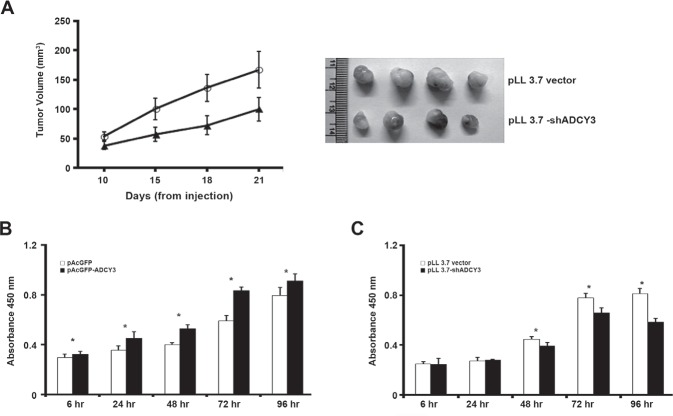
Adenylate cyclase 3 (ADCY3) is a widely expressed membrane-associated protein in human tissues, which catalyzes the formation of cyclic adenosine-3',5'-monophosphate (cAMP). However, our transcriptome analysis of gastric cancer tissue samples (NCBI GEO GSE30727) revealed that ADCY3 expression was specifically altered in cancer samples. Here we investigated the tumor-promoting effects of ADCY3 overexpression and confirmed a significant correlation between the upregulation of ADCY3 and Lauren's intestinal-type gastric cancers. ADCY3 overexpression increased cell migration, invasion, proliferation, and clonogenicity in HEK293 cells; conversely, silencing ADCY3 expression in SNU-216 cells reduced these phenotypes. Interestingly, ADCY3 overexpression increased both the mRNA level and activity of matrix metalloproteinase 2 (MMP2) and MMP9 by increasing the levels of cAMP and phosphorylated cAMP-responsive element-binding protein (CREB). Consistent with these findings, treatment with a protein kinase A (PKA) inhibitor decreased MMP2 and MMP9 expression levels in ADCY3-overexpressing cells. Knockdown of ADCY3 expression by stable shRNA in human gastric cancer cells suppressed tumor growth in a tumor xenograft model. Thus, ADCY3 overexpression may exert its tumor-promoting effects via the cAMP/PKA/CREB pathway. Additionally, bisulfite sequencing of the ADCY3 promoter region revealed that gene expression was reduced by hypermethylation of CpG sites, and increased by 5-Aza-2'-deoxycytidine (5-Aza-dC)-induced demethylation. Our study is the first to report an association of ADCY3 with gastric cancer as well as its tumorigenic potentials. In addition, we demonstrate that the expression of ADCY3 is regulated through an epigenetic mechanism. Further study on the mechanism of ADCY3 in tumorigenesis will provide the basis as a new molecular target of gastric cancer.
腺苷酸环化酶3(ADCY3)是一种在人体组织中广泛表达的膜相关蛋白,它催化环磷酸腺苷(cAMP)的形成。然而,我们对胃癌组织样本的转录组分析(NCBI GEO GSE30727)显示,ADCY3的表达在癌症样本中发生了特异性改变。在此,我们研究了ADCY3过表达的促肿瘤作用,并证实ADCY3的上调与劳伦肠型胃癌之间存在显著相关性。ADCY3过表达增加了HEK293细胞的迁移、侵袭、增殖和克隆形成能力;相反,在SNU - 216细胞中沉默ADCY3表达则降低了这些表型。有趣的是,ADCY3过表达通过增加cAMP和磷酸化的cAMP反应元件结合蛋白(CREB)的水平,提高了基质金属蛋白酶2(MMP2)和MMP9的mRNA水平及活性。与这些发现一致,用蛋白激酶A(PKA)抑制剂处理可降低ADCY3过表达细胞中MMP2和MMP9的表达水平。在人胃癌细胞中通过稳定的短发夹RNA(shRNA)敲低ADCY3表达可抑制肿瘤异种移植模型中的肿瘤生长。因此,ADCY3过表达可能通过cAMP/PKA/CREB途径发挥其促肿瘤作用。此外,对ADCY3启动子区域的亚硫酸氢盐测序显示,基因表达因CpG位点的高甲基化而降低,因5 - 氮杂 - 2'-脱氧胞苷(5 - Aza - dC)诱导的去甲基化而增加。我们的研究首次报道了ADCY3与胃癌的关联及其致瘤潜力。此外,我们证明ADCY3的表达是通过表观遗传机制调控的。对ADCY3在肿瘤发生机制方面的进一步研究将为胃癌新分子靶点的研究提供依据。