Department of Otolaryngology, Hearing Implant Center, Medical University of Warsaw, Warsaw, Poland.
Clin Interv Aging. 2013;8:1339-46. doi: 10.2147/CIA.S50698. Epub 2013 Oct 2.
To assess the benefits of cochlear implantation in the elderly.
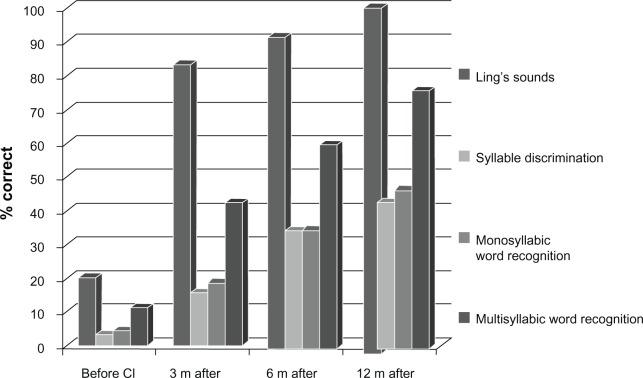
A retrospective analysis of 31 postlingually deafened elderly (≥60 years of age) with unilateral cochlear implants was conducted. Audiological testing included preoperative and postoperative pure-tone audiometry and a monosyllabic word recognition test presented from recorded material in free field. Speech perception tests included Ling's six sound test (sound detection, discrimination, and identification), syllable discrimination, and monosyllabic and multisyllabic word recognition (open set) without lip-reading. Everyday life benefits from cochlear implantation were also evaluated.
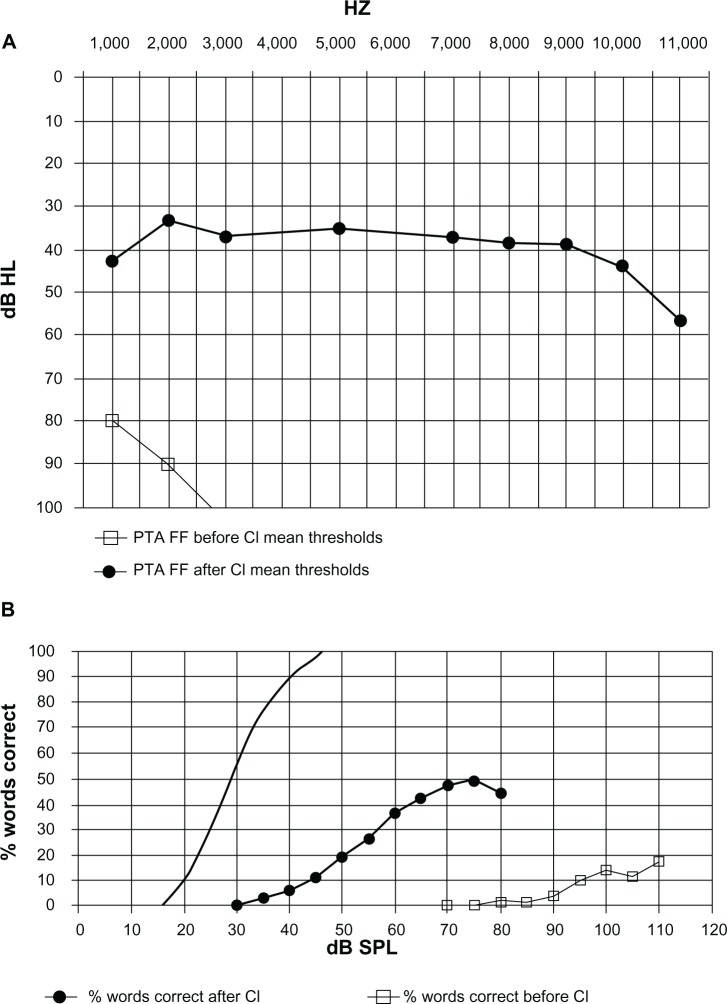
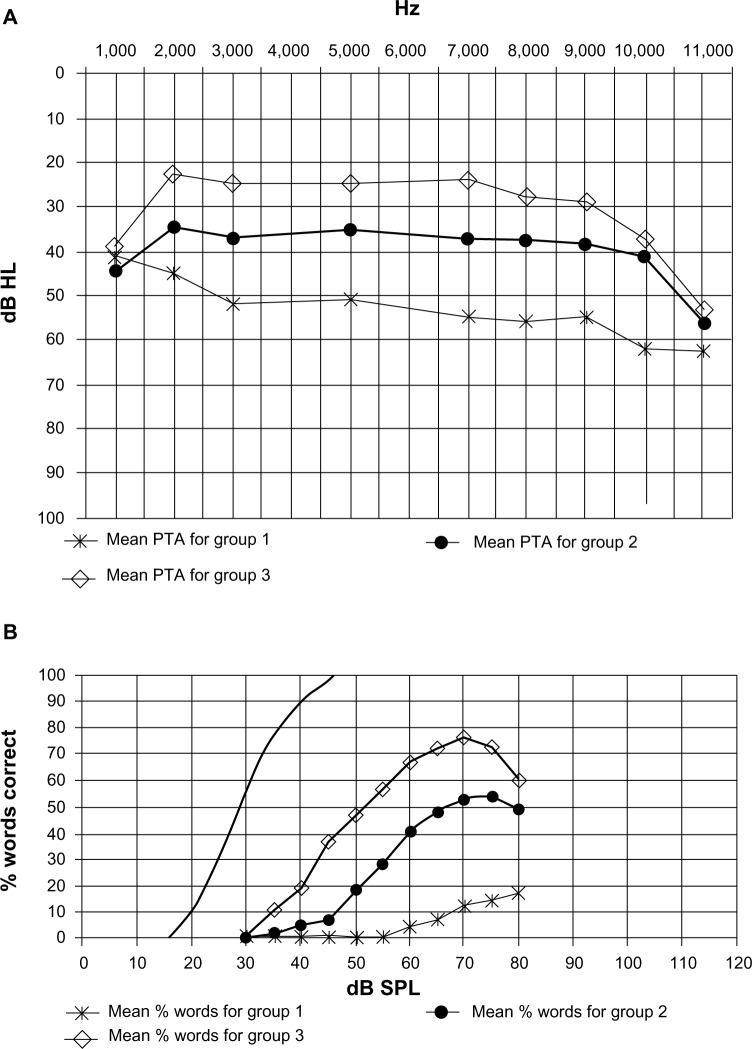
The mean age at the time of cochlear implantation was 72.4 years old. The mean postimplantation follow-up time was 2.34 years. All patients significantly improved their audiological and speech understanding performances. The preoperative mean pure-tone average threshold for 500 Hz, 1,000 Hz, 2,000 Hz, and 4,000 Hz was 110.17 dB HL. Before cochlear implantation, all patients scored 0% on the monosyllabic word recognition test in free field at 70 dB SPL intensity level. The postoperative pure-tone average was 37.14 dB HL (the best mean threshold was 17.50 dB HL, the worst was 58.75 dB HL). After the surgery, mean monosyllabic word recognition reached 47.25%. Speech perception tests showed statistically significant improvement in speech recognition.
The results of this study showed that cochlear implantation is indeed a successful treatment for improving speech recognition and offers a great help in everyday life to deafened elderly patients. Therefore, they can be good candidates for cochlear implantation and their age alone should not be a relevant or excluding factor when choosing candidates for cochlear implantation.
评估人工耳蜗植入对老年人的益处。
对 31 名(≥60 岁)后天聋的老年单侧人工耳蜗植入患者进行回顾性分析。听力测试包括术前和术后纯音测听以及从自由场记录材料中呈现的单音节词识别测试。言语感知测试包括 Ling 六音测试(声音检测、辨别和识别)、音节辨别、单音节和多音节词识别(开放集)以及不唇读。还评估了人工耳蜗植入对日常生活的益处。
人工耳蜗植入时的平均年龄为 72.4 岁。平均植入后随访时间为 2.34 年。所有患者的听力和言语理解能力均显著提高。术前 500 Hz、1000 Hz、2000 Hz 和 4000 Hz 的平均纯音听阈为 110.17 dB HL。在人工耳蜗植入前,所有患者在 70 dB SPL 强度水平的自由场中单音节词识别测试得分为 0%。术后纯音平均听阈为 37.14 dB HL(最佳平均阈值为 17.50 dB HL,最差为 58.75 dB HL)。手术后,平均单音节词识别率达到 47.25%。言语感知测试显示言语识别有统计学上的显著改善。
本研究结果表明,人工耳蜗植入确实是改善言语识别的成功治疗方法,为失聪老年患者的日常生活提供了极大帮助。因此,他们可以成为人工耳蜗植入的良好候选者,而他们的年龄本身不应成为选择人工耳蜗植入候选者的相关或排除因素。