Department of Paediatrics, University of Oxford, Oxford, United Kingdom ; KwaZulu-Natal Research Institute for Tuberculosis and HIV (K-RITH), Nelson R Mandela School of Medicine, University of Kwazulu-Natal, Durban, KwaZulu-Natal, South Africa ; Department of International Health, Immunology and Microbiology, University of Copenhagen, Copenhagen, Denmark.
PLoS One. 2013 Oct 4;8(10):e74389. doi: 10.1371/journal.pone.0074389. eCollection 2013.
HIV Gag-specific CD4+ and CD8+ T-cell responses are important for HIV immune control. Pulsing overlapping Gag peptides on autologous lymphocytes (OPAL) has proven immunogenic and effective in reducing viral loads in multiple pigtail macaque studies, warranting clinical evaluation.
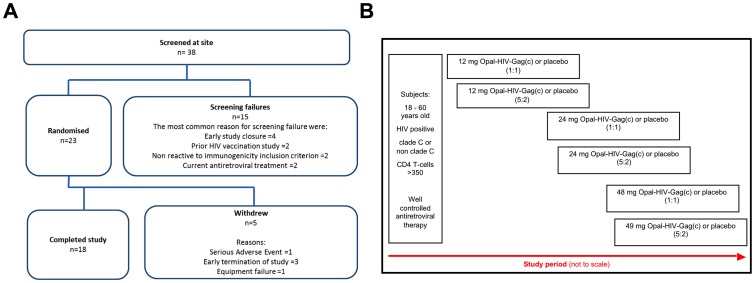
We performed a phase I, single centre, placebo-controlled, double-blinded and dose-escalating study to evaluate the safety and preliminary immunogenicity of a novel therapeutic vaccine approach 'OPAL-HIV-Gag(c)'. This vaccine is comprised of 120 15mer peptides, overlapping by 11 amino acids, spanning the HIV Gag C clade sequence proteome, pulsed on white blood cells enriched from whole blood using a closed system, followed by intravenous reinfusion. Patients with undetectable HIV viral loads (<50 copies/ml plasma) on HAART received four administrations at week 0, 4, 8 and 12, and were followed up for 12 weeks post-treatment. Twenty-three people were enrolled in four groups: 12 mg (n = 6), 24 mg (n = 7), 48 mg (n = 2) or matching placebo (n = 8) with 18 immunologically evaluable. T-cell immunogenicity was assessed by IFNγ ELIspot and intracellular cytokine staining (ICS).
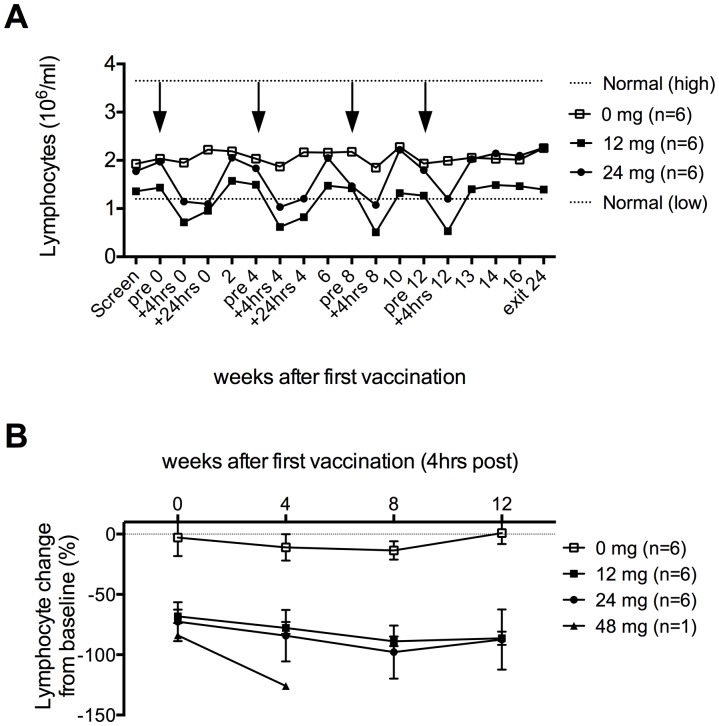
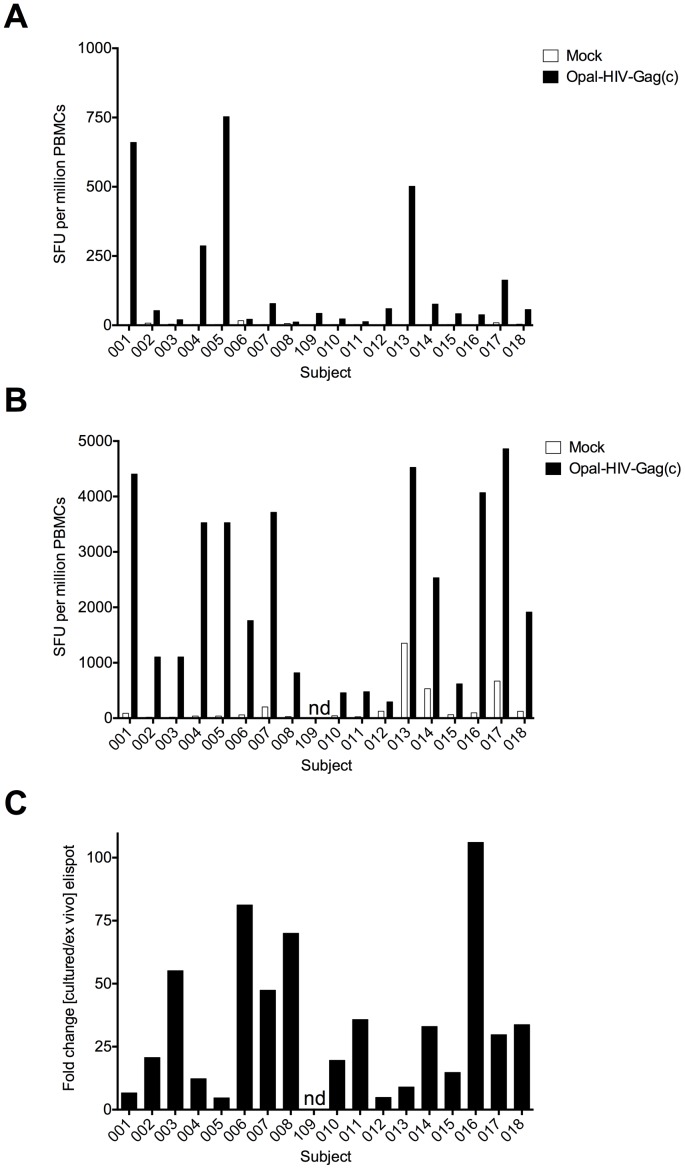
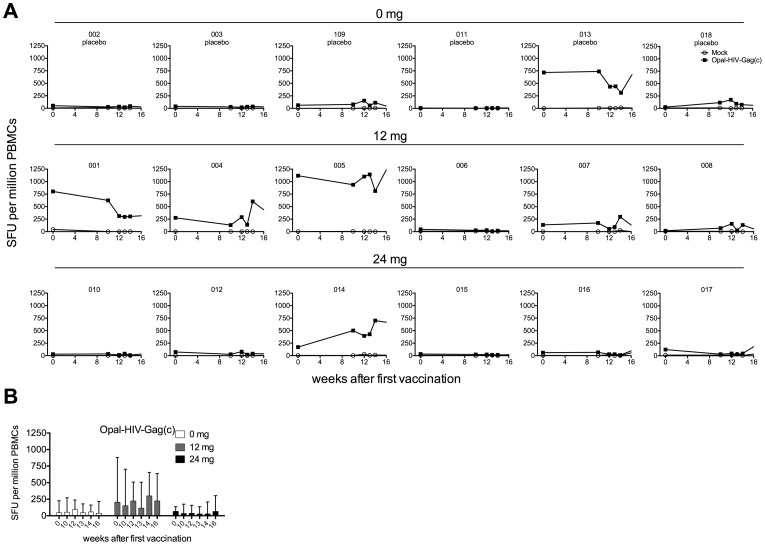
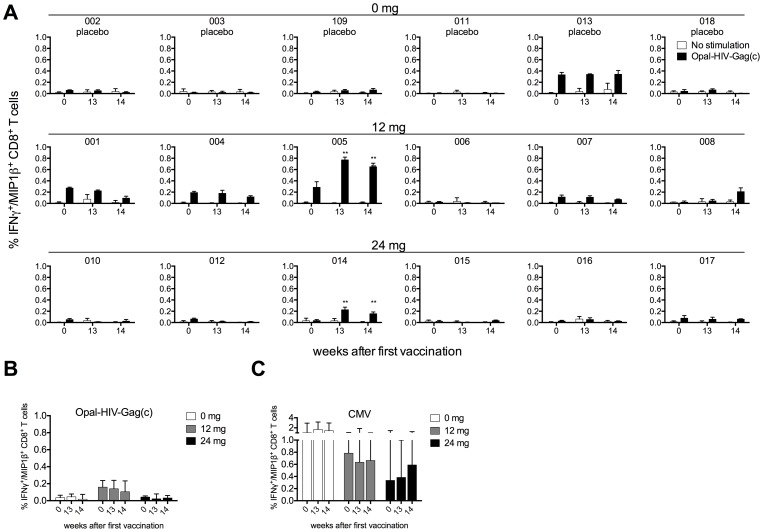
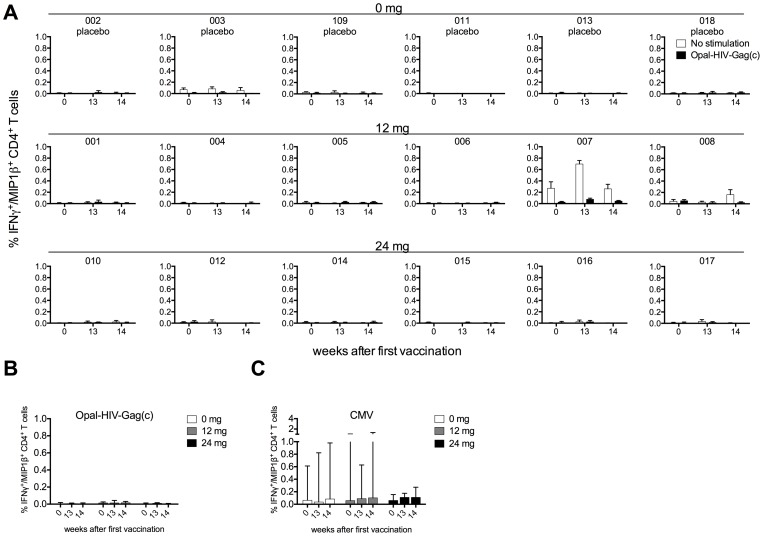
The OPAL-HIV-Gag(c) peptides were antigenic in vitro in 17/17 subjects. After vaccination with OPAL-HIV-Gag(c), 1/6 subjects at 12 mg and 1/6 subjects at 24 mg dose groups had a 2- and 3-fold increase in ELIspot magnitudes from baseline, respectively, of Gag-specific CD8+ T-cells at week 14, compared to 0/6 subjects in the placebo group. No Gag-specific CD4+ T-cell responses or overall change in Rev, Nef, Tat and CMV specific responses were detected. Marked, transient and self-limiting lymphopenia was observed immediately post-vaccination (4 hours) in OPAL-HIV-Gag(c) but not in placebo recipients, with median fall from 1.72 to 0.67 million lymphocytes/mL for active groups (P<0.001), compared to post-placebo from 1.70 to 1.56 lymphocytes/ml (P = 0.16).
CONCLUSION/SIGNIFICANCE: Despite strong immunogenicity observed in several Macaca nemestrina studies using this approach, OPAL-HIV-Gag(c) was not significantly immunogenic in humans and improved methods of generating high-frequency Gag-specific T-cell responses are required.
ClinicalTrials.gov, Registry number: NCT01123915, URL trial registry database: http://www.clinicaltrials.gov/ct2/results?term=OPAL-HIV-1001&Search=Search.
HIV Gag 特异性 CD4+和 CD8+ T 细胞应答对于 HIV 免疫控制很重要。在多个长尾猕猴研究中,自体淋巴细胞上的重叠 Gag 肽脉冲(OPAL)已被证明具有免疫原性和有效性,可降低病毒载量,值得临床评估。
我们进行了一项 I 期、单中心、安慰剂对照、双盲和剂量递增研究,以评估新型治疗性疫苗方法“OPAL-HIV-Gag(c)”的安全性和初步免疫原性。该疫苗由 120 个 15 聚体肽组成,重叠 11 个氨基酸,跨越 HIV Gag C 谱系蛋白组,使用封闭系统在富含白细胞的全血上进行脉冲,然后静脉内再输注。接受高效抗逆转录病毒治疗 (HAART) 且 HIV 病毒载量不可检测(<50 拷贝/ml 血浆)的患者在 0、4、8 和 12 周时接受 4 次给药,治疗后随访 12 周。23 人被纳入 4 个组:12mg(n=6)、24mg(n=7)、48mg(n=2)或匹配安慰剂(n=8),其中 18 人具有免疫评估。通过 IFNγ ELIspot 和细胞内细胞因子染色(ICS)评估 T 细胞免疫原性。
OPAL-HIV-Gag(c) 肽在体外对 17/17 例受试者具有抗原性。接种 OPAL-HIV-Gag(c) 后,与安慰剂组的 0/6 例受试者相比,在 12mg 和 24mg 剂量组中,1/6 例受试者在第 14 周时的 Gag 特异性 CD8+T 细胞的 ELIspot 幅度分别增加了 2 倍和 3 倍,而在安慰剂组中则没有 Gag 特异性 CD4+T 细胞应答或 Rev、Nef、Tat 和 CMV 特异性应答的总体变化。在 OPAL-HIV-Gag(c) 治疗组中,接种疫苗后即刻(4 小时)观察到明显、短暂和自限性的淋巴细胞减少,与安慰剂组相比,活性组从 1.72 降至 0.67 百万个淋巴细胞/mL(P<0.001),而安慰剂组从 1.70 降至 1.56 个淋巴细胞/ml(P=0.16)。
结论/意义:尽管该方法在几项长尾猕猴研究中观察到了强烈的免疫原性,但 OPAL-HIV-Gag(c) 在人类中并未表现出显著的免疫原性,需要改进生成高频率 Gag 特异性 T 细胞应答的方法。
ClinicalTrials.gov,注册号:NCT01123915,网址:http://www.clinicaltrials.gov/ct2/results?term=OPAL-HIV-1001&Search=Search。