Swiss Tropical and Public Health Institute, Basel, Switzerland ; University of Basel, Basel, Switzerland.
PLoS Negl Trop Dis. 2013 Oct 10;7(10):e2475. doi: 10.1371/journal.pntd.0002475. eCollection 2013.
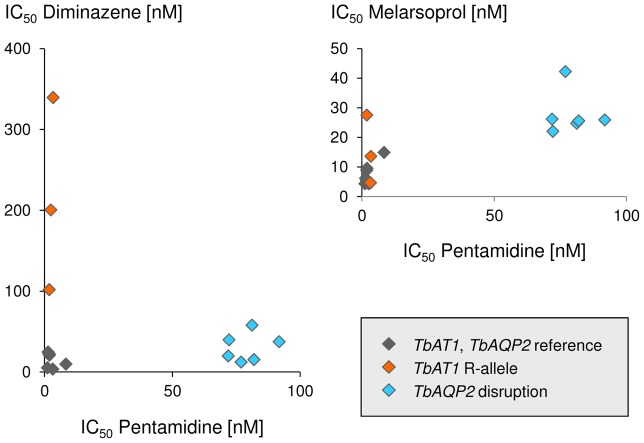
The predominant mechanism of drug resistance in African trypanosomes is decreased drug uptake due to loss-of-function mutations in the genes for the transporters that mediate drug import. The role of transporters as determinants of drug susceptibility is well documented from laboratory-selected Trypanosoma brucei mutants. But clinical isolates, especially of T. b. gambiense, are less amenable to experimental investigation since they do not readily grow in culture without prior adaptation. Here we analyze a selected panel of 16 T. brucei ssp. field isolates that (i) have been adapted to axenic in vitro cultivation and (ii) mostly stem from treatment-refractory cases. For each isolate, we quantify the sensitivity to melarsoprol, pentamidine, and diminazene, and sequence the genomic loci of the transporter genes TbAT1 and TbAQP2. The former encodes the well-characterized aminopurine permease P2 which transports several trypanocides including melarsoprol, pentamidine, and diminazene. We find that diminazene-resistant field isolates of T. b. brucei and T. b. rhodesiense carry the same set of point mutations in TbAT1 that was previously described from lab mutants. Aquaglyceroporin 2 has only recently been identified as a second transporter involved in melarsoprol/pentamidine cross-resistance. Here we describe two different kinds of TbAQP2 mutations found in T. b. gambiense field isolates: simple loss of TbAQP2, or loss of wild-type TbAQP2 allele combined with the formation of a novel type of TbAQP2/3 chimera. The identified mutant T. b. gambiense are 40- to 50-fold less sensitive to pentamidine and 3- to 5-times less sensitive to melarsoprol than the reference isolates. We thus demonstrate for the first time that rearrangements of the TbAQP2/TbAQP3 locus accompanied by TbAQP2 gene loss also occur in the field, and that the T. b. gambiense carrying such mutations correlate with a significantly reduced susceptibility to pentamidine and melarsoprol.
在非洲锥虫中,药物耐药性的主要机制是由于介导药物输入的转运蛋白基因的功能丧失突变,导致药物摄取减少。转运蛋白作为药物敏感性决定因素的作用已在实验室选择的布氏锥虫突变体中得到充分证明。但是,临床分离株,特别是冈比亚锥虫,由于在没有预先适应的情况下不易在培养中生长,因此不太适合进行实验研究。在这里,我们分析了一组经过选择的 16 个布氏锥虫亚种的野外分离株,这些分离株(i)已经适应了体外无细胞培养,并且(ii)主要来自治疗耐药的病例。对于每个分离株,我们定量测定了对米氮平和戊烷脒以及二脒嗪的敏感性,并对转运蛋白基因 TbAT1 和 TbAQP2 的基因组基因座进行了测序。前者编码了特征明确的氨基嘌呤通透酶 P2,该酶可转运多种锥虫药物,包括米氮平、戊烷脒和二脒嗪。我们发现,先前从实验室突变体中描述的米氮平耐药冈比亚锥虫和罗得西亚锥虫的野外分离株携带相同的 TbAT1 点突变集。Aquaglyceroporin 2 最近才被确定为涉及米氮平/戊烷脒交叉耐药的第二种转运蛋白。在这里,我们描述了在冈比亚锥虫野外分离株中发现的两种不同类型的 TbAQP2 突变:简单的 TbAQP2 缺失或野生型 TbAQP2 等位基因缺失与新型 TbAQP2/3 嵌合体的形成相结合。鉴定出的突变体冈比亚锥虫对戊烷脒的敏感性降低了 40-50 倍,对米氮平的敏感性降低了 3-5 倍,与参考分离株相比。因此,我们首次证明了 TbAQP2/TbAQP3 基因座的重排伴随着 TbAQP2 基因缺失也发生在野外,并且携带这种突变的冈比亚锥虫与戊烷脒和米氮平的敏感性显著降低相关。