Di Francesco Alexander, Flamini Stefano, Fiori Filippo, Mastri Franco
Department of Orthopaedic Surgery, San Salvatore Hospital, Via Vetoio, No. 1, 67100 L'Aquila, Italy.
Indian J Orthop. 2013 Sep;47(5):474-81. doi: 10.4103/0019-5413.118203.
Total knee arthroplasty (TKA) can result in major postoperative blood loss which can impact on the recovery and rehabilitation of patients. It also requires expensive transfusions. The purpose of the study was to investigate whether a hemostatic matrix, composed of cross-linked gelatin and a thrombin solution, would reduce blood loss in patients following TKA.
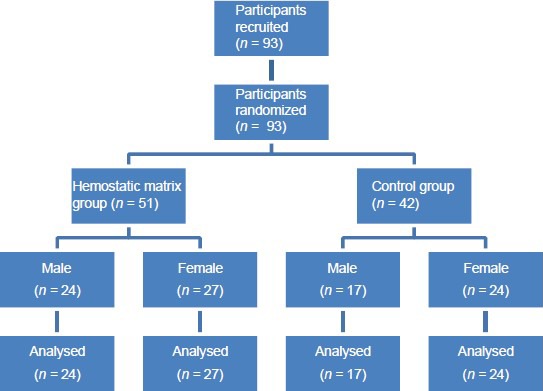
THIS WAS A PROSPECTIVE, RANDOMIZED, CONTROLLED STUDY (TRIAL REGISTRATION: Hospital S. Salvatore L'Aquila ADJ00843) conducted in 93 patients. Criteria for participation were unilateral TKA for osteoarthritis, and a preoperative hemoglobin level >13 g/dL. The outcomes measured were postoperative hemoglobin and hematocrit levels measured at 24h, 72 h, and 7 days. The mean total postoperative blood loss was calculated from drainage volume, patient blood volume, hematocrit, and red blood cell volume. In addition, the drain output within 24 h following surgery and any transfusion requirements were determined.
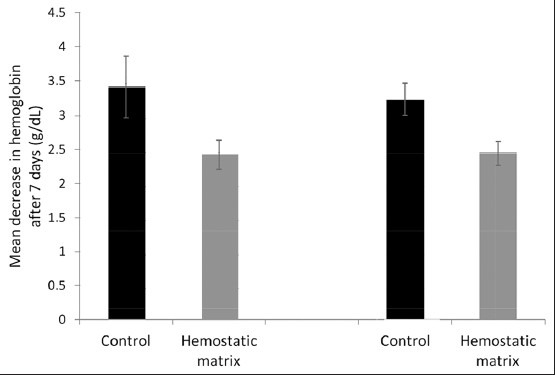
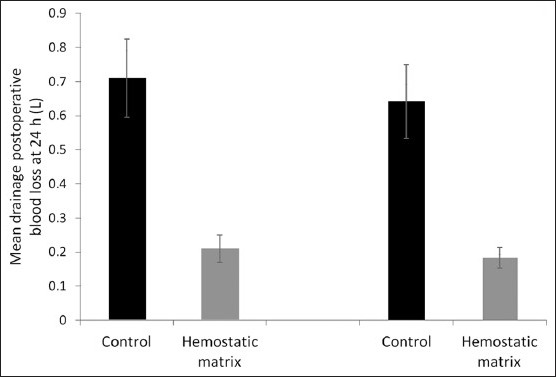
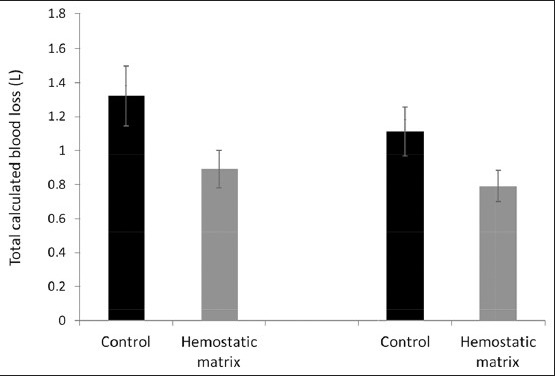
Hemostatic matrix-treated patients (n = 51) showed significant reductions in calculated postoperative blood loss of 32.3% and 28.7% versus control in men and women, respectively (P < 0.01). Postoperative blood loss after 24 h in drain was significantly less with the hemostatic matrix versus control, as were decreases in hemoglobin levels 7 days post-surgery (each P < 0.01). Three patients in the control group required blood transfusion, whereas no blood transfusions were necessary in the hemostatic matrix group.
The use of a hemostatic matrix provides a safe and effective means to reduce blood loss and blood transfusion requirements in TKA.
全膝关节置换术(TKA)可导致术后大量失血,这会影响患者的恢复和康复。此外,该手术还需要昂贵的输血治疗。本研究旨在调查一种由交联明胶和凝血酶溶液组成的止血基质是否能减少TKA患者的失血量。
这是一项针对93例患者的前瞻性、随机对照研究(试验注册号:拉奎拉圣萨尔瓦托雷医院ADJ00843)。纳入标准为因骨关节炎行单侧TKA,且术前血红蛋白水平>13 g/dL。测量的结果包括术后24小时、72小时和7天时的血红蛋白和血细胞比容水平。术后总失血量通过引流液量、患者血容量、血细胞比容和红细胞体积计算得出。此外,还测定了术后24小时内的引流液量以及任何输血需求。
接受止血基质治疗的患者(n = 51)术后计算得出的失血量,男性较对照组显著减少32.3%,女性较对照组显著减少28.7%(P < 0.01)。与对照组相比,使用止血基质后术后24小时引流液中的失血量显著减少,术后7天血红蛋白水平的下降幅度也显著减小(均P < 0.01)。对照组有3例患者需要输血,而止血基质组无需输血。
使用止血基质为减少TKA患者的失血量和输血需求提供了一种安全有效的方法。