Yang Wanjie, Zhao Xuefeng, Feng Qingguo, An Youzhong, Wei Kai, Wang Wei, Li Chang, Cheng Xiuling
Intensive Care Unit, the Fifth Central Hospital of Tianjin, Tianjin, People's Republic of China.
Patient Prefer Adherence. 2013 Oct 8;7:1041-5. doi: 10.2147/PPA.S52122. eCollection 2013.
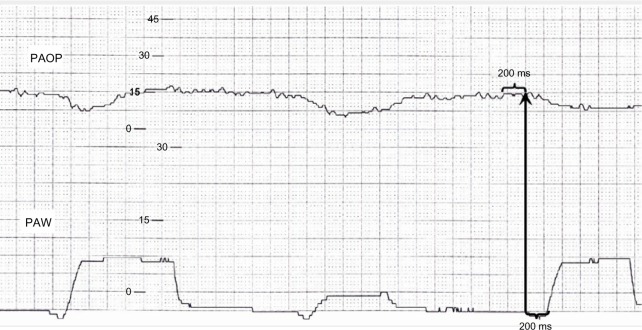
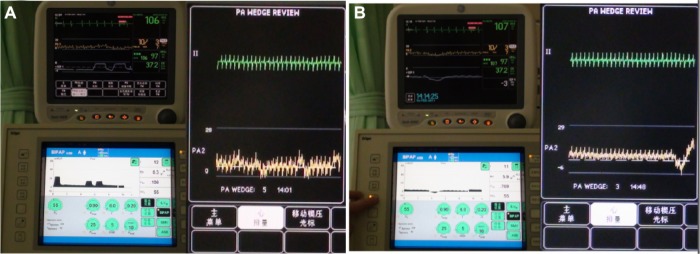
To accurately measure the end-expiratory pulmonary artery wedge pressure (PAWP) with the "expiration holding" function on the ventilator and the "pulmonary artery wedge pressure review" software on the monitor.
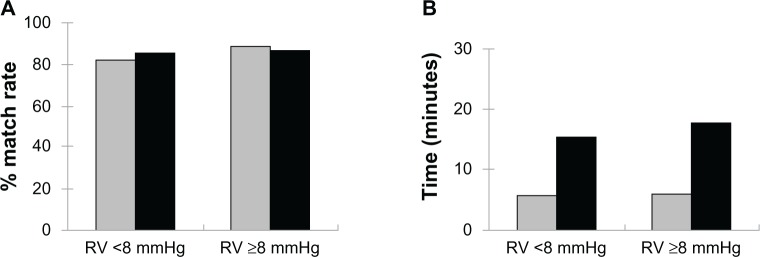
Fifty prospective measurements were made on 12 patients undergoing pulmonary artery catheter and mechanical ventilation. All measurements were divided into <8 mmHg or ≥8 mmHg subgroups according to respiratory variability, and they were then subdivided into either an airway pressure display measurement group (AM group) or an expiration holding (EH) group for comparison.
In all measurements, the two groups showed similar levels of accuracy; however, for the time spent for measurement, the EH group was much faster than the airway pressure display measurement group (P<0.001). Additionally, the EH group was associated with lower medical costs.
The expiration holding approach measured the PAWP more accurately, more quickly, and with reduced costs in comparison to the airway pressure display approach.
利用呼吸机的“呼气末屏气”功能和监护仪上的“肺动脉楔压回顾”软件准确测量呼气末肺动脉楔压(PAWP)。
对12例接受肺动脉导管检查和机械通气的患者进行了50次前瞻性测量。所有测量根据呼吸变异性分为<8 mmHg或≥8 mmHg亚组,然后再细分为气道压力显示测量组(AM组)或呼气末屏气(EH)组进行比较。
在所有测量中,两组显示出相似的准确度水平;然而,就测量所用时间而言,EH组比气道压力显示测量组快得多(P<0.001)。此外,EH组的医疗成本更低。
与气道压力显示法相比,呼气末屏气法测量PAWP更准确、更快且成本更低。