De Bock Marijke, Kerrebrouck Marianne, Wang Nan, Leybaert Luc
Physiology Group, Department of Basic Medical Sciences, Ghent University Ghent, Belgium.
Front Pharmacol. 2013 Sep 26;4:120. doi: 10.3389/fphar.2013.00120.
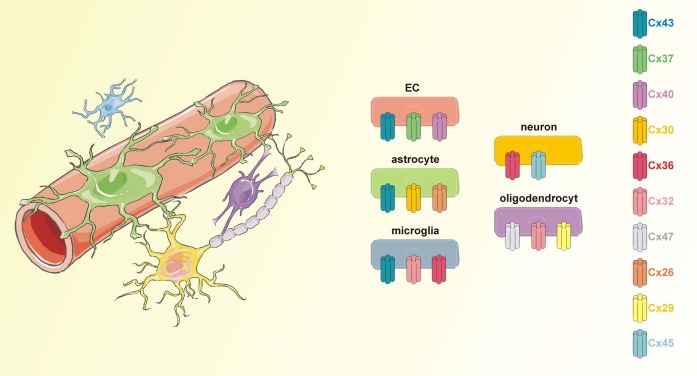
The coordination of tissue function is mediated by gap junctions (GJs) that enable direct cell-cell transfer of metabolic and electric signals. GJs are formed by connexins of which Cx43 is most widespread in the human body. In the brain, Cx43 GJs are mostly found in astroglia where they coordinate the propagation of Ca(2+) waves, spatial K(+) buffering, and distribution of glucose. Beyond its role in direct intercellular communication, Cx43 also forms unapposed, non-junctional hemichannels in the plasma membrane of glial cells. These allow the passage of several neuro- and gliotransmitters that may, combined with downstream paracrine signaling, complement direct GJ communication among glial cells and sustain glial-neuronal signaling. Mutations in the GJA1 gene encoding Cx43 have been identified in a rare, mostly autosomal dominant syndrome called oculodentodigital dysplasia (ODDD). ODDD patients display a pleiotropic phenotype reflected by eye, hand, teeth, and foot abnormalities, as well as craniofacial and bone malformations. Remarkably, neurological symptoms such as dysarthria, neurogenic bladder (manifested as urinary incontinence), spasticity or muscle weakness, ataxia, and epilepsy are other prominent features observed in ODDD patients. Over 10 mutations detected in patients diagnosed with neurological disorders are associated with altered functionality of Cx43 GJs/hemichannels, but the link between ODDD-related abnormal channel activities and neurologic phenotype is still elusive. Here, we present an overview on the nature of the mutants conveying structural and functional changes of Cx43 channels and discuss available evidence for aberrant Cx43 GJ and hemichannel function. In a final step, we examine the possibilities of how channel dysfunction may lead to some of the neurological manifestations of ODDD.
组织功能的协调由间隙连接(GJ)介导,间隙连接能够实现代谢和电信号在细胞间的直接传递。间隙连接由连接蛋白形成,其中Cx43在人体中分布最为广泛。在大脑中,Cx43间隙连接主要存在于星形胶质细胞中,它们协调钙离子(Ca(2+))波的传播、空间钾离子(K(+))缓冲以及葡萄糖的分布。除了在直接细胞间通讯中的作用外,Cx43还在胶质细胞膜上形成未对接的、非连接性的半通道。这些半通道允许几种神经递质和神经胶质递质通过,它们可能与下游旁分泌信号传导相结合,补充胶质细胞间的直接间隙连接通讯,并维持胶质-神经元信号传导。在一种罕见的、主要为常染色体显性遗传的综合征——眼牙指发育不良(ODDD)中,已鉴定出编码Cx43的GJA1基因突变。ODDD患者表现出多效性表型,表现为眼睛、手部、牙齿和足部异常,以及颅面和骨骼畸形。值得注意的是,构音障碍、神经源性膀胱(表现为尿失禁)、痉挛或肌肉无力、共济失调和癫痫等神经症状是ODDD患者中观察到的其他突出特征。在被诊断患有神经疾病的患者中检测到的10多种突变与Cx43间隙连接/半通道的功能改变有关,但ODDD相关异常通道活动与神经表型之间的联系仍然难以捉摸。在这里,我们概述了传达Cx43通道结构和功能变化的突变体的性质,并讨论了Cx43间隙连接和半通道功能异常的现有证据。在最后一步中,我们研究了通道功能障碍可能导致ODDD某些神经表现的可能性。