Department of Experimental Psychology, Centre for Neuroscience in Education University of Cambridge, UK ; Laboratoire Cognition, Langage et Développement, Centre de Recherche Cognition et Neurosciences, Université Libre de Bruxelles (ULB) Bruxelles, Belgium.
Front Psychol. 2013 Oct 10;4:715. doi: 10.3389/fpsyg.2013.00715. eCollection 2013.
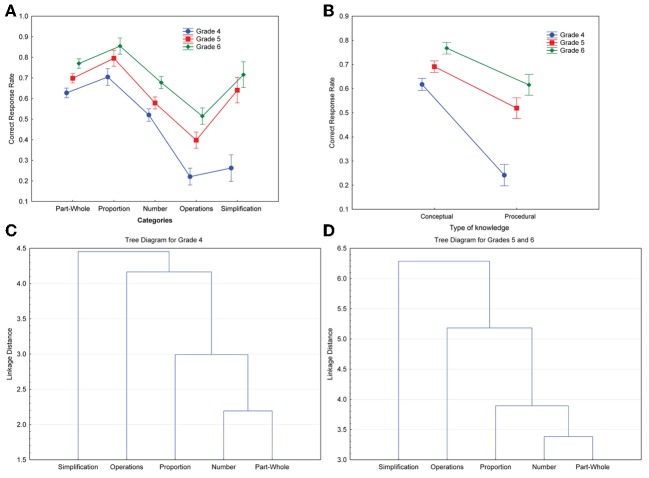
Fractions are well known to be difficult to learn. Various hypotheses have been proposed in order to explain those difficulties: fractions can denote different concepts; their understanding requires a conceptual reorganization with regard to natural numbers; and using fractions involves the articulation of conceptual knowledge with complex manipulation of procedures. In order to encompass the major aspects of knowledge about fractions, we propose to distinguish between conceptual and procedural knowledge. We designed a test aimed at assessing the main components of fraction knowledge. The test was carried out by fourth-, fifth- and sixth-graders from the French Community of Belgium. The results showed large differences between categories. Pupils seemed to master the part-whole concept, whereas numbers and operations posed problems. Moreover, pupils seemed to apply procedures they do not fully understand. Our results offer further directions to explain why fractions are amongst the most difficult mathematical topics in primary education. This study offers a number of recommendations on how to teach fractions.
分数是众所周知的难以学习。为了解释这些困难,提出了各种假设:分数可以表示不同的概念;它们的理解需要对自然数进行概念上的重新组织;使用分数需要将概念知识与复杂的程序操作联系起来。为了涵盖分数知识的主要方面,我们建议区分概念知识和程序知识。我们设计了一个测试,旨在评估分数知识的主要组成部分。该测试由来自比利时法语社区的四年级、五年级和六年级学生进行。结果表明,各分类之间存在很大差异。学生似乎掌握了部分整体的概念,而数字和运算则存在问题。此外,学生似乎在应用他们不完全理解的程序。我们的结果提供了进一步的解释,说明为什么分数是小学教育中最困难的数学主题之一。这项研究提出了一些关于如何教授分数的建议。