Institute of Pathology, University Hospital Heidelberg, Heidelberg, Germany.
Br J Cancer. 2013 Nov 12;109(10):2665-74. doi: 10.1038/bjc.2013.610. Epub 2013 Oct 17.
Biliary tract cancers (BTC) are relatively rare malignant tumours with poor prognosis. It is known from other solid neoplasms that antitumour inflammatory response has an impact on tumour behaviour and patient outcome. The aim of this study was to provide a comprehensive characterisation of antitumour inflammatory response in human BTC.
Tumour-infiltrating T lymphocytes (CD4+, CD8+, and Foxp3+), natural killer cells (perforin+), B lymphocytes (CD20+), macrophages (CD68+) as well as mast cells (CD117+) were assessed by immunohistochemistry in 375 BTC including extrahepatic (ECC; n=157), intrahepatic (ICC; n=149), and gallbladder (GBAC; n=69) adenocarcinomas. Overall and intraepithelial quantity of tumour-infiltrating immune cells was analysed. Data were correlated with clinicopathological variables and patient survival.
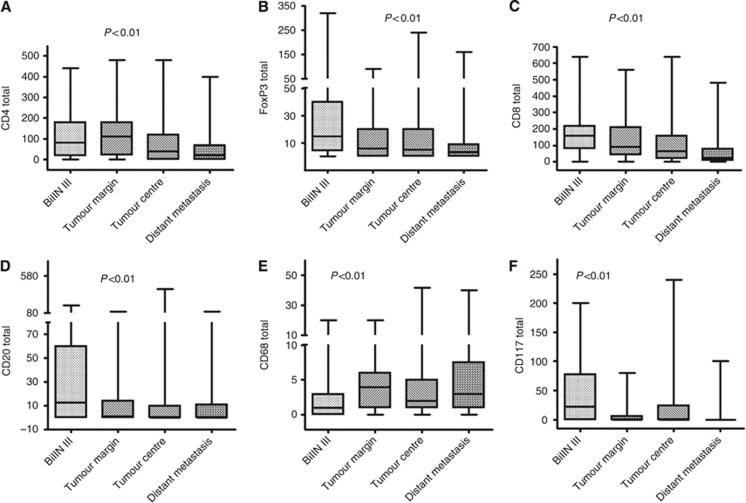
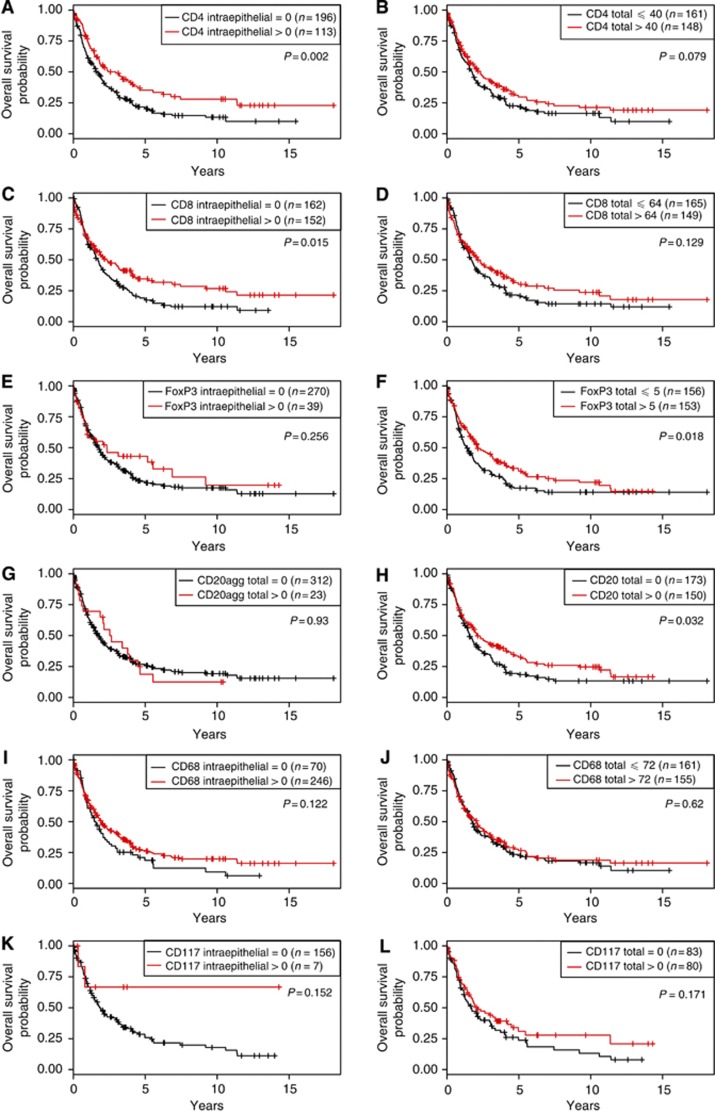
The most prevalent inflammatory cell type in BTC was the T lymphocyte. Components of the adaptive immune response decreased, whereas innate immune response components increased significantly in the biliary intraepithelial neoplasia - primary carcinoma - metastasis sequence. BTC patients with intraepithelial tumour-infiltrating CD4+, CD8+, and Foxp3+ T lymphocytes showed a significantly longer overall survival. Number of total intraepithelial tumour-infiltrating Foxp3+ regulatory T lymphocytes (HR: 0.492, P=0.002) and CD4+ T lymphocytes (HR: 0.595, P=0.008) were tumour grade- and UICC-stage-independent prognosticators. The subtype-specific evaluation revealed that the tumour-infiltrating lymphocytic infiltrate is a positive outcome predictor in ECC and GBAC but not in ICC.
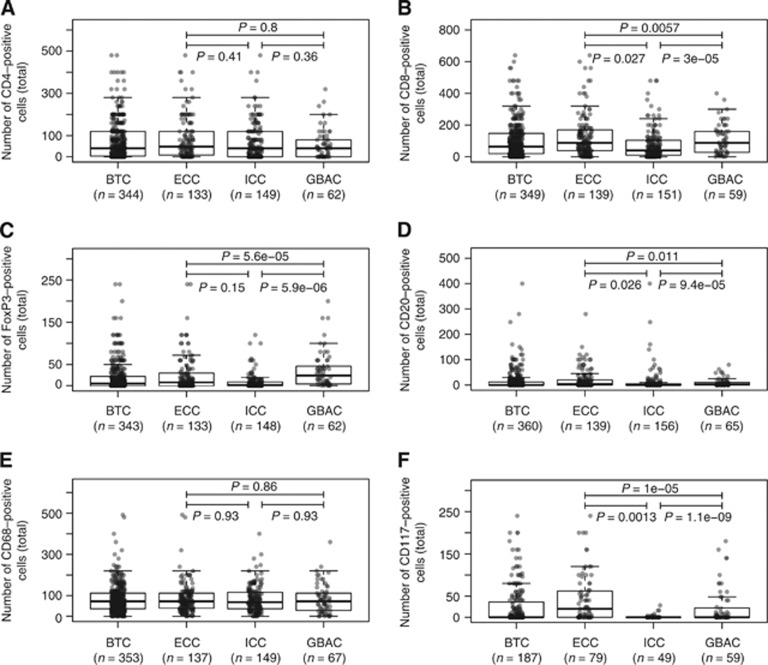
Our findings characterise the immune response in cholangiocarcinogenesis and identify inflammatory cell types that influence the outcome of BTC patients. Further, we show that BTC subtypes show relevant differences with respect to density, quality of inflammation, and impact on patient survival.
胆道癌(BTC)是一种相对罕见的恶性肿瘤,预后较差。从其他实体肿瘤可知,抗肿瘤炎症反应会影响肿瘤的行为和患者的预后。本研究的目的是全面描述人类 BTC 的抗肿瘤炎症反应。
采用免疫组织化学法检测 375 例 BTC 组织中肿瘤浸润性 T 淋巴细胞(CD4+、CD8+和 Foxp3+)、自然杀伤细胞(穿孔素+)、B 淋巴细胞(CD20+)、巨噬细胞(CD68+)和肥大细胞(CD117+)。包括肝外(ECC;n=157)、肝内(ICC;n=149)和胆囊(GBAC;n=69)腺癌。分析肿瘤浸润免疫细胞的总体和上皮内数量。将数据与临床病理变量和患者生存相关联。
BTC 中最常见的炎症细胞类型是 T 淋巴细胞。适应性免疫反应的成分减少,而固有免疫反应的成分在胆管上皮内肿瘤-原发性癌-转移序列中显著增加。肿瘤上皮内浸润 CD4+、CD8+和 Foxp3+T 淋巴细胞的 BTC 患者总生存时间明显延长。总上皮内肿瘤浸润 Foxp3+调节性 T 淋巴细胞(HR:0.492,P=0.002)和 CD4+T 淋巴细胞(HR:0.595,P=0.008)的数量是肿瘤分级和 UICC 分期独立的预后因素。亚组特异性评估显示,肿瘤浸润性淋巴细胞浸润是 ECC 和 GBAC 患者的阳性预后预测因子,但在 ICC 中并非如此。
我们的研究结果描述了胆管癌发生过程中的免疫反应,并确定了影响 BTC 患者预后的炎症细胞类型。此外,我们还发现,BTC 亚型在密度、炎症质量和对患者生存的影响方面存在显著差异。