Department of Experimental Medicine, University of Rome "Tor Vergata", Via Montpellier 1, 00133, Rome, Italy.
Infection. 2014 Feb;42(1):61-71. doi: 10.1007/s15010-013-0510-3. Epub 2013 Oct 22.
We have developed a sequencing assay for determining the usage of the genotypic HIV-1 co-receptor using peripheral blood mononuclear cell (PBMC) DNA in virologically suppressed HIV-1 infected patients. Our specific aims were to (1) evaluate the efficiency of V3 sequences in B versus non-B subtypes, (2) compare the efficiency of V3 sequences and tropism prediction using whole blood and PBMCs for DNA extraction, (3) compare the efficiency of V3 sequences and tropism prediction using a single versus a triplicate round of amplification.
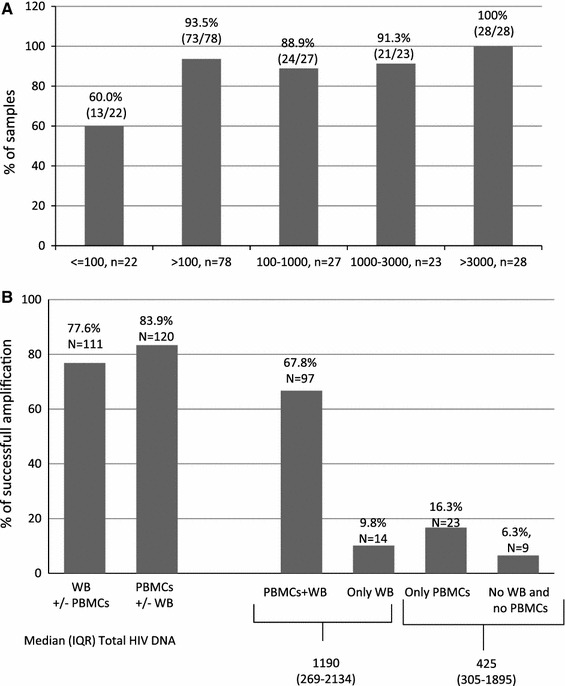
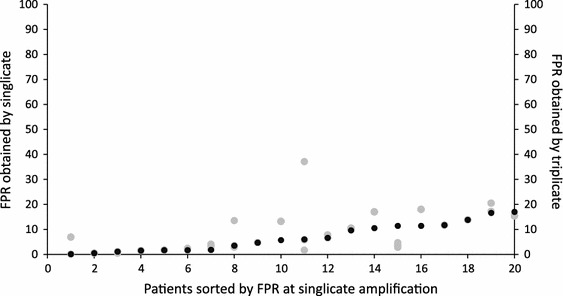
The overall rate of successful V3 sequences ranged from 100 % in samples with >3,000 copies HIV-1 DNA/10(6) PBMCs to 60 % in samples with <100 copies total HIV-1 DNA /10(6) PBMCs. Analysis of 143 paired PBMCs and whole-blood samples showed successful V3 sequences rates of 77.6 % for PBMCs and 83.9 % for whole blood. These rates are in agreement with the tropism prediction obtained using the geno2pheno co-receptor algorithm, namely, 92.1 % with a false-positive rate (FPR) of 10 or 20 % and of 96.5 % with an FPR of 5.75 %. The agreement between tropism prediction values using single versus triplicate amplification was 98.2 % (56/57) of patients using an FPR of 20 % and 92.9 % (53/57) using an FPR of 10 or 5.75 %. For 63.0 % (36/57) of patients, the FPR obtained via the single amplification procedure was superimposable to all three FPRs obtained by triplicate amplification.
Our results show the feasibility and consistency of genotypic testing on HIV-1 DNA tropism, supporting its possible use for selecting patients with suppressed plasma HIV-1 RNA as candidates for CCR5-antagonist treatment. The high agreement between tropism prediction by single and triple amplification does not support the use of triplicate amplification in clinical practice.
我们开发了一种测序分析方法,用于检测使用外周血单核细胞(PBMC)DNA 的基因型 HIV-1 辅助受体的使用情况,该方法适用于病毒学抑制的 HIV-1 感染患者。我们的具体目标是:(1)评估 V3 序列在 B 型和非 B 型亚群中的效率;(2)比较使用全血和 PBMC 进行 DNA 提取时 V3 序列和趋化因子受体预测的效率;(3)比较单轮和三轮扩增时 V3 序列和趋化因子受体预测的效率。
V3 序列成功的总体比率范围为,HIV-1 DNA/10(6)PBMC 大于 3000 拷贝的样本中为 100%,HIV-1 DNA/10(6)PBMC 小于 100 拷贝的样本中为 60%。对 143 对 PBMC 和全血样本进行分析,结果显示 PBMC 中 V3 序列的成功率为 77.6%,全血中的成功率为 83.9%。这些结果与使用 geno2pheno 共受体算法获得的趋化因子受体预测结果一致,即假阳性率(FPR)为 10%或 20%时为 92.1%,FPR 为 5.75%时为 96.5%。使用单轮和三轮扩增时,预测值之间的一致性为,FPR 为 20%时,57 例患者中有 98.2%(56/57),FPR 为 10%或 5.75%时,57 例患者中有 92.9%(53/57)。对于 57 例患者中的 63.0%(36/57),通过单轮扩增获得的 FPR 与通过三轮扩增获得的所有三个 FPR 重叠。
我们的结果表明,对 HIV-1 DNA 趋化因子受体进行基因检测是可行且一致的,支持将其用于选择病毒学抑制的血浆 HIV-1 RNA 患者作为 CCR5 拮抗剂治疗的候选者。单轮和三轮扩增之间的高预测值一致性不支持在临床实践中使用三轮扩增。