Academic Radiation Oncology Department & University Lille II, CLCC Oscar Lambret, Lille, France.
PLoS One. 2013 Oct 11;8(10):e77472. doi: 10.1371/journal.pone.0077472. eCollection 2013.
Stereotactic body radiation therapy (SBRT) for hepatocellular carcinoma (HCC) has been evaluated in several recent studies. The CyberKnife(®) is an SBRT system that allows for real-time tracking of the tumor. The purpose of this study was to evaluate the prognostic factors for local control and overall survival following this treatment.
75 patients with 96 liver-confined HCC were treated with SBRT at the Oscar Lambret Comprehensive Cancer Center. Fiducials were implanted in the liver before treatment and were used as markers to track the lesion's movement. Treatment response was scored according to RECIST v1.1. Local control and overall survival were calculated using the Kaplan and Meier method. A stepwise multivariate analysis (Cox regression) of prognostic factors was performed for local control and overall survival.
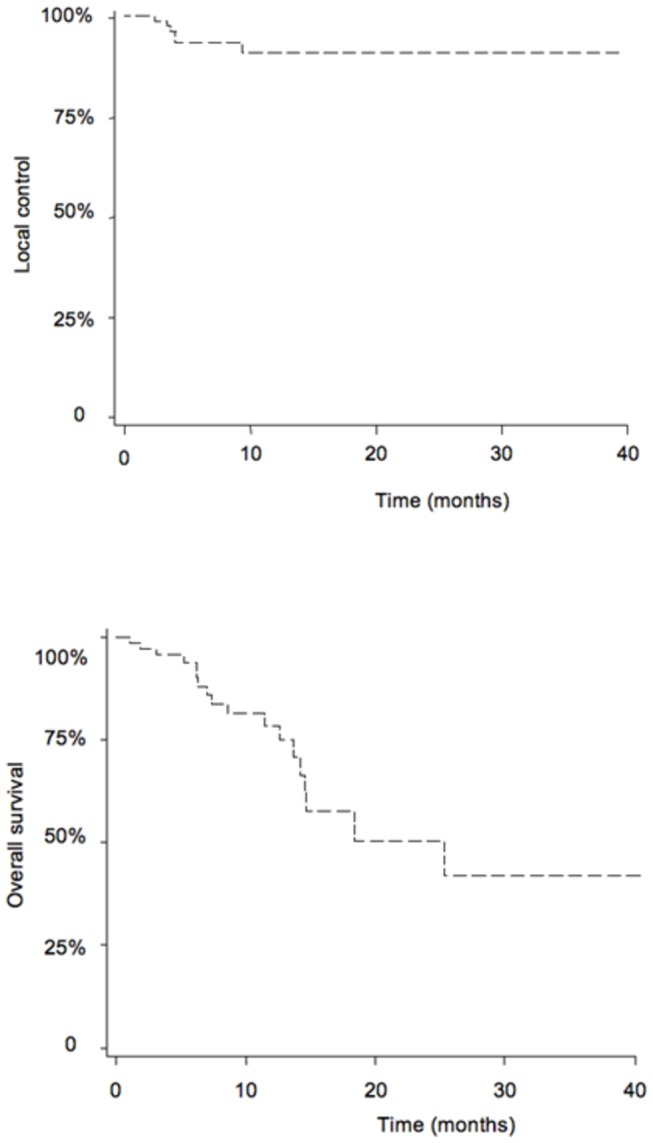
There were 67 patients with Child-Turcotte-Pugh (CTP) Class A and eight patients with CTP Class B. Treatment was administered in three sessions. A total dose of 40-45 Gy to the 80% isodose line was delivered. The median follow-up was 10 months (range, 3-49 months). The local control rate was 89.8% at 1 and 2 years. Overall survival was 78.5% and 50.4% at 1 and 2 years, respectively. Toxicity mainly consisted of grade 1 and grade 2 events. Higher alpha-fetoprotein (aFP) levels were associated with less favorable local control (HR=1.001; 95% CI [1.000, 1.002]; p=0.0063). A higher dose was associated with better local control (HR=0.866; 95% CI [0.753, 0.996]; p=0.0441). A Child-Pugh score higher than 5 was associated with worse overall survival (HR= 3.413; 95% CI [1.235, 9.435]; p=0.018).
SBRT affords good local tumor control and higher overall survival rates than other historical controls (best supportive care or sorafenib). High aFP levels were associated with lesser local control, but a higher treatment dose improved local control.
立体定向体部放射治疗(SBRT)已在几项最近的研究中评估了肝细胞癌(HCC)的疗效。CyberKnife(®)是一种 SBRT 系统,可实时跟踪肿瘤。本研究的目的是评估这种治疗后局部控制和总生存率的预后因素。
75 例 96 例肝局限性 HCC 患者在 Oscar Lambret 综合癌症中心接受 SBRT 治疗。在治疗前植入肝内基准标记物,并用作跟踪病变运动的标记物。根据 RECIST v1.1 标准对治疗反应进行评分。使用 Kaplan 和 Meier 方法计算局部控制和总生存率。对局部控制和总生存率进行了逐步多因素分析(Cox 回归)。
67 例患者为 Child-Turcotte-Pugh(CTP)A级,8 例患者为 CTP B 级。治疗分 3 次进行。80%等剂量线给予 40-45 Gy 的总剂量。中位随访时间为 10 个月(范围 3-49 个月)。1 年和 2 年的局部控制率分别为 89.8%和 81.6%。总体生存率分别为 78.5%和 50.4%。1 年和 2 年。毒性主要为 1 级和 2 级事件。较高的甲胎蛋白(aFP)水平与局部控制不良相关(HR=1.001;95%CI[1.000,1.002];p=0.0063)。较高的剂量与更好的局部控制相关(HR=0.866;95%CI[0.753,0.996];p=0.0441)。Child-Pugh 评分大于 5 与总体生存率降低相关(HR=3.413;95%CI[1.235,9.435];p=0.018)。
SBRT 提供了比其他历史对照(最佳支持治疗或索拉非尼)更好的局部肿瘤控制和更高的总生存率。较高的 aFP 水平与局部控制较差相关,但较高的治疗剂量可改善局部控制。