Department of Obstetrics and Gynecology, Osaka University Graduate School of Medicine, Osaka, Japan.
J Gynecol Oncol. 2013 Oct;24(4):321-9. doi: 10.3802/jgo.2013.24.4.321. Epub 2013 Oct 2.
To investigate the utility of serum squamous cell carcinoma antigen (SCC-Ag) levels upon the diagnosis of recurrent cervical cancer for decision making in patient management.
Clinical records from 167 cervical cancer patients who developed recurrence between April 1996 and September 2010 were reviewed. A Cox proportional hazards regression model was used to investigate the prognostic significance of serum SCC-Ag levels at the time of recurrence. The effects of various salvage treatments on survival outcomes of recurrent cervical cancer were examined with respect to serum SCC-Ag levels.
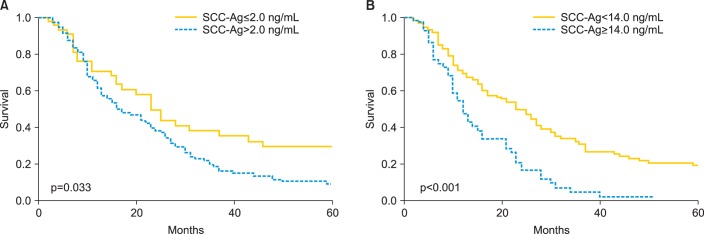
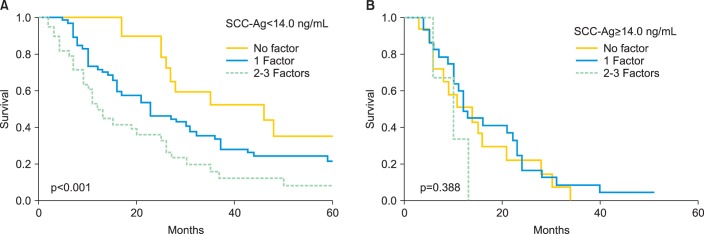
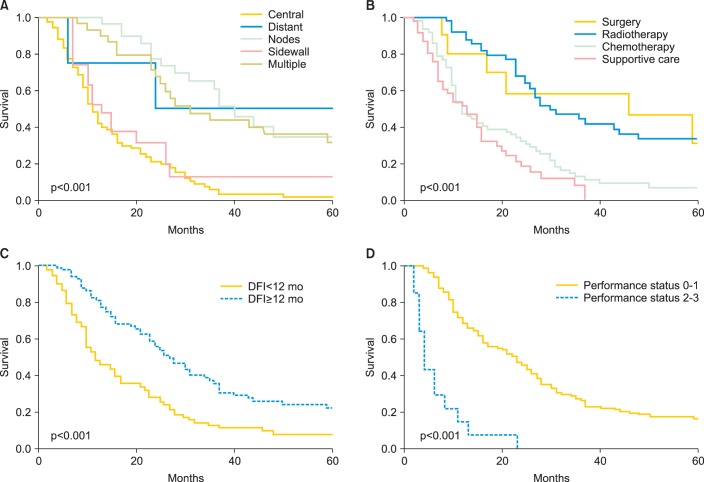
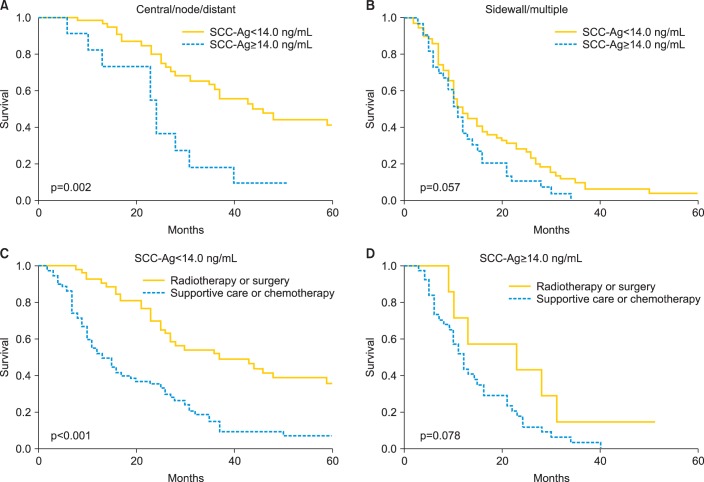
Serum SCC-Ag levels were elevated (>2.0 ng/mL) in 125 patients (75%) when recurrence was diagnosed. These patients exhibited significantly shorter postrecurrence survival than those with normal SCC-Ag levels (log-rank; p=0.033). Multivariate analyses revealed that an elevated serum SCC-Ag level was an independent prognostic factor for poor postrecurrence survival. In patients with SCC-Ag levels <14.0 ng/mL, radiotherapy or surgery resulted in improved survival compared with chemotherapy or supportive care. In contrast, in patients with SCC-Ag levels of ≥14.0 ng/mL, salvage treatment with radiotherapy had only a minimal impact on postrecurrence survival.
The serum SCC-Ag level measured when cervical cancer recurrence is diagnosed can be useful for deciding upon the appropriate salvage treatment.
研究血清鳞状细胞癌抗原(SCC-Ag)水平在复发性宫颈癌诊断中的应用,为患者管理中的决策提供依据。
回顾了 1996 年 4 月至 2010 年 9 月期间发生复发的 167 例宫颈癌患者的临床记录。采用 Cox 比例风险回归模型探讨复发时血清 SCC-Ag 水平的预后意义。根据血清 SCC-Ag 水平,考察了各种挽救性治疗对复发性宫颈癌生存结局的影响。
在诊断复发时,125 例(75%)患者的血清 SCC-Ag 水平升高(>2.0ng/mL)。这些患者的复发后生存时间明显短于 SCC-Ag 水平正常的患者(对数秩检验;p=0.033)。多因素分析显示,血清 SCC-Ag 水平升高是复发后生存不良的独立预后因素。在 SCC-Ag 水平<14.0ng/mL 的患者中,与化疗或支持治疗相比,放疗或手术可改善生存。相比之下,在 SCC-Ag 水平≥14.0ng/mL 的患者中,放疗的挽救性治疗对复发后生存的影响很小。
在诊断宫颈癌复发时测量血清 SCC-Ag 水平可用于决定适当的挽救性治疗。