Health Behaviour Research Centre, Department of Epidemiology and Public Health, University College London, London WC1E 6BT, UK.
King's College London Promoting Early Presentation Group, King's College London, London SE1 3QD, UK.
Br J Cancer. 2014 Jan 7;110(1):12-8. doi: 10.1038/bjc.2013.684. Epub 2013 Oct 31.
Not recognising a symptom as suspicious is a common reason given by cancer patients for delayed help-seeking; but inevitably this is retrospective. We therefore investigated associations between recognition of warning signs for breast, colorectal and lung cancer and anticipated time to help-seeking for symptoms of each cancer.
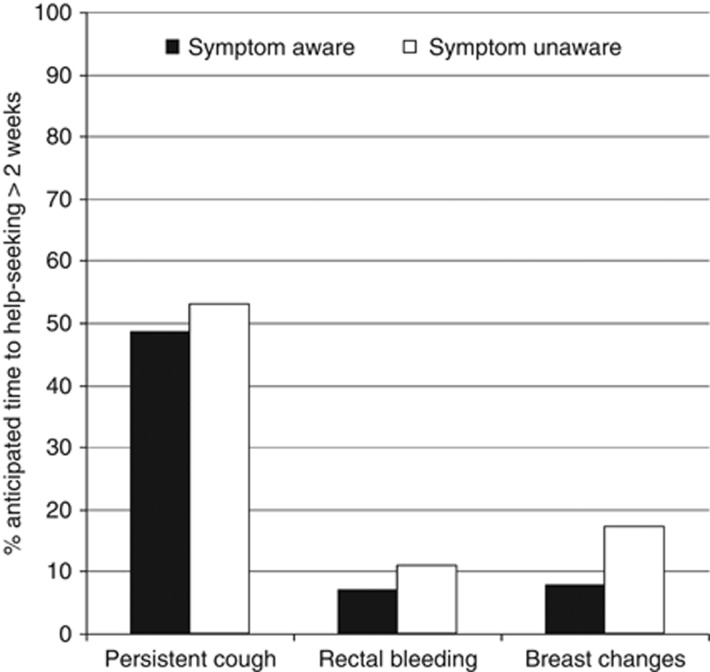
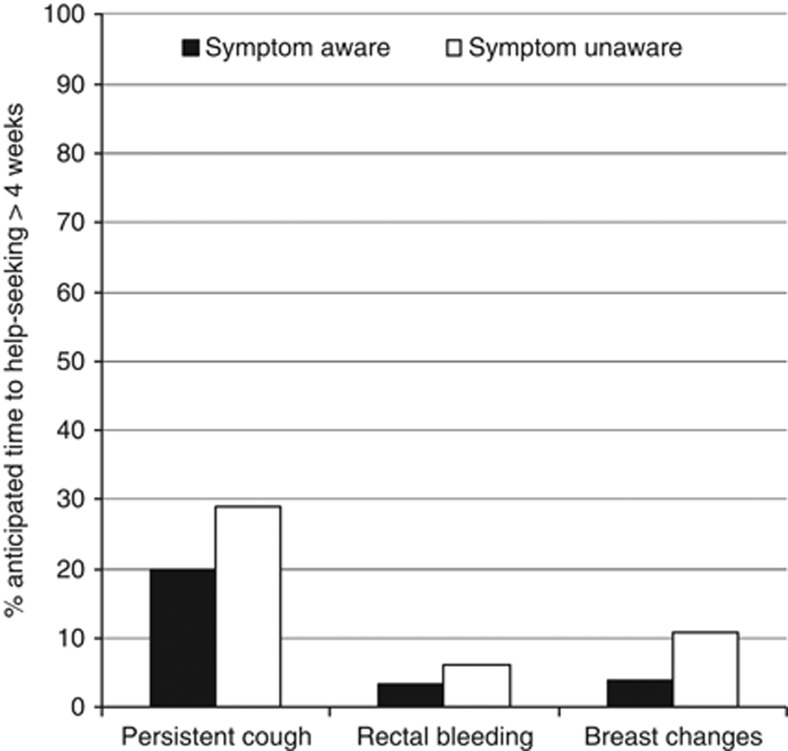
Computer-assisted telephone interviews were conducted with a population-representative sample (N=6965) of UK adults age ≥ 50 years, using the Awareness and Beliefs about Cancer scale. Anticipated time to help-seeking for persistent cough, rectal bleeding and breast changes was categorised as >2 vs ≤ 2 weeks. Recognition of persistent cough, unexplained bleeding and unexplained lump as cancer warning signs was assessed (yes/no). Associations between recognition and help-seeking were examined for each symptom controlling for demographics and perceived ease of health-care access.
For each symptom, the odds of waiting for >2 weeks were significantly increased in those who did not recognise the related warning sign: breast changes: OR=2.45, 95% CI 1.47-4.08; rectal bleeding: OR=1.77, 1.36-2.30; persistent cough: OR=1.30, 1.17-1.46, independent of demographics and health-care access.
Recognition of warning signs was associated with anticipating faster help-seeking for potential symptoms of cancer. Strategies to improve recognition are likely to facilitate earlier diagnosis.
未能识别出可疑症状是癌症患者寻求帮助时延迟的常见原因;但这不可避免地是回顾性的。因此,我们研究了对乳腺癌、结直肠癌和肺癌的警告信号的识别与对每种癌症症状的预期求助时间之间的关联。
使用 Awareness and Beliefs about Cancer 量表,对英国≥50 岁的具有代表性的成年人(N=6965)进行了计算机辅助电话访谈。将持续咳嗽、直肠出血和乳房变化的预期求助时间分为>2 周和≤2 周。评估了对持续咳嗽、不明原因出血和不明原因肿块作为癌症警告信号的识别(是/否)。在控制人口统计学和感知医疗保健可及性的情况下,研究了对每种症状的识别与求助之间的关联。
对于每种症状,未识别出相关警告信号的人等待>2 周的可能性显著增加:乳房变化:OR=2.45,95%CI 1.47-4.08;直肠出血:OR=1.77,1.36-2.30;持续咳嗽:OR=1.30,1.17-1.46,独立于人口统计学和医疗保健可及性。
对警告信号的识别与对潜在癌症症状的更快求助的预期相关。改善识别的策略可能有助于更早的诊断。