Xu Xianglai, Li Shiqi, Lin Yiwei, Chen Hong, Hu Zhenghui, Mao Yeqing, Xu Xin, Wu Jian, Zhu Yi, Zheng Xiangyi, Luo Jindan, Xie Liping
Department of Urology, the First Affiliated Hospital, Zhejiang University, Hangzhou, Zhejiang Province, China.
J Transl Med. 2013 Nov 2;11:276. doi: 10.1186/1479-5876-11-276.
Increasing evidence has suggested that dysregulation of certain microRNAs (miRNAs) may contribute to human disease including carcinogenesis and tumor metastasis in human. miR-124-3p is down-regulated in various cancers, and modulates proliferation and aggressiveness of cancer cells. However, the roles of miR-124-3p in human bladder cancer are elusive. Thus, this study was conducted to investigate the biological functions and its molecular mechanisms of miR-124-3p in human bladder cancer cell lines, discussing whether it has a potential to be a therapeutic biomarker of bladder cancer.
Three human bladder cancer cell lines and samples from ten patients with bladder cancer were analyzed for the expression of miR-124-3p by quantitative RT--PCR. Exogenetic overexpression of miR-124-3p was established by transfecting mimics into T24, UM-UC-3 and J82 cells, after that cell proliferation and cell cycle were assessed by MTT assay, flow cytometry and Colony-forming assay. Cell motility and invasion ability were evaluated by wound healing assay and transwell assay. Tissue microarray, and immunohistochemistry with antibodies against ROCK1, MMP2 and MMP9 was performed using the peroxidase and DAB methods. The target gene of miR-124-3p was determined by luciferase assays, quantitative RT--PCR and western blot. The regulation of epithelial-to-mesenchymal transition by miR-124-3p was analyzed by western blot.
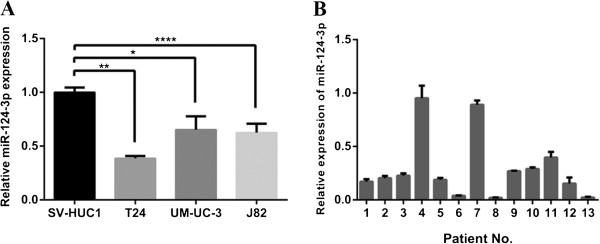
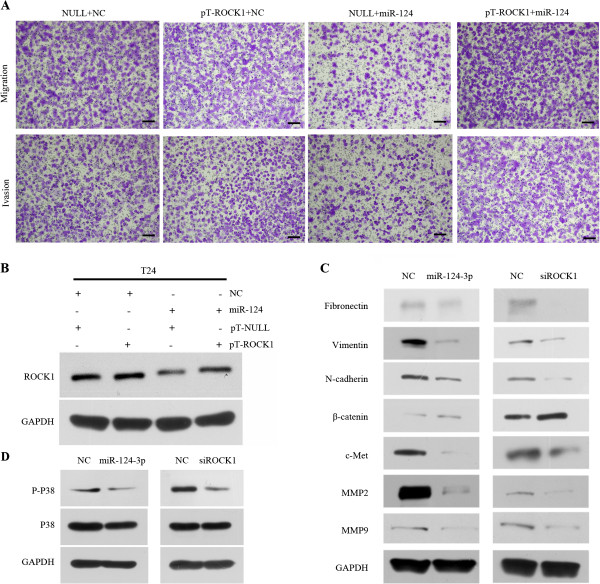
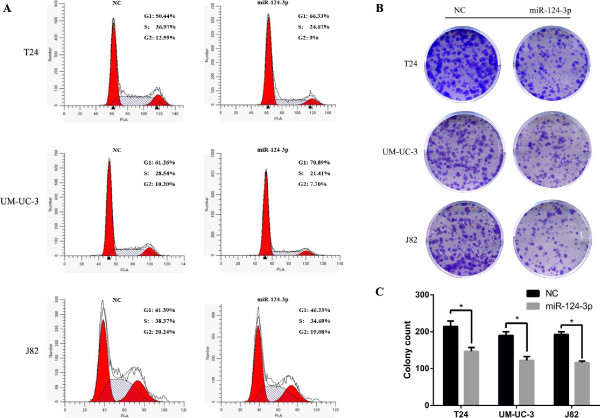
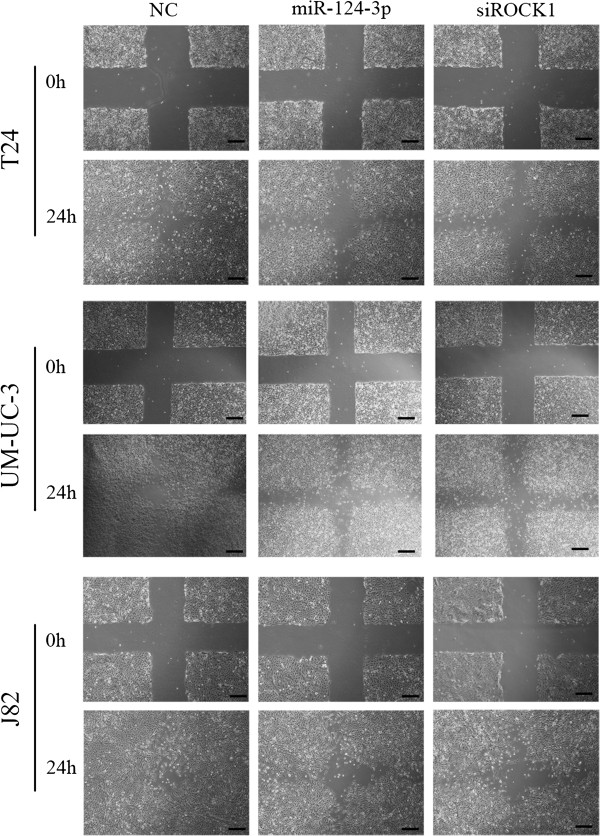
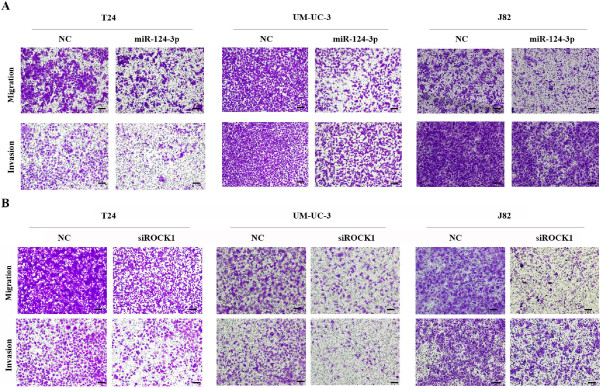
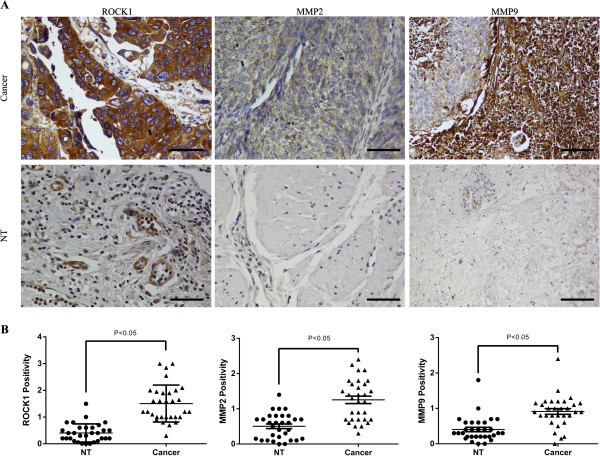
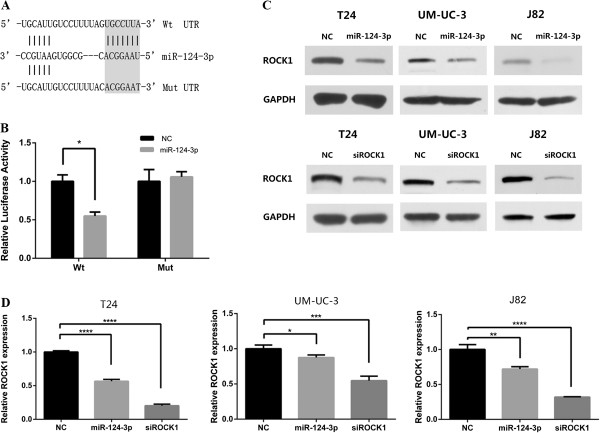
miR-124-3p is frequently down-regulated in bladder cancer both in three bladder cancer cell lines, T24, UM-UC-3, J82 and clinical samples. Overexpression of miR-124-3p induced G1-phase arrest in T24, UM-UC-3 and J82 cell lines and suppressed cell growth in colony-forming assay. miR-124-3p significantly repressed the capability of migration and invasion of bladder cancer cells. In addition, ROCK1 was identified as a new target of miR-124-3p. ROCK1, MMP2, MMP9 were up-regulated in bladder cancer tissues. Furthermore, we demonstrated miR-124-3p could inhibit bladder cancer cell epithelial mesenchymal transfer, and regulated the expression of c-Met, MMP2, MMP9.
miR-124-3p can repress the migration and invasion of bladder cancer cells via regulating ROCK1. Our data indicate that miR-124-3p could be a tumor suppressor and may have a potential to be a diagnostics or predictive biomarker in bladder cancer.
越来越多的证据表明,某些微小RNA(miRNA)失调可能导致人类疾病,包括人类的致癌作用和肿瘤转移。miR-124-3p在多种癌症中表达下调,并调节癌细胞的增殖和侵袭性。然而,miR-124-3p在人类膀胱癌中的作用尚不清楚。因此,本研究旨在探讨miR-124-3p在人膀胱癌细胞系中的生物学功能及其分子机制,探讨其是否有潜力成为膀胱癌的治疗生物标志物。
采用定量RT-PCR分析三种人膀胱癌细胞系和十例膀胱癌患者样本中miR-124-3p的表达。通过将模拟物转染到T24、UM-UC-3和J82细胞中建立miR-124-3p的外源性过表达,然后通过MTT法、流式细胞术和集落形成试验评估细胞增殖和细胞周期。通过伤口愈合试验和Transwell试验评估细胞运动性和侵袭能力。使用过氧化物酶和DAB方法进行组织芯片以及针对ROCK1、MMP2和MMP9的免疫组织化学检测。通过荧光素酶试验、定量RT-PCR和蛋白质印迹法确定miR-124-3p的靶基因。通过蛋白质印迹法分析miR-124-3p对上皮-间质转化的调节作用。
miR-124-3p在三种膀胱癌细胞系T24、UM-UC-3、J82以及临床样本中的膀胱癌中均经常下调。miR-124-3p的过表达诱导T24、UM-UC-3和J82细胞系的G1期阻滞,并在集落形成试验中抑制细胞生长。miR-124-3p显著抑制膀胱癌细胞的迁移和侵袭能力。此外,ROCK1被鉴定为miR-124-3p的新靶标。ROCK1、MMP2、MMP9在膀胱癌组织中上调。此外,我们证明了miR-124-3p可以抑制膀胱癌细胞上皮间质转化,并调节c-Met、MMP2、MMP9的表达。
miR-124-3p可通过调节ROCK1抑制膀胱癌细胞的迁移和侵袭。我们的数据表明,miR-124-3p可能是一种肿瘤抑制因子,并可能有潜力成为膀胱癌的诊断或预测生物标志物。