
缝隙连接耦联与主细胞调节中间神经元兴奋性。
Regulation of interneuron excitability by gap junction coupling with principal cells.
机构信息
1] Neuroscience Graduate Program, Oregon Health and Science University, Portland, Oregon, USA. [2] Vollum Institute and Oregon Hearing Research Center, Oregon Health and Science University, Portland, Oregon, USA.
出版信息
Nat Neurosci. 2013 Dec;16(12):1764-72. doi: 10.1038/nn.3569. Epub 2013 Nov 3.
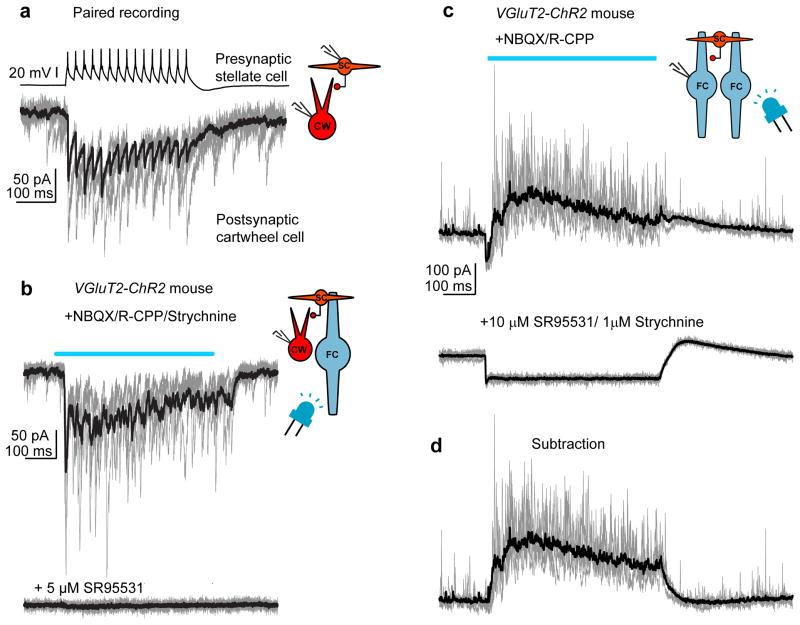
Electrical coupling of inhibitory interneurons can synchronize activity across multiple neurons, thereby enhancing the reliability of inhibition onto principal cell targets. It is unclear whether downstream activity in principal cells controls the excitability of such inhibitory networks. Using paired patch-clamp recordings, we show that excitatory projection neurons (fusiform cells) and inhibitory stellate interneurons of the dorsal cochlear nucleus form an electrically coupled network through gap junctions containing connexin36 (Cxc36, also called Gjd2). Remarkably, stellate cells were more strongly coupled to fusiform cells than to other stellate cells. This heterologous coupling was functionally asymmetric, biasing electrical transmission from the principal cell to the interneuron. Optogenetically activated populations of fusiform cells reliably enhanced interneuron excitability and generated GABAergic inhibition onto the postsynaptic targets of stellate cells, whereas deep afterhyperpolarizations following fusiform cell spike trains potently inhibited stellate cells over several hundred milliseconds. Thus, the excitability of an interneuron network is bidirectionally controlled by distinct epochs of activity in principal cells.
抑制性中间神经元的电耦合可以在多个神经元之间同步活动,从而增强抑制作用对主要细胞靶标的可靠性。目前尚不清楚主要细胞中的下游活动是否控制这种抑制性网络的兴奋性。通过配对膜片钳记录,我们发现耳蜗背核的兴奋性投射神经元(梭形细胞)和抑制性星状中间神经元通过包含连接蛋白 36(Cxc36,也称为 Gjd2)的缝隙连接形成电耦合网络。值得注意的是,星状细胞与梭形细胞的耦合比与其他星状细胞的耦合更强。这种异源耦合具有功能不对称性,偏向于将电信号从主要细胞传递到中间神经元。光遗传激活的梭形细胞群体可靠地增强了中间神经元的兴奋性,并在星状细胞的突触后靶标上产生 GABA 能抑制作用,而梭形细胞尖峰后深度超极化在几百毫秒内强烈抑制星状细胞。因此,中间神经元网络的兴奋性被主要细胞中不同的活动时期双向控制。


 Zotero 插件