Pérez-Ramos Ignacio M, Verdú José R, Numa Catherine, Marañón Teodoro, Lobo Jorge M
Instituto de Recursos Naturales y Agrobiología de Sevilla (IRNAS), Consejo Superior de Investigaciones Científicas (CSIC), Sevilla, Spain.
PLoS One. 2013 Oct 23;8(10):e77197. doi: 10.1371/journal.pone.0077197. eCollection 2013.
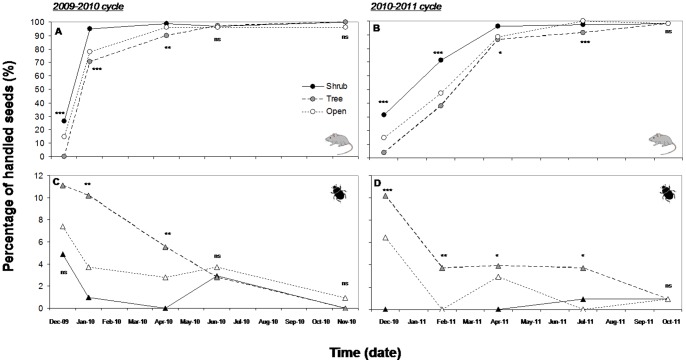
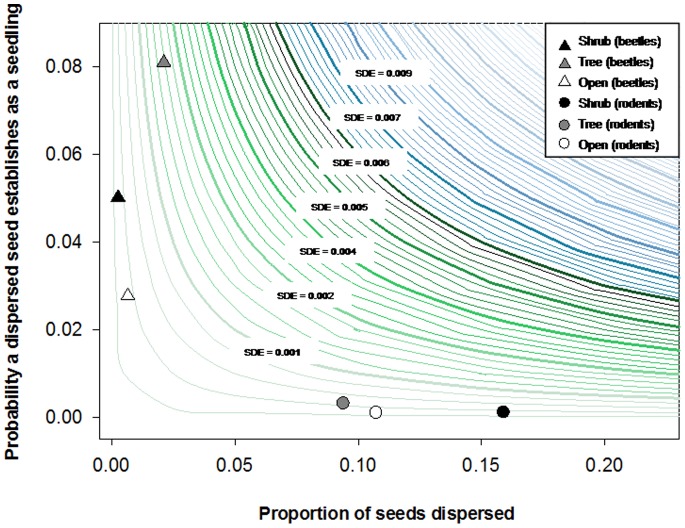
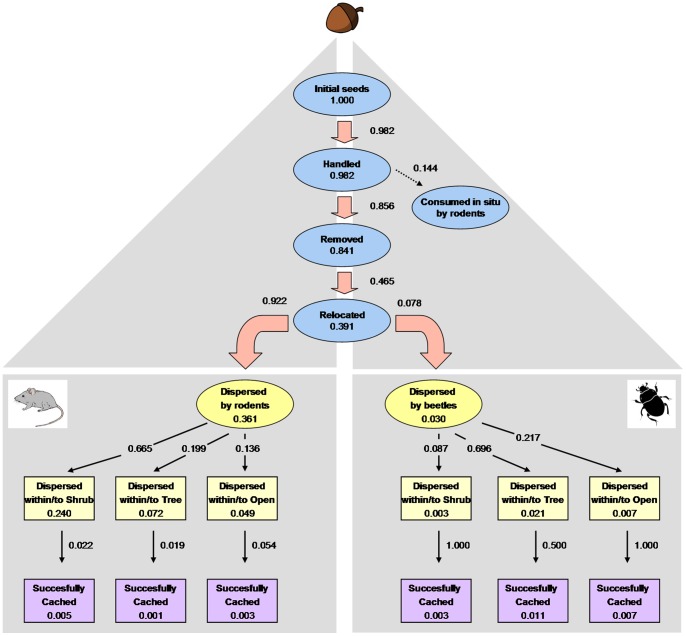
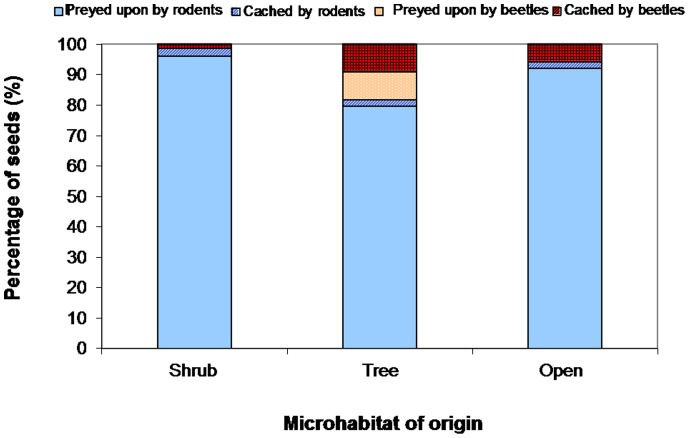
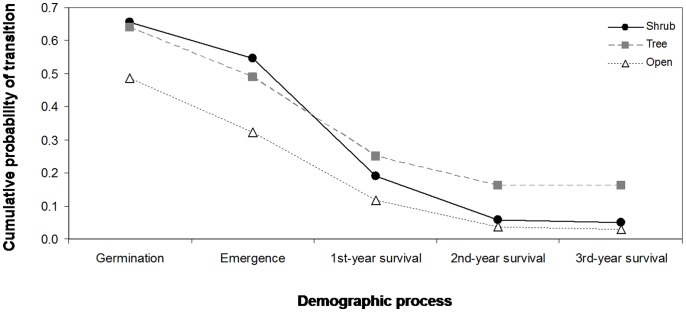
The process of seed dispersal of many animal-dispersed plants is frequently mediated by a small set of biotic agents. However, the contribution that each of these dispersers makes to the overall recruitment may differ largely, with important ecological and management implications for the population viability and dynamics of the species implied in these interactions. In this paper, we compared the relative contribution of two local guilds of scatter-hoarding animals with contrasting metabolic requirements and foraging behaviours (rodents and dung beetles) to the overall recruitment of two Quercus species co-occurring in the forests of southern Spain. For this purpose, we considered not only the quantity of dispersed seeds but also the quality of the seed dispersal process. The suitability for recruitment of the microhabitats where the seeds were deposited was evaluated in a multi-stage demographic approach. The highest rates of seed handling and predation occurred in those microhabitats located under shrubs, mostly due to the foraging activity of rodents. However, the probability of a seed being successfully cached was higher in microhabitats located beneath a tree canopy as a result of the feeding behaviour of beetles. Rodents and beetles showed remarkable differences in their effectiveness as local acorn dispersers. Quantitatively, rodents were much more important than beetles because they dispersed the vast majority of acorns. However, they were qualitatively less effective because they consumed a high proportion of them (over 95%), and seeds were mostly dispersed under shrubs, a less suitable microhabitat for short-term recruitment of the two oak species. Our findings demonstrate that certain species of dung beetles (such as Thorectes lusitanicus), despite being quantitatively less important than rodents, can act as effective local seed dispersers of Mediterranean oak species. Changes in the abundance of beetle populations could thus have profound implications for oak recruitment and community dynamics.
许多依靠动物传播种子的植物,其种子传播过程通常由一小部分生物媒介介导。然而,这些传播者对整体幼苗补充的贡献可能有很大差异,这对这些相互作用中所涉及物种的种群生存能力和动态具有重要的生态和管理意义。在本文中,我们比较了两个具有不同代谢需求和觅食行为的本地贮藏种子动物类群(啮齿动物和蜣螂)对西班牙南部森林中共存的两种栎属植物整体幼苗补充的相对贡献。为此,我们不仅考虑了传播种子的数量,还考虑了种子传播过程的质量。通过多阶段种群统计学方法评估了种子沉积微生境对幼苗补充的适宜性。种子处理和捕食率最高的微生境位于灌木下,这主要是由于啮齿动物的觅食活动。然而,由于甲虫的取食行为,种子成功贮藏在树冠下微生境中的概率更高。啮齿动物和甲虫作为本地橡子传播者的有效性存在显著差异。从数量上看,啮齿动物比甲虫重要得多,因为它们传播了绝大多数橡子。然而,从质量上看,它们的效果较差,因为它们消耗了很大比例的橡子(超过95%),而且种子大多散布在灌木下,这对这两种栎树的短期幼苗补充来说是不太适宜的微生境。我们的研究结果表明,某些种类的蜣螂(如葡萄牙嗡蜣螂),尽管在数量上不如啮齿动物重要,但可以作为地中海栎树物种有效的本地种子传播者。因此,甲虫种群数量的变化可能对栎树的幼苗补充和群落动态产生深远影响。