
DNA依赖性蛋白激酶是Lmx1a和中脑特化的一种上下文依赖性调节因子。
DNA-dependent protein kinase is a context dependent regulator of Lmx1a and midbrain specification.
作者信息
Hunt Cameron P, Fabb Stewart A, Pouton Colin W, Haynes John M
机构信息
Drug Discovery Biology, Monash Institute of Pharmaceutical Sciences, Monash University (Parkville), Melbourne, Australia.
出版信息
PLoS One. 2013 Oct 23;8(10):e78759. doi: 10.1371/journal.pone.0078759. eCollection 2013.
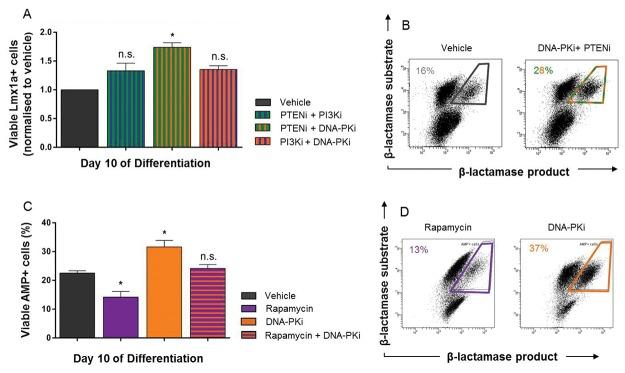
The identification of small molecules capable of directing pluripotent cell differentiation towards specific lineages is highly desirable to both reduce cost, and increase efficiency. Within neural progenitors, LIM homeobox transcription factor 1 alpha (Lmx1a) is required for proper development of roof plate and cortical hem structures of the forebrain, as well as the development of floor plate and midbrain dopaminergic neurons. In this study we generated homologous recombinant cell lines expressing either luciferase or β-lactamase under the control of the Lmx1a promoter, and used these cell lines to investigate kinase-mediated regulation of Lmx1a activity during neuronal differentiation. A screen of 143 small molecule tyrosine kinase inhibitors yielded 16 compounds that positively or negatively modulated Lmx1a activity. Inhibition of EGF, VEGF and DNA-dependent protein kinase (DNA-PK) signaling significantly upregulated Lmx1a activity whereas MEK inhibition strongly downregulated its activity. Quantitative FACS analysis revealed that the DNA-PK inhibitor significantly increased the number of Lmx1a+ progenitors while subsequent qPCR showed an upregulation of Notch effectors, the basic helix-loop-helix genes, Hes5 and Hey1. FACS further revealed that DNA-PK-mediated regulation of Lmx1a+ cells is dependent on the rapamycin-sensitive complex, mTORC1. Interestingly, this DNA-PK inhibitor effect was preserved in a co-culture differentiation protocol. Terminal differentiation assays showed that DNA-PK inhibition shifted development of neurons from forebrain toward midbrain character as assessed by Pitx3/TH immunolabeling and corresponding upregulation of midbrain (En1), but not forebrain (FoxG1) transcripts. These studies show that Lmx1a signaling in mouse embryonic stem cells contributes to a molecular cascade establishing neuronal specification. The data presented here identifies a novel regulatory pathway where signaling from DNA-PK appears to suppress midbrain-specific Lmx1a expression.
能够引导多能细胞向特定谱系分化的小分子的鉴定,对于降低成本和提高效率都非常有必要。在神经祖细胞中,LIM同源框转录因子1α(Lmx1a)对于前脑顶板和皮质下托结构的正常发育以及底板和中脑多巴胺能神经元的发育是必需的。在本研究中,我们构建了在Lmx1a启动子控制下表达荧光素酶或β-内酰胺酶的同源重组细胞系,并利用这些细胞系研究神经元分化过程中激酶介导的Lmx1a活性调节。对143种小分子酪氨酸激酶抑制剂进行筛选,得到了16种对Lmx1a活性有正向或负向调节作用的化合物。抑制表皮生长因子(EGF)、血管内皮生长因子(VEGF)和DNA依赖性蛋白激酶(DNA-PK)信号通路可显著上调Lmx1a活性,而抑制丝裂原活化蛋白激酶/细胞外信号调节激酶(MEK)则强烈下调其活性。定量荧光激活细胞分选(FACS)分析显示,DNA-PK抑制剂显著增加了Lmx1a+祖细胞的数量,随后的定量聚合酶链反应(qPCR)显示Notch效应分子、碱性螺旋-环-螺旋基因Hes5和Hey1上调。FACS进一步显示,DNA-PK介导的对Lmx1a+细胞的调节依赖于雷帕霉素敏感复合物哺乳动物雷帕霉素靶蛋白复合体1(mTORC1)。有趣的是,这种DNA-PK抑制剂效应在共培养分化方案中得以保留。终末分化试验表明,通过Pitx3/酪氨酸羟化酶(TH)免疫标记以及中脑(En1)而非前脑(FoxG1)转录本的相应上调评估,DNA-PK抑制使神经元的发育从前脑向中脑特征转变。这些研究表明,小鼠胚胎干细胞中的Lmx1a信号传导有助于建立神经元特化的分子级联反应。此处呈现的数据确定了一条新的调节途径,其中DNA-PK的信号传导似乎抑制中脑特异性Lmx1a的表达。




 Zotero 插件