Basic Research Department, The Parkinson's Institute, 675 Almanor Ave, Sunnyvale, CA 94085, USA.
Stem Cells Int. 2012;2012:140427. doi: 10.1155/2012/140427. Epub 2012 Apr 10.
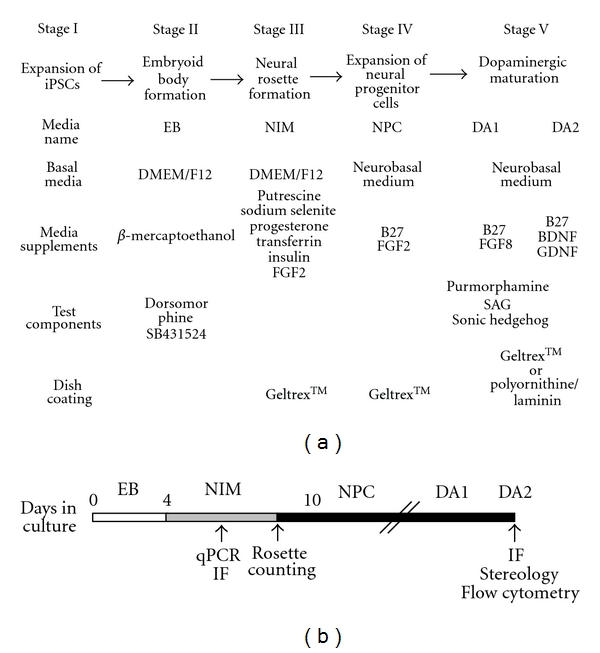
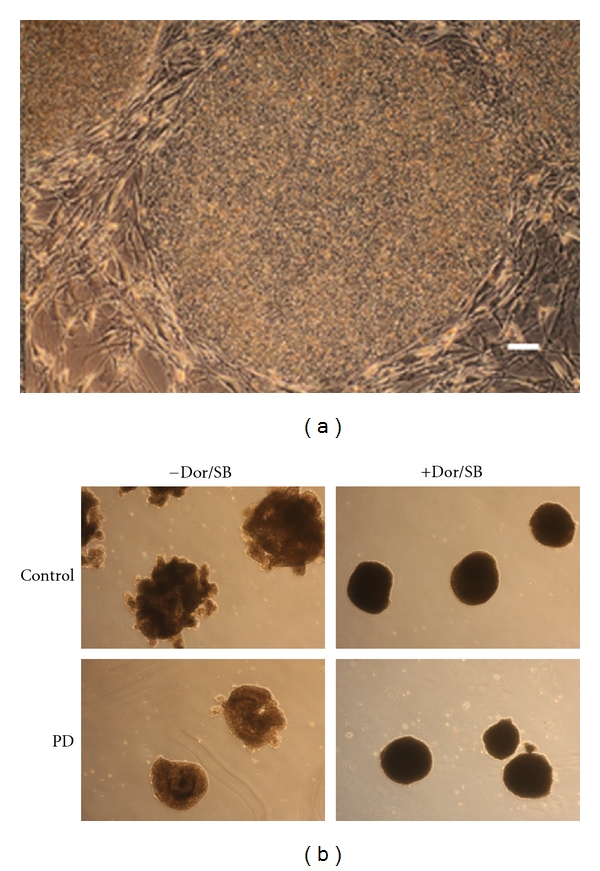
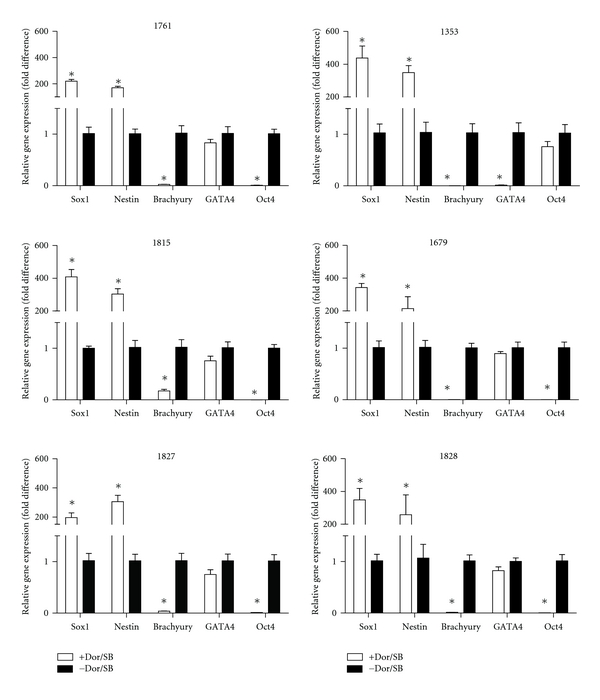
Efficient in vitro differentiation into specific cell types is more important than ever after the breakthrough in nuclear reprogramming of somatic cells and its potential for disease modeling and drug screening. Key success factors for neuronal differentiation are the yield of desired neuronal marker expression, reproducibility, length, and cost. Three main neuronal differentiation approaches are stromal-induced neuronal differentiation, embryoid body (EB) differentiation, and direct neuronal differentiation. Here, we describe our neurodifferentiation protocol using small molecules that very efficiently promote neural induction in a 5-stage EB protocol from six induced pluripotent stem cells (iPSC) lines from patients with Parkinson's disease and controls. This protocol generates neural precursors using Dorsomorphin and SB431542 and further maturation into dopaminergic neurons by replacing sonic hedgehog with purmorphamine or smoothened agonist. The advantage of this approach is that all patient-specific iPSC lines tested in this study were successfully and consistently coaxed into the neural lineage.
核重编程体细胞的突破及其在疾病建模和药物筛选方面的潜力,使得将体细胞高效分化为特定细胞类型变得比以往任何时候都更为重要。神经分化的关键成功因素包括所需神经元标志物表达的产量、可重复性、长度和成本。三种主要的神经元分化方法是基质诱导的神经元分化、类胚体(EB)分化和直接神经元分化。在这里,我们描述了一种使用小分子的神经分化方案,该方案非常有效地促进了从小鼠胚胎干细胞(iPSC)诱导的 6 条帕金森病患者和对照患者的 iPSC 系中,通过 5 个阶段的 EB 方案诱导产生神经前体细胞。该方案通过使用 Dorsomorphin 和 SB431542 来促进神经诱导,并通过用 Purmorphamine 或 Smoothened 激动剂取代 Sonic Hedgehog 进一步将其成熟为多巴胺能神经元。该方法的优势在于,本研究中测试的所有患者特异性 iPSC 系均被成功且一致地诱导进入神经谱系。