Fujita Yuria, Noguchi Kohji, Suzuki Tomonori, Katayama Kazuhiro, Sugimoto Yoshikazu
Division of Chemotherapy, Faculty of Pharmacy, Keio University, 1-5-30 Shibakoen, Minato-ku, Tokyo 105-8512, Japan.
BMC Res Notes. 2013 Nov 6;6:445. doi: 10.1186/1756-0500-6-445.
The ATP-binding cassette (ABC) transporters P-glycoprotein (P-gp)/ABCB1 and breast cancer resistance protein (BCRP)/ABCG2 are involved in the intestinal absorption and renal excretion of various substrate drugs. Their activities affect sub-therapeutic drug concentrations and excretion of natural transporter substrates. The new oral anti-HCV drug telaprevir has dramatically improved the efficacy of hepatitis-C virus (HCV) treatment, and recent studies have suggested a possible pharmacological interaction between telaprevir and P-gp. We studied the kinetics of in vitro interactions between telaprevir and P-gp and BCRP to understand the molecular basis of that interaction.
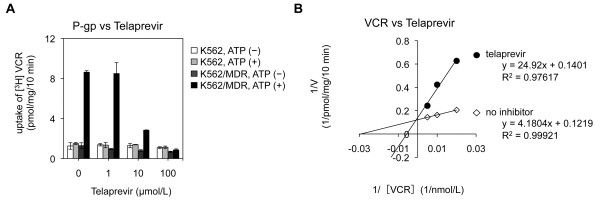
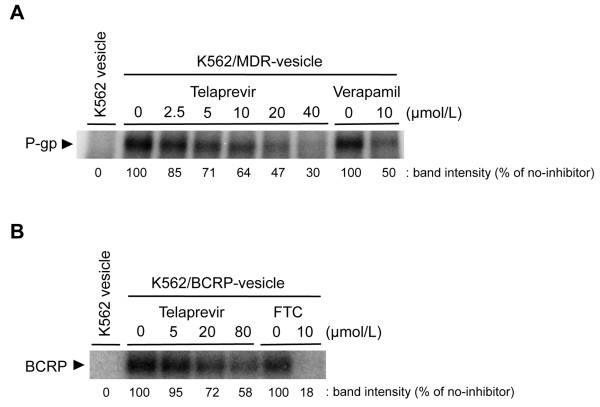
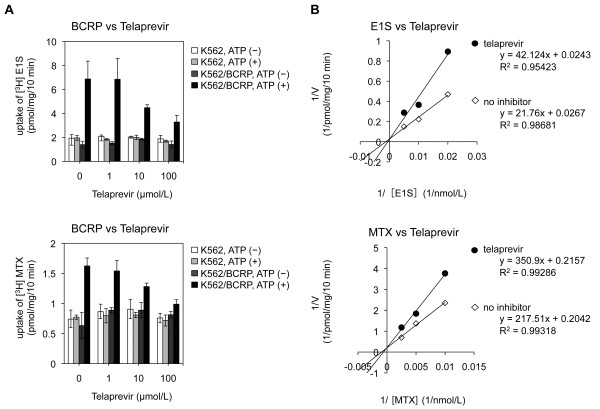
The effect of telaprevir on P-gp- and BCRP-mediated transport was evaluated by an in vitro vesicle transporter assay using different transport substrates, and the kinetics of transporter inhibition was determined. The results showed that telaprevir could inhibit P-gp- and BCRP-mediated transport in the in vitro vesicle transport assay, with each IC50 values of ≈ 7 μmol/L and ≈ 30 μmol/L, respectively. Analyses of Lineweaver-Burk plots showed that telaprevir was likely to be a competitive inhibitor against P-gp and BCRP. Photoaffinity labeling experiments were employed to observe competitive inhibition by telaprevir using iodoarylazidoprazosin (IAAP) as a binding substrate for P-gp and BCRP. These experiments revealed that telaprevir inhibited [125I]-IAAP-binding with P-gp and BCRP.
Telaprevir competitively inhibited P-gp and BCRP, and P-gp-mediated transport was more sensitive to telaprevir compared with BCRP-mediated transport. These data suggest that telaprevir represses the transporter functions of P-gp and BCRP via direct inhibition.
ATP结合盒(ABC)转运蛋白P-糖蛋白(P-gp)/ABCB1和乳腺癌耐药蛋白(BCRP)/ABCG2参与多种底物药物的肠道吸收和肾脏排泄。它们的活性会影响天然转运体底物的亚治疗药物浓度和排泄。新型口服抗丙型肝炎病毒(HCV)药物特拉匹韦显著提高了丙型肝炎病毒(HCV)治疗的疗效,最近的研究表明特拉匹韦与P-gp之间可能存在药物相互作用。我们研究了特拉匹韦与P-gp和BCRP之间体外相互作用的动力学,以了解这种相互作用的分子基础。
通过使用不同转运底物的体外囊泡转运体测定法评估特拉匹韦对P-gp和BCRP介导的转运的影响,并确定转运体抑制的动力学。结果表明,在体外囊泡转运测定中,特拉匹韦可抑制P-gp和BCRP介导的转运,其IC50值分别约为7 μmol/L和约30 μmol/L。Lineweaver-Burk图分析表明,特拉匹韦可能是P-gp和BCRP的竞争性抑制剂。采用光亲和标记实验,以碘芳基叠氮基哌唑嗪(IAAP)作为P-gp和BCRP的结合底物,观察特拉匹韦的竞争性抑制作用。这些实验表明特拉匹韦抑制[125I]-IAAP与P-gp和BCRP的结合。
特拉匹韦竞争性抑制P-gp和BCRP,与BCRP介导的转运相比,P-gp介导的转运对特拉匹韦更敏感。这些数据表明特拉匹韦通过直接抑制作用抑制P-gp和BCRP的转运体功能。