Division of Clinical Oncology, Department of Medicine, Medical University of Graz, Auenbruggerplatz 15, 8036 Graz, Austria.
Clinical Institute of Medical and Chemical Laboratory Diagnostics, Medical University of Graz, Auenbruggerplatz 15, 8036 Graz, Austria.
Br J Cancer. 2014 Jan 7;110(1):183-8. doi: 10.1038/bjc.2013.701. Epub 2013 Nov 7.
Recent evidence indicates that the host inflammatory response has an important role in the tumour progression. Elevated C-reactive protein (CRP) levels have been previously associated with poor prognosis in several cancer types including small-scale studies in pancreatic cancer (PC) patients. The purpose of the present study was to validate the prognostic impact of plasma CRP levels at date of diagnosis on cancer-specific survival (CSS) in a large cohort of PC patients.
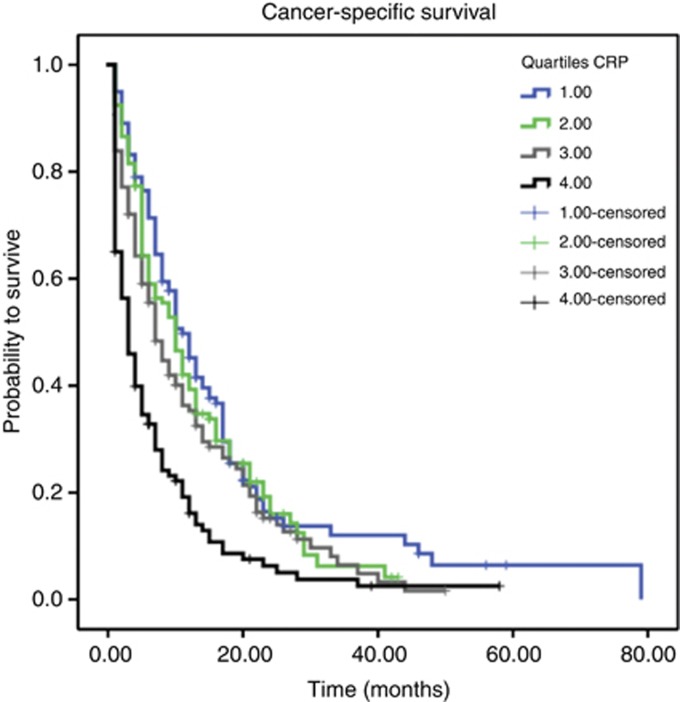
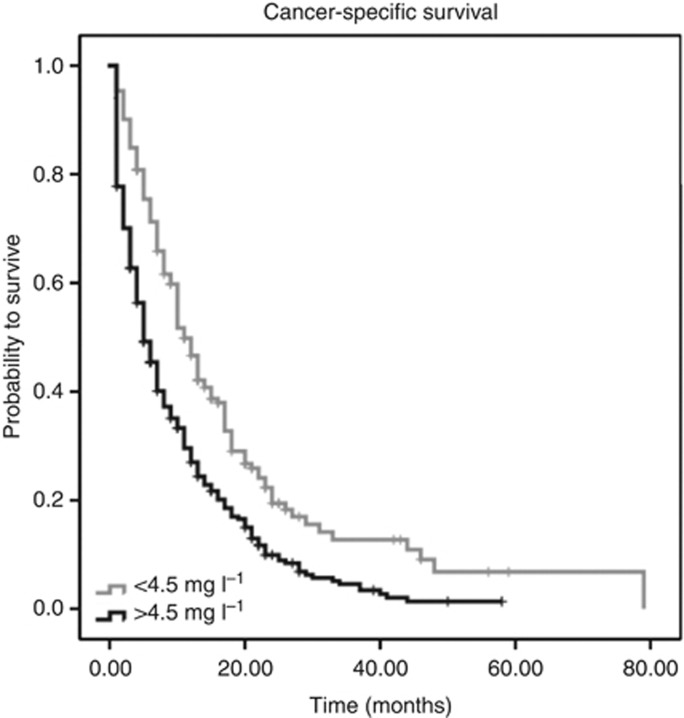
Data from 474 consecutive patients with adenocarcinoma of the pancreas, treated between 2004 and 2012 at a single centre, were evaluated retrospectively. CSS was analysed using the Kaplan-Meier method. To evaluate the prognostic significance of plasma CRP levels, univariate and multivariate Cox analyses were applied.
High plasma CRP levels at diagnosis were significantly associated with well-established prognostic factors, including high tumour stage and tumour grade and the administration of chemotherapy (P<0.05). In univariate analysis, we observed that a high plasma CRP level was a consistent factor for poor CSS in PC patients (hazard ratio (HR)=2.21; 95% confidence interval (CI)=1.68-2.92, P<0.001). In multivariate analysis, tumour stage, grade, administration of chemotherapy, a high neutrophil-lymphocyte ratio and the highest quartile of CRP levels (HR=1.60, 95% CI=1.16-2.21; P=0.005) were identified as independent prognostic factors in PC patients.
In conclusion, we confirmed a significant association of elevated CRP levels with poor clinical outcome in PC patients. Our results indicate that the plasma CRP level might represent a useful marker for patient stratification in PC management.
最近的证据表明,宿主炎症反应在肿瘤进展中起着重要作用。以前的研究表明,C 反应蛋白(CRP)水平升高与包括胰腺癌(PC)在内的几种癌症类型的不良预后相关,而这些研究的样本量较小。本研究的目的是在一个大型 PC 患者队列中验证诊断时血浆 CRP 水平对癌症特异性生存(CSS)的预后影响。
回顾性分析了 2004 年至 2012 年在一家中心治疗的 474 例腺癌患者的数据。使用 Kaplan-Meier 方法分析 CSS。为了评估血浆 CRP 水平的预后意义,进行了单因素和多因素 Cox 分析。
诊断时高血浆 CRP 水平与公认的预后因素显著相关,包括高肿瘤分期和肿瘤分级以及化疗的应用(P<0.05)。单因素分析显示,高血浆 CRP 水平是 PC 患者 CSS 不良的一致因素(危险比(HR)=2.21;95%置信区间(CI)=1.68-2.92,P<0.001)。多因素分析显示,肿瘤分期、分级、化疗的应用、高中性粒细胞-淋巴细胞比值和 CRP 水平最高四分位数(HR=1.60,95%CI=1.16-2.21;P=0.005)是 PC 患者的独立预后因素。
综上所述,我们证实了 CRP 水平升高与 PC 患者临床结局不良之间存在显著关联。我们的研究结果表明,血浆 CRP 水平可能是 PC 患者分层的有用标志物。