Hsieh Yi-Chia, Cheng Tsung-Han, Wang Chu-An, Hu Che-Yuan, Yang Wen-Horng, Ou Chien-Hui, Jan Hau-Chern
Department of Urology, National Cheng Kung University Hospital, College of Medicine, National Cheng Kung University, Tainan 70403, Taiwan, R.O.C.
Division of Urology, Department of Surgery, National Cheng Kung University Hospital Dou-Liou Branch, Yunlin 64043, Taiwan, R.O.C.
Biomed Rep. 2024 Dec 10;22(2):32. doi: 10.3892/br.2024.1910. eCollection 2025 Feb.
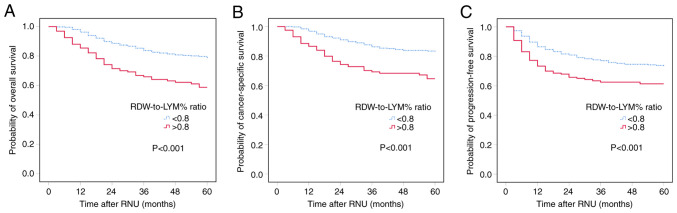
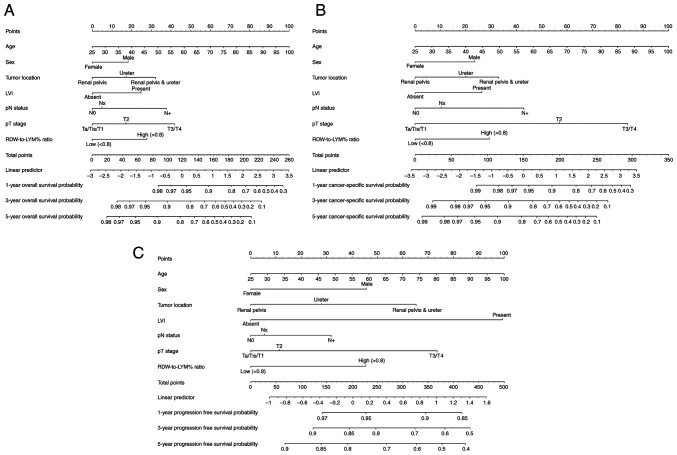
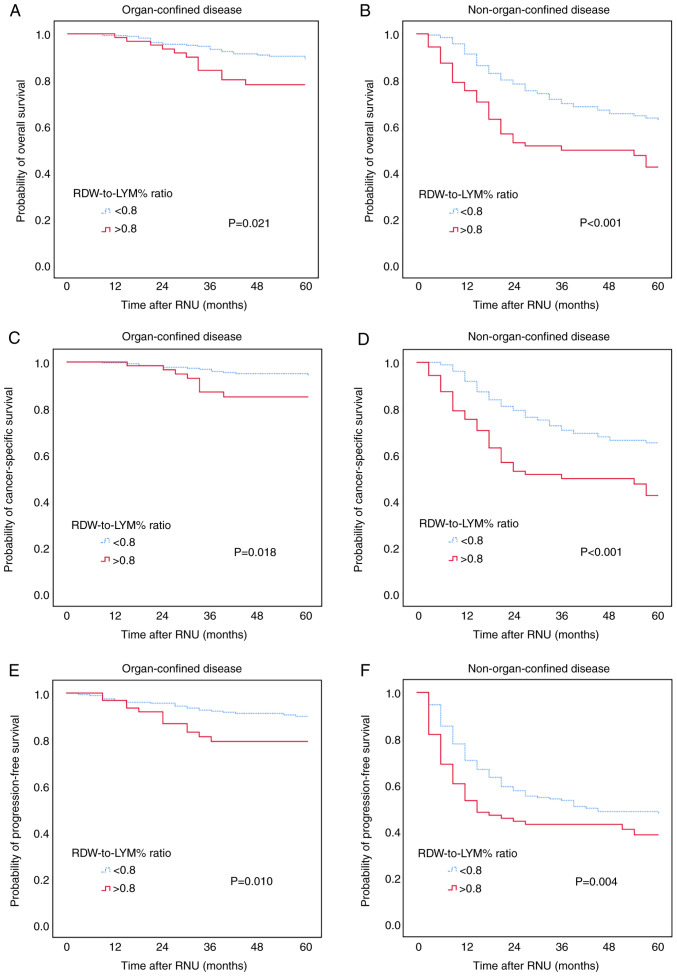
The aim of the present study was to determine the prognostic significance of a novel marker, the red cell distribution width to lymphocyte percentage (RDW-to-LYM%) ratio, in patients with upper tract urothelial carcinoma (UTUC) after radical nephroureterectomy (RNU). The clinical and follow-up data of 625 patients with UTUC receiving RNU were retrospectively analyzed. The optimal cut-off value of the pre-treatment RDW-to-LYM% ratio was determined as 0.80 using receiver operating characteristic (ROC) analysis according to cancer-specific death. The associations between low (≤0.80) and high (>0.8) RDW-to-LYM% ratio and other clinicopathological parameters were evaluated using the χ test and logistic regression analysis. The impact of the RDW-to-LYM% ratio on overall survival (OS), cancer-specific survival (CSS) and progression-free survival (PFS) rates was assessed using the Kaplan-Meier method and Cox regression analysis. A high RDW-to-LYM% ratio (>0.80) was significantly associated with impaired kidney function, previous/concurrent bladder cancer, tumors involving both the pelvis and ureter, advanced pathological T stage, lymph node involvement and lymphovascular invasion (LVI). Kaplan-Meier analysis revealed that a high RDW-to-LYM% ratio was associated with poorer OS, CSS and PFS than a low RDW-to-LYM% ratio (all P<0.001). The multiple logistic regression analysis revealed that high RDW-to-LYM% ratio was associated with non-organ-confined (NOC) disease [odd ratio (OR), 2.107; 95% confidence interval (CI), 1.446-3.069; P<0.001] and positive LVI (OR, 1.978; 95% CI, 1.338-2.916; P<0.001). Furthermore, the multivariate analysis showed that the RDW-to-LYM% ratio was an independent factor for predicting OS [hazard ratio (HR), 2.046; P<0.001], CSS (HR, 2.041; P<0.001) and PFS (HR, 1.502; P=0.009). In conclusion, the pre-treatment RDW-to-LYM% ratio was found to be a significant predictor of both NOC and the presence of LVI in patients with UTUC. Moreover, an elevated pre-treatment RDW-to-LYM% ratio was identified as an independent factor for unfavorable survival outcomes in patients with UTUC undergoing RNU.
本研究的目的是确定一种新型标志物——红细胞分布宽度与淋巴细胞百分比(RDW-to-LYM%)比值,在接受根治性肾输尿管切除术(RNU)的上尿路尿路上皮癌(UTUC)患者中的预后意义。对625例接受RNU的UTUC患者的临床和随访数据进行了回顾性分析。根据癌症特异性死亡情况,使用受试者工作特征(ROC)分析确定治疗前RDW-to-LYM%比值的最佳临界值为0.80。使用χ检验和逻辑回归分析评估低(≤0.80)和高(>0.8)RDW-to-LYM%比值与其他临床病理参数之间的关联。使用Kaplan-Meier方法和Cox回归分析评估RDW-to-LYM%比值对总生存期(OS)、癌症特异性生存期(CSS)和无进展生存期(PFS)率的影响。高RDW-to-LYM%比值(>0.80)与肾功能受损、既往/同时性膀胱癌、累及肾盂和输尿管的肿瘤、晚期病理T分期、淋巴结受累和淋巴管浸润(LVI)显著相关。Kaplan-Meier分析显示,高RDW-to-LYM%比值组的OS、CSS和PFS均低于低RDW-to-LYM%比值组(所有P<0.001)。多因素逻辑回归分析显示,高RDW-to-LYM%比值与非器官局限性(NOC)疾病相关[比值比(OR),2.107;95%置信区间(CI),1.446 - 3.069;P<0.001]和阳性LVI相关(OR,1.978;95%CI,1.338 - 2.916;P<0.001)。此外,多因素分析表明,RDW-to-LYM%比值是预测OS[风险比(HR),2.046;P<0.001]、CSS(HR,2.041;P<0.001)和PFS(HR,1.502;P = 0.009)的独立因素。总之,发现治疗前RDW-to-LYM%比值是UTUC患者NOC和LVI存在的重要预测指标。此外,治疗前RDW-to-LYM%比值升高被确定为接受RNU的UTUC患者生存结果不良的独立因素。