Radiation Oncology, Institute of Cancer Sciences, University of Glasgow, Garscube Estate, Glasgow G61 1BD, Scotland.
EJNMMI Res. 2013 Nov 13;3(1):73. doi: 10.1186/2191-219X-3-73.
The radiopharmaceutical 131I-metaiodobenzylguanidine (131I-MIBG) is used for the targeted radiotherapy of noradrenaline transporter (NAT)-expressing neuroblastoma. Enhancement of 131I-MIBG's efficacy is achieved by combination with the topoisomerase I inhibitor topotecan - currently being evaluated clinically. Proteasome activity affords resistance of tumour cells to radiation and topoisomerase inhibitors. Therefore, the proteasome inhibitor bortezomib was evaluated with respect to its cytotoxic potency as a single agent and in combination with 131I-MIBG and topotecan. Since elevated levels of reactive oxygen species (ROS) are induced by bortezomib, the role of ROS in tumour cell kill was determined following treatment with bortezomib or the alternative proteasome inhibitor, MG132.
Clonogenic assay and growth of tumour xenografts were used to investigate the effects of proteasome inhibitors alone or in combination with radiation treatment. Synergistic interactions in vitro were evaluated by combination index analysis. The dependency of proteasome inhibitor-induced clonogenic kill on ROS generation was assessed using antioxidants.
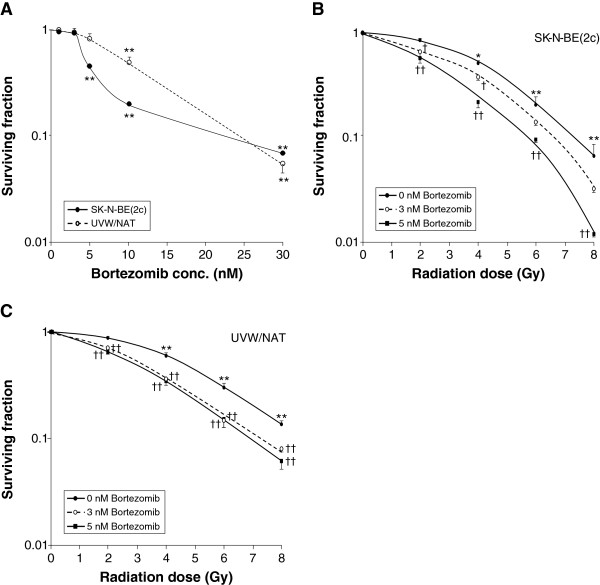
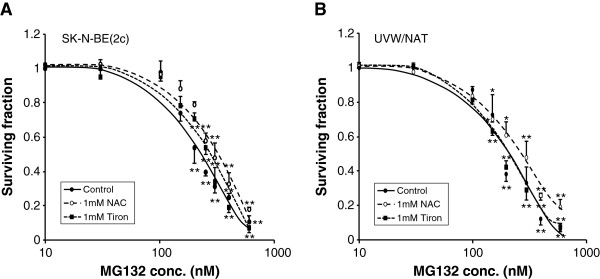
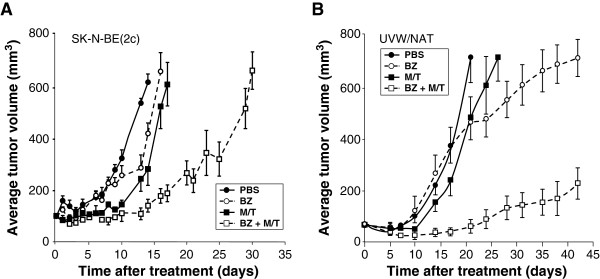
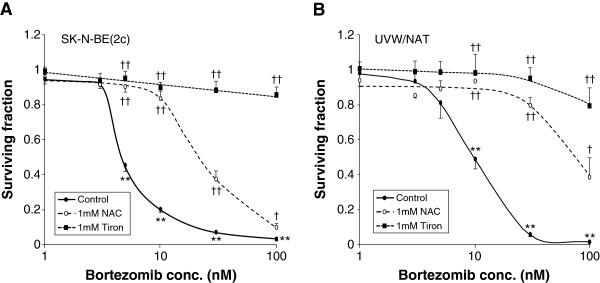
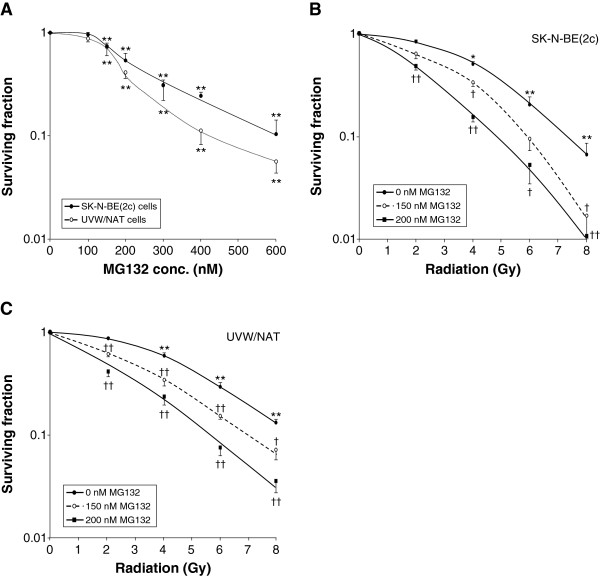
Bortezomib, in the dose range 1 to 30 nM, decreased clonogenic survival of both SK-N-BE(2c) and UVW/NAT cells, and this was prevented by antioxidants. It also acted as a sensitizer in vitro when administered with X-radiation, with 131I-MIBG, or with 131I-MIBG and topotecan. Moreover, bortezomib enhanced the delay of the growth of human tumour xenografts in athymic mice when administered in combination with 131I-MIBG and topotecan. MG132 and bortezomib had similar radiosensitizing potency, but only bortezomib-induced cytotoxicity was ROS-dependent.
Proteasome inhibition shows promise for the treatment of neuroblastoma in combination with 131I-MIBG and topotecan. Since the cytotoxicity of MG132, unlike that of bortezomib, was not ROS-dependent, the latter proteasome inhibitor may have a favourable toxicity profile in normal tissues.
放射性药物 131I-间碘苄胍(131I-MIBG)用于靶向治疗去甲肾上腺素转运体(NAT)表达的神经母细胞瘤。通过与拓扑异构酶 I 抑制剂拓扑替康联合使用,可以增强 131I-MIBG 的疗效-目前正在临床评估中。蛋白酶体活性使肿瘤细胞对辐射和拓扑异构酶抑制剂产生耐药性。因此,评估了蛋白酶体抑制剂硼替佐米作为单一药物以及与 131I-MIBG 和拓扑替康联合使用的细胞毒性效力。由于硼替佐米诱导活性氧(ROS)水平升高,因此在用硼替佐米或替代蛋白酶体抑制剂 MG132 处理后,确定了 ROS 在肿瘤细胞杀伤中的作用。
克隆形成试验和肿瘤异种移植的生长用于研究单独使用蛋白酶体抑制剂或与放射治疗联合使用的效果。通过组合指数分析评估体外协同相互作用。使用抗氧化剂评估蛋白酶体抑制剂诱导的集落杀伤对 ROS 产生的依赖性。
硼替佐米在 1 至 30 nM 的剂量范围内降低了 SK-N-BE(2c)和 UVW/NAT 细胞的集落存活能力,并且抗氧化剂可以阻止这种情况。当与 X 射线、131I-MIBG 或 131I-MIBG 和拓扑替康联合使用时,它也在体外表现为增敏剂。此外,当与 131I-MIBG 和拓扑替康联合使用时,硼替佐米增强了人肿瘤异种移植在无胸腺小鼠中的生长延迟。MG132 和硼替佐米具有相似的放射增敏作用,但只有硼替佐米诱导的细胞毒性依赖于 ROS。
蛋白酶体抑制联合 131I-MIBG 和拓扑替康有望用于神经母细胞瘤的治疗。由于 MG132 的细胞毒性与硼替佐米不同,不依赖于 ROS,因此后者的蛋白酶体抑制剂在正常组织中可能具有有利的毒性特征。