Department of Neuroscience, University of Arizona , Tucson, AZ, USA.
Front Neurosci. 2013 Nov 7;7:208. doi: 10.3389/fnins.2013.00208.
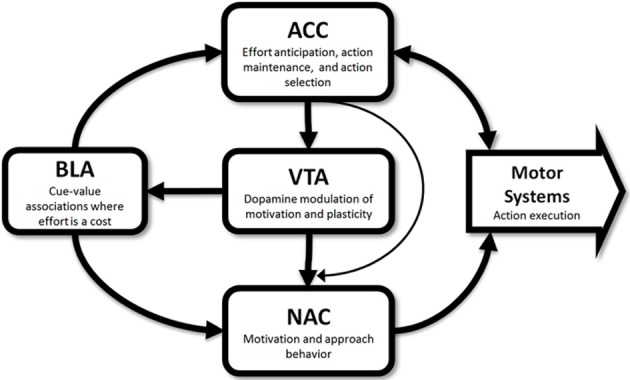
The physical effort required to seek out and extract a resource is an important consideration for a foraging animal. A second consideration is the variability or risk associated with resource delivery. An intriguing observation from ethological studies is that animals shift their preference from stable to variable food sources under conditions of increased physical effort or falling energetic reserves. Although theoretical models for this effect exist, no exploration into its biological basis has been pursued. Recent advances in understanding the neural basis of effort- and risk-guided decision making suggest that opportunities exist for determining how effort influences risk preference. In this review, we describe the intersection between the neural systems involved in effort- and risk-guided decision making and outline two mechanisms by which effort-induced changes in dopamine release may increase the preference for variable rewards.
对于觅食动物来说,寻找和获取资源所需的体力消耗是一个重要的考虑因素。第二个考虑因素是与资源传递相关的可变性或风险。动物行为学研究的一个有趣观察结果是,在体力消耗增加或能量储备下降的情况下,动物会从稳定的食物来源转向可变的食物来源。尽管存在这种效应的理论模型,但尚未对其生物学基础进行探索。最近在理解努力和风险导向决策的神经基础方面的进展表明,有机会确定努力如何影响风险偏好。在这篇综述中,我们描述了参与努力和风险导向决策的神经系统之间的交点,并概述了两种机制,通过这些机制,多巴胺释放的努力诱导变化可能会增加对可变奖励的偏好。