Ahmadzai Nadera, Newberry Sydne J, Maglione Margaret A, Tsertsvadze Alexander, Ansari Mohammed T, Hempel Susanne, Motala Aneesa, Tsouros Sophia, Schneider Chafen Jennifer J, Shanman Roberta, Moher David, Shekelle Paul G
Knowledge Synthesis Group, Ottawa Hospital Research Institute, Clinical Epidemiology Program, Center for Practice-Changing Research, 501 Smyth Road, Ottawa, ON K1H 8L6, Canada.
Syst Rev. 2013 Nov 14;2:104. doi: 10.1186/2046-4053-2-104.
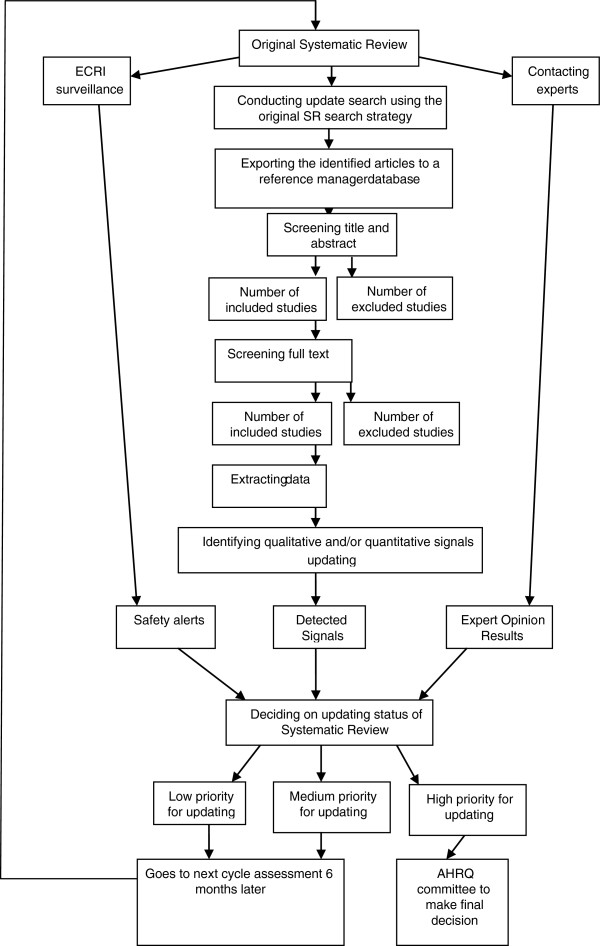
Systematic reviews (SRs) can become outdated as new evidence emerges over time. Organizations that produce SRs need a surveillance method to determine when reviews are likely to require updating. This report describes the development and initial results of a surveillance system to assess SRs produced by the Agency for Healthcare Research and Quality (AHRQ) Evidence-based Practice Center (EPC) Program.
Twenty-four SRs were assessed using existing methods that incorporate limited literature searches, expert opinion, and quantitative methods for the presence of signals triggering the need for updating. The system was designed to begin surveillance six months after the release of the original review, and then ceforth every six months for any review not classified as being a high priority for updating. The outcome of each round of surveillance was a classification of the SR as being low, medium or high priority for updating.
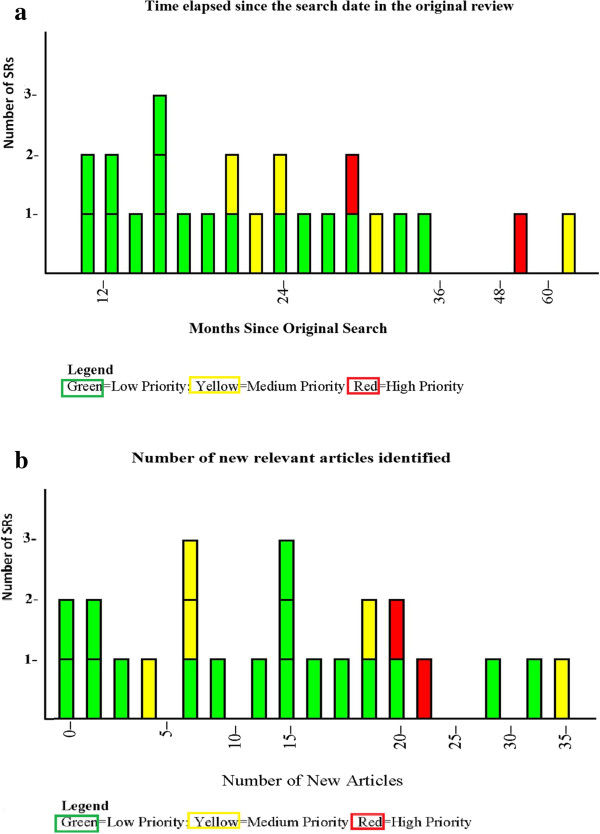
Twenty-four SRs underwent surveillance at least once, and ten underwent surveillance a second time during the 18 months of the program. Two SRs were classified as high, five as medium, and 17 as low priority for updating. The time lapse between the searches conducted for the original reports and the updated searches (search time lapse - STL) ranged from 11 months to 62 months: The STL for the high priority reports were 29 months and 54 months; those for medium priority reports ranged from 19 to 62 months; and those for low priority reports ranged from 11 to 33 months. Neither the STL nor the number of new relevant articles was perfectly associated with a signal for updating. Challenges of implementing the surveillance system included determining what constituted the actual conclusions of an SR that required assessing; and sometimes poor response rates of experts.
In this system of regular surveillance of 24 systematic reviews on a variety of clinical interventions produced by a leading organization, about 70% of reviews were determined to have a low priority for updating. Evidence suggests that the time period for surveillance is yearly rather than the six months used in this project.
随着时间的推移,新证据不断出现,系统评价(SRs)可能会过时。开展系统评价的组织需要一种监测方法来确定何时可能需要更新评价。本报告描述了一个监测系统的开发及初步结果,该系统用于评估医疗保健研究与质量局(AHRQ)循证实践中心(EPC)项目所产生的系统评价。
使用现有方法对24项系统评价进行评估,这些方法包括有限的文献检索、专家意见以及用于发现触发更新需求信号的定量方法。该系统设计为在原始评价发布六个月后开始监测,对于未被归类为更新高优先级的任何评价,此后每六个月监测一次。每轮监测的结果是将系统评价分类为更新低、中或高优先级。
在该项目的18个月期间,24项系统评价至少接受了一次监测,其中10项接受了第二次监测。两项系统评价被归类为更新高优先级,五项为中优先级,17项为低优先级。原始报告搜索与更新搜索之间的时间间隔(搜索时间间隔 - STL)为11个月至62个月:高优先级报告的STL为29个月和54个月;中优先级报告的STL为19至62个月;低优先级报告的STL为11至33个月。STL和新的相关文章数量均与更新信号不完全相关。实施监测系统的挑战包括确定需要评估的系统评价的实际结论是什么;以及有时专家的回复率较低。
在这个对一个领先组织产生的关于各种临床干预措施的24项系统评价进行定期监测的系统中,约70%的评价被确定为更新优先级较低。有证据表明,监测周期应为每年,而非本项目中使用的六个月。