Beck Irene R, Schmid Nicole S, Berres Manfred, Monsch Andreas U
Memory Clinic, University Center for Medicine of Aging Basel, Felix Platter-Hospital, Basel, Switzerland.
Int J Geriatr Psychiatry. 2014 Jun;29(6):624-34. doi: 10.1002/gps.4045. Epub 2013 Nov 14.
The diagnosis of mild cognitive impairment (MCI) and dementia requires detailed neuropsychological examinations. These examinations typically yield a large number of outcome variables, which may complicate the interpretation and communication of results. The purposes of this study were the following: (i) to reduce a large data set of interrelated neuropsychological variables to a smaller number of cognitive dimensions; (ii) to create a common metric for these dimensions (z-scores); and (iii) to study the ability of the cognitive dimensions to distinguish between groups of patients with different types of cognitive impairment.
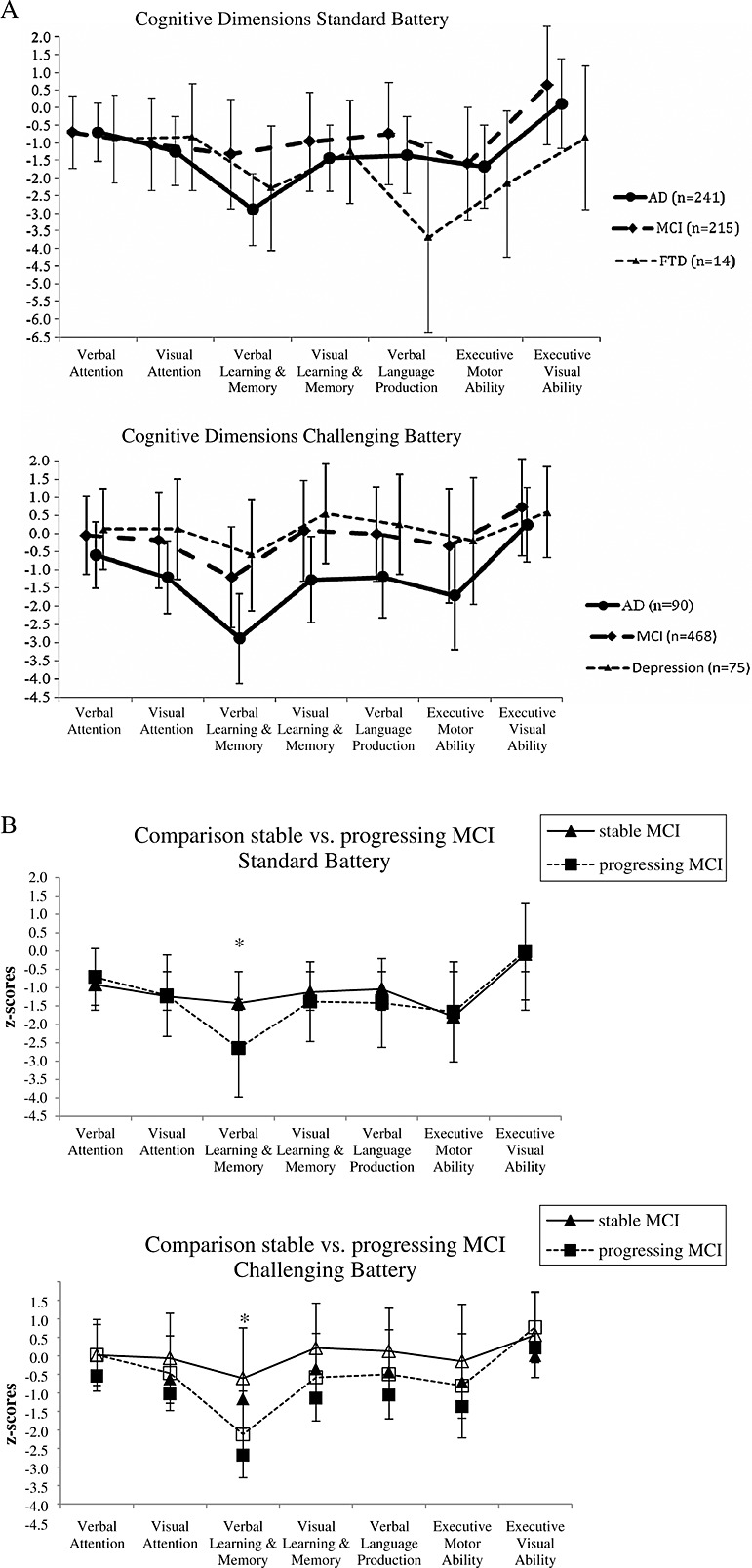
We tested 1646 patients with different forms of dementia or with a major depression with a standard (n = 632) or, if cognitively less affected, a challenging neuropsychological battery (n = 1014). To identify the underlying cognitive dimensions of the two test batteries, maximum likelihood factor analyses with a promax rotation were conducted. To interpret the sum scores of the factors as standard scores, we divided them by the standard deviation of a cognitively healthy sample (n = 1145).
The factor analyses yielded seven factors for each test battery. The cognitive dimensions in both test batteries distinguished patients with different forms of dementia (MCI, Alzheimer's dementia or frontotemporal dementia) and patients with major depression. Furthermore, patients with stable MCI could be separated from patients with progressing MCI. Discriminant analyses with an independent new sample of patients (n = 306) revealed that the new dimension scores distinguished new samples of patients with MCI from patients with Alzheimer's dementia with high accuracy.
These findings suggest that these cognitive dimensions may benefit neuropsychological diagnostics.
轻度认知障碍(MCI)和痴呆的诊断需要详细的神经心理学检查。这些检查通常会产生大量的结果变量,这可能会使结果的解释和交流变得复杂。本研究的目的如下:(i)将大量相互关联的神经心理学变量数据集简化为较少数量的认知维度;(ii)为这些维度创建一个通用指标(z分数);(iii)研究认知维度区分不同类型认知障碍患者组的能力。
我们用标准神经心理学测试组(n = 632)或在认知影响较轻时用具有挑战性的神经心理学测试组(n = 1014)对1646例患有不同形式痴呆或重度抑郁症的患者进行了测试。为了确定两个测试组潜在的认知维度,我们进行了采用斜交旋转的极大似然因子分析。为了将因子的总分解释为标准分数,我们将它们除以认知健康样本(n = 1145)的标准差。
每个测试组的因子分析都产生了七个因子。两个测试组中的认知维度能够区分不同形式痴呆(MCI、阿尔茨海默病性痴呆或额颞叶痴呆)患者和重度抑郁症患者。此外,稳定型MCI患者与进展型MCI患者也能够被区分开来。对一个独立的新患者样本(n = 306)进行的判别分析表明,新的维度分数能够高精度地区分MCI患者新样本与阿尔茨海默病性痴呆患者新样本。
这些发现表明,这些认知维度可能对神经心理学诊断有益。