Department of Internal Medicine and the Institute of Hypertension, Tongji Hospital, Tongji Medical College of Huazhong University of Science and Technology, Wuhan 430030, People's Republic of China.
BMC Neurol. 2013 Nov 16;13:178. doi: 10.1186/1471-2377-13-178.
Recently, plasma miRNAs have been reported as biomarkers for various diseases. However, the knowledge on the association of plasma miRNAs with ischemic stroke is still lacking. In this study, we investigated whether plasma concentrations of miR-30a, miR-126 and let-7b may be biomarkers for ischemic stroke in humans.
One hundred ninety seven patients with ischemic stroke were recruited and their blood samples were collected at 24 h, 1 week, 4 weeks, 24 weeks and 48 weeks after symptoms onset, and fifty healthy volunteers were selected as control. Levels of miRNA were quantified by quantitative real-time PCR. Relative expression level of miRNA was calculated using 2(-ΔΔct) method. The ability to distinguish the ischemic stroke group from control group was characterized by receiver operating characteristic (ROC) curve, and the area under ROC curve (AUC) was calculated.
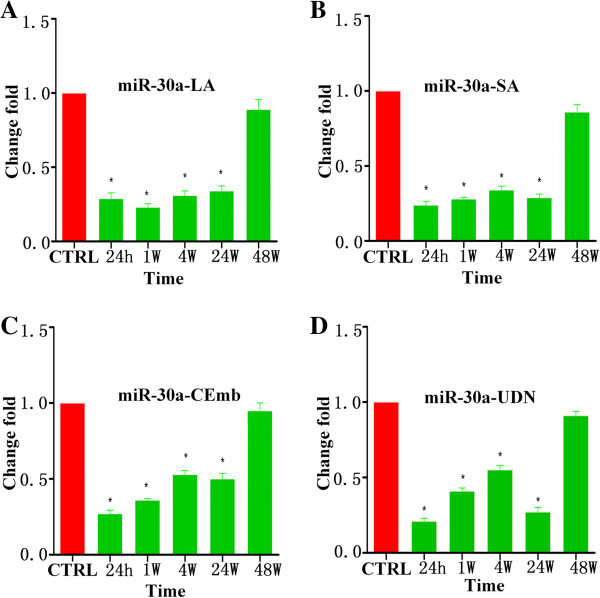
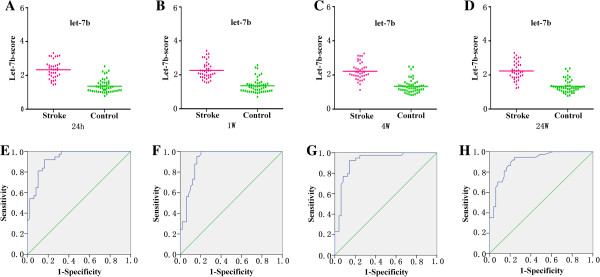
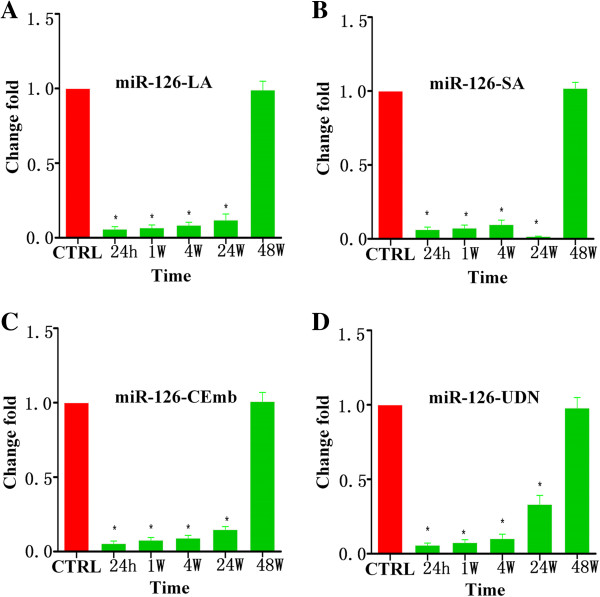
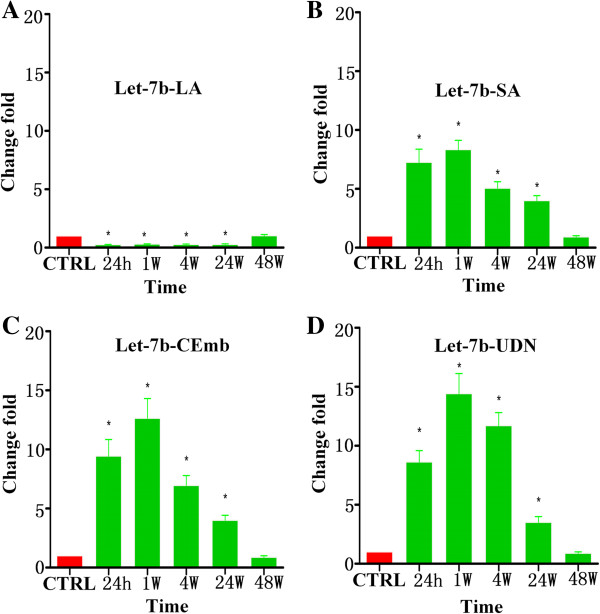
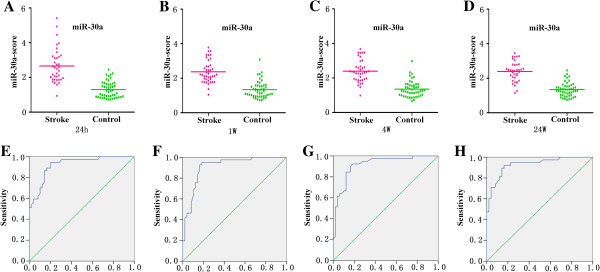
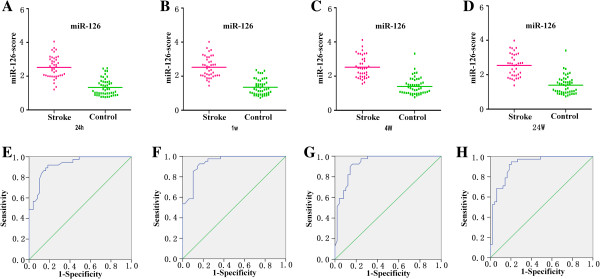
Circulating miR-30a and miR-126 levels were markedly down-regulated in all patients with ischemic stroke until 24 weeks. However, circulating let-7b was lower in patients with large-vessel atherosclerosis than healthy volunteers, whereas circulating let-7b had higher level in patients with other kinds of ischemic stroke until 24 weeks. Among all patients, circulating miRNAs levels returned to normal 48 weeks after symptom onset. Receiver operating characteristic (ROC) curve analysis showed that the areas under the curve (AUC) of plasma miR-30a were 0.91, 0.91, 0.92 and 0.93, the miR-126 were 0.92, 0.94, 0.93 and 0.92, and let-7b were 0.93, 0.92, 0.92 and 0.91 at 24 h, 1 w, 4 w and 24 w, respectively.
These data suggest that miR-30a, miR-126 and let-7b might be useful biomarkers for ischemic stroke in humans.
最近,血浆 miRNA 已被报道为各种疾病的生物标志物。然而,关于血浆 miRNA 与缺血性卒中的关联的知识仍然缺乏。在这项研究中,我们研究了血浆 miR-30a、miR-126 和 let-7b 的浓度是否可能成为人类缺血性卒中的生物标志物。
招募了 197 例缺血性卒中患者,在症状发作后 24 h、1 周、4 周、24 周和 48 周采集他们的血液样本,选择 50 名健康志愿者作为对照。通过实时定量 PCR 定量 miRNA 水平。使用 2(-ΔΔct)方法计算 miRNA 的相对表达水平。通过接收者操作特征 (ROC) 曲线来描述区分缺血性卒中组和对照组的能力,并计算 ROC 曲线下的面积 (AUC)。
所有缺血性卒中患者的循环 miR-30a 和 miR-126 水平在所有时间点均显著下调,直至 24 周。然而,大动脉粥样硬化性缺血性卒中患者的循环 let-7b 水平低于健康志愿者,而其他类型的缺血性卒中患者的循环 let-7b 水平在 24 周前较高。在所有患者中,循环 miRNA 水平在症状发作后 48 周恢复正常。ROC 曲线分析显示,血浆 miR-30a 的 AUC 在 24 h、1 w、4 w 和 24 w 时分别为 0.91、0.91、0.92 和 0.93,miR-126 的 AUC 分别为 0.92、0.94、0.93 和 0.92,let-7b 的 AUC 分别为 0.93、0.92、0.92 和 0.91。
这些数据表明,miR-30a、miR-126 和 let-7b 可能是人类缺血性卒中的有用生物标志物。