Devers Eye Institute, Legacy Research Institute, Portland, Oregon.
Devers Eye Institute, Legacy Research Institute, Portland, Oregon; New York Eye and Ear Infirmary, New York, New York.
Am J Ophthalmol. 2014 Mar;157(3):540-9.e1-2. doi: 10.1016/j.ajo.2013.11.007. Epub 2013 Nov 13.
To test whether the minimum rim area assessed by spectral domain optical coherence tomography (SD-OCT), based on the shortest distance from the Bruch membrane opening (BMO) to the inner limiting membrane, corresponds more closely to retinal nerve fiber layer (RNFL) thickness and visual field mean deviation (MD) than current rim measures in early glaucoma.
Prospective cross-sectional study.
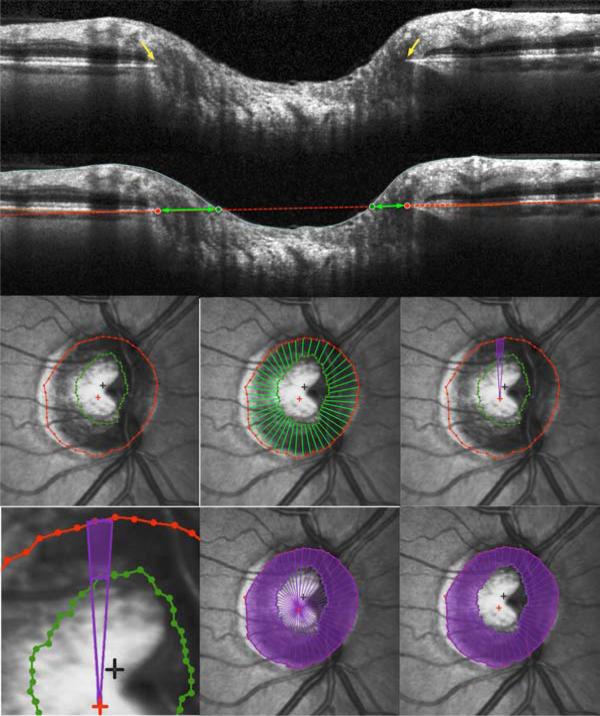
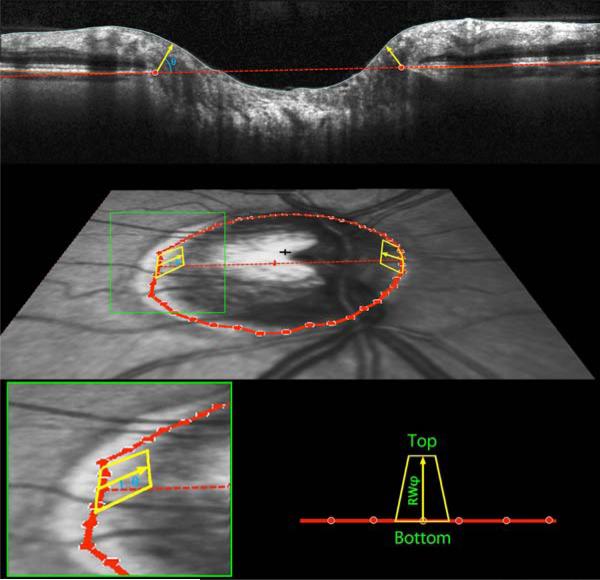
We studied 221 participants with non-endstage glaucoma or high-risk ocular hypertension and performed standard automated perimetry. We received SD-OCT and confocal scanning laser ophthalmoscopy (CSLO) scans on the same day. Rim area measured by CSLO was compared with 3 SD-OCT rim measures from radial B-scans: horizontal rim area between BMO and inner limiting membrane within the BMO plane; mean minimum rim width (BMO-MRW); and minimum rim area (BMO-MRA) optimized within sectors and then summed. Correlations between these measures and either MD from perimetry or RNFL thickness from SD-OCT were compared using the Steiger test.
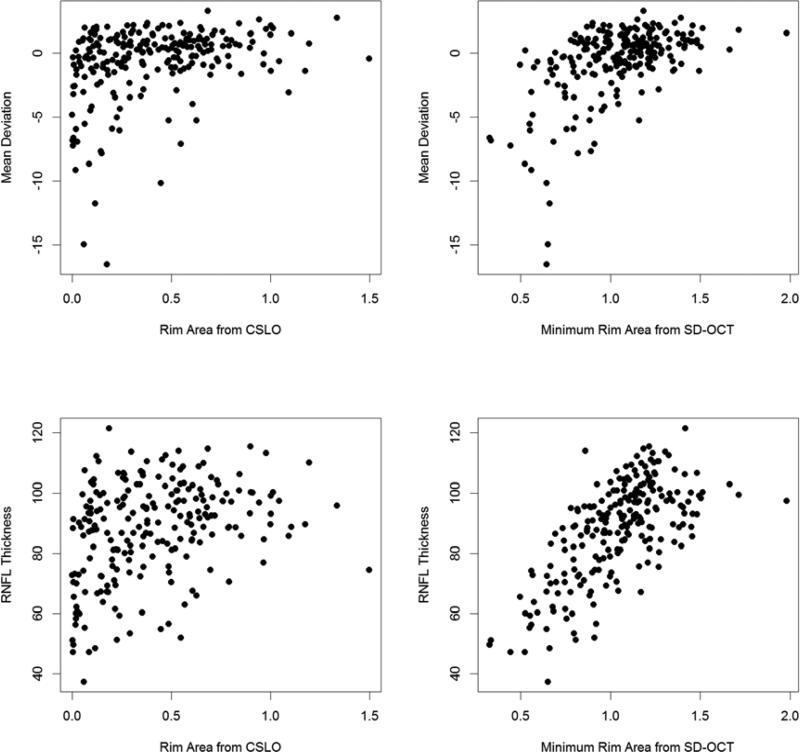
RNFL thickness was better correlated with BMO-MRA (r = 0.676) or BMO-MRW (r = 0.680) than with either CSLO rim area (r = 0.330, P < 0.001) or horizontal rim area (r = 0.482, P < 0.001). MD was better correlated with BMO-MRA (r = 0.534) or BMO-MRW (r = 0.546) than with either CSLO rim area (r = 0.321, P < 0.001) or horizontal rim area (0.403, P < 0.001). The correlation between MD and RNFL thickness was r = 0.646.
Minimum rim measurements from SD-OCT are significantly better correlated to both RNFL thickness and MD than rim measurements within the BMO plane or based on the clinical disc margin. They provide new structural parameters for both diagnostic and research purposes in glaucoma.
通过评估基于从 Bruch 膜开口(BMO)到内界膜最短距离的光谱域光相干断层扫描(SD-OCT)最小边缘区域,来检测其是否比当前早期青光眼边缘测量值更能准确反映视网膜神经纤维层(RNFL)厚度和视野平均偏差(MD)。
前瞻性横断面研究。
我们研究了 221 名非晚期青光眼或高危眼高压患者,并进行了标准自动视野检查。同一天我们进行了 SD-OCT 和共焦扫描激光检眼镜(CSLO)扫描。CSLO 测量的边缘区域与来自径向 B 扫描的 3 个 SD-OCT 边缘区域进行了比较:BMO 平面内 BMO 和内界膜之间的水平边缘区域;平均最小边缘宽度(BMO-MRW);以及在扇区中进行优化后的最小边缘区域(BMO-MRA),然后对其进行求和。使用 Steiger 检验比较这些测量值与视野 MD 或 SD-OCT 中 RNFL 厚度之间的相关性。
与 CSLO 边缘区域(r = 0.330,P < 0.001)或水平边缘区域(r = 0.482,P < 0.001)相比,RNFL 厚度与 BMO-MRA(r = 0.676)或 BMO-MRW(r = 0.680)相关性更好。MD 与 BMO-MRA(r = 0.534)或 BMO-MRW(r = 0.546)相关性更好,与 CSLO 边缘区域(r = 0.321,P < 0.001)或水平边缘区域(0.403,P < 0.001)相关性较差。MD 和 RNFL 厚度之间的相关性为 r = 0.646。
与 BMO 平面内或基于临床视盘边缘的边缘测量值相比,SD-OCT 的最小边缘测量值与 RNFL 厚度和 MD 的相关性显著更高。它们为青光眼的诊断和研究目的提供了新的结构参数。