Center for Infection and Immunity Amsterdam (CINIMA), Academic Medical Center, University of Amsterdam, Amsterdam, The Netherlands ; Center for Experimental and Molecular Medicine (CEMM), Academic Medical Center, University of Amsterdam, Amsterdam, The Netherlands.
PLoS One. 2013 Nov 11;8(11):e80062. doi: 10.1371/journal.pone.0080062. eCollection 2013.
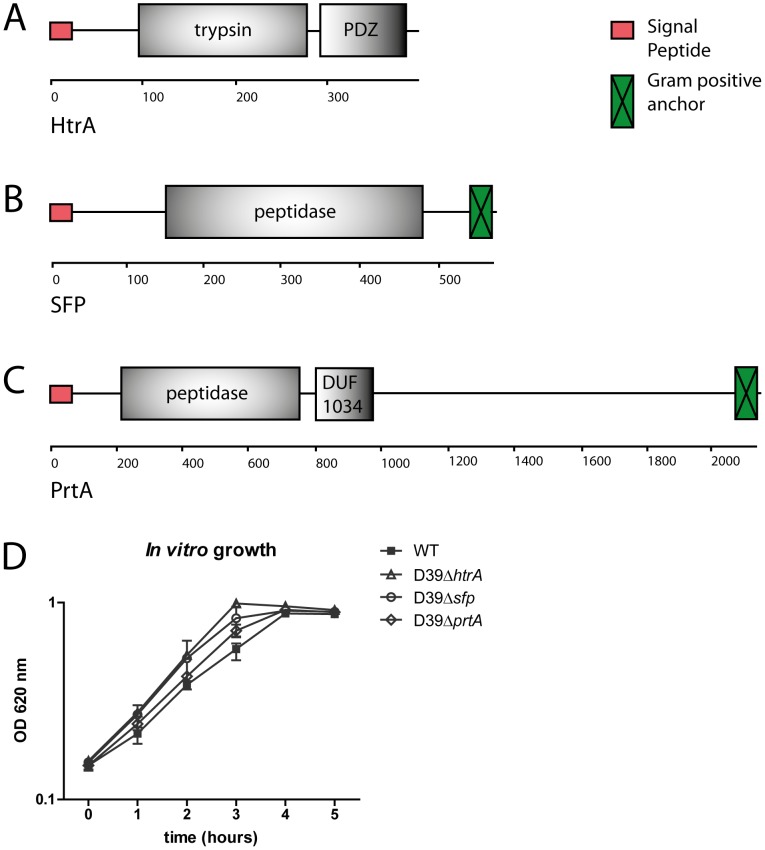
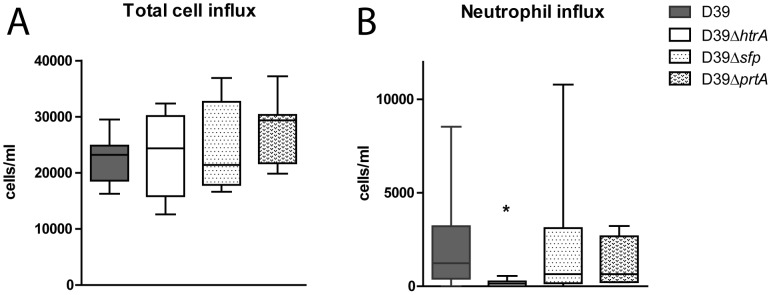
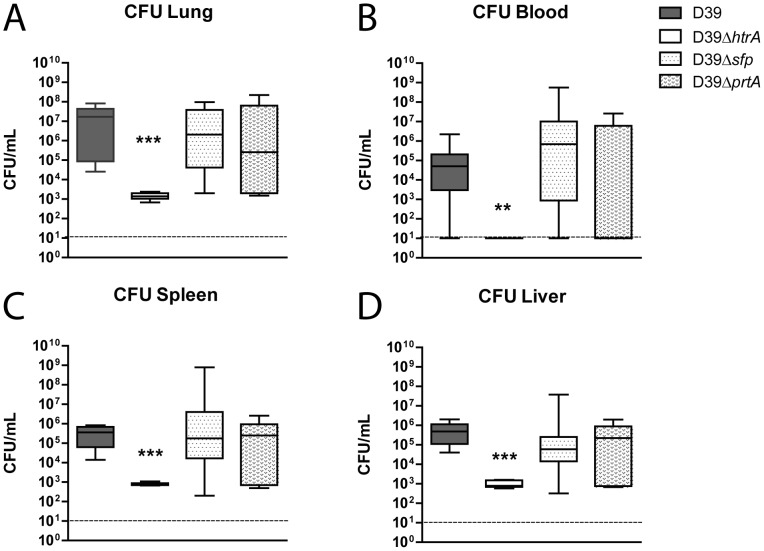
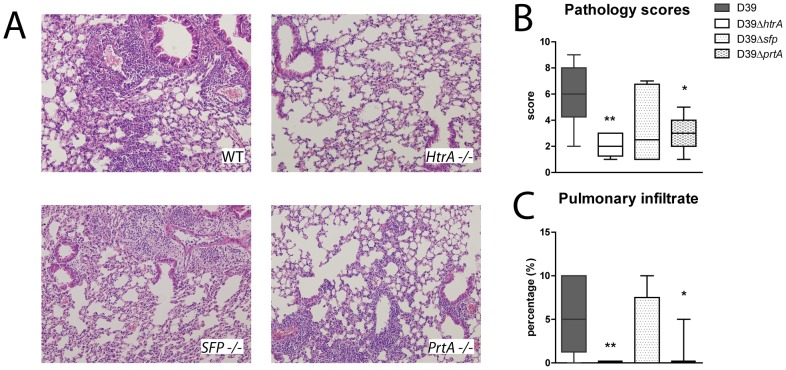
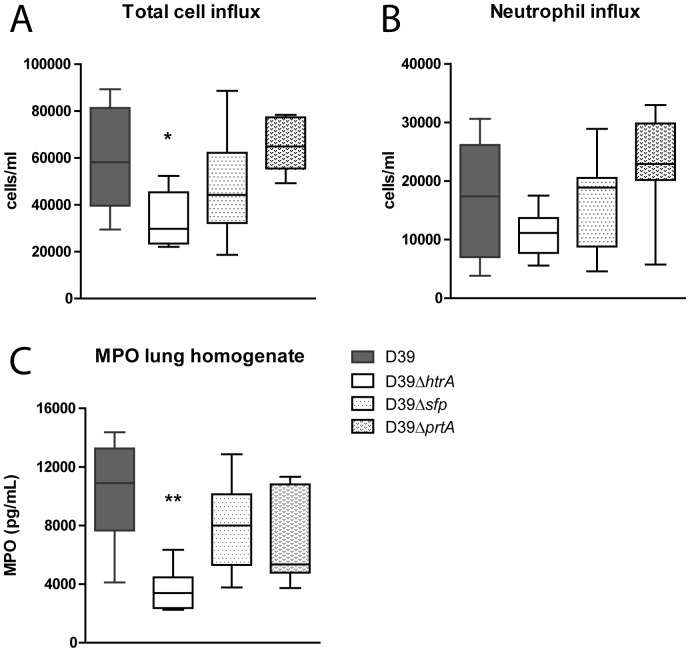
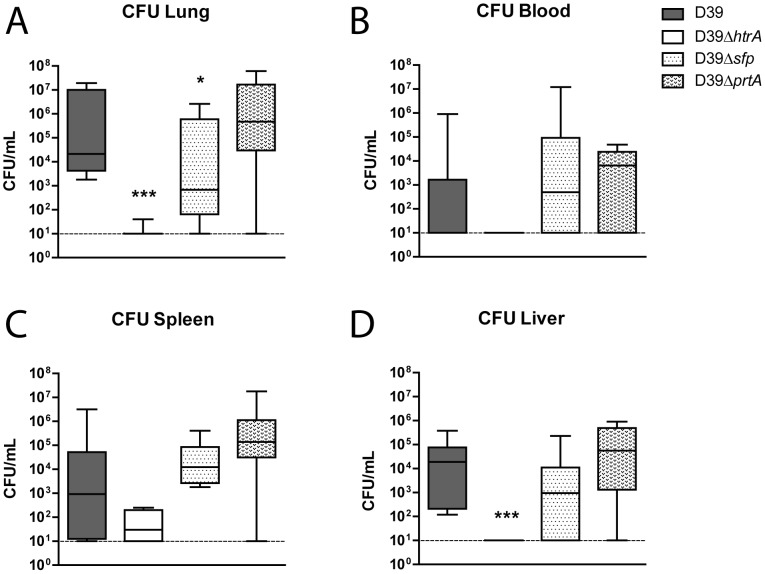
Streptococcus (S.) pneumoniae is a common causative pathogen in pneumonia. Serine protease orthologs expressed by a variety of bacteria have been found of importance for virulence. Previous studies have identified two serine proteases in S. pneumoniae, HtrA (high-temperature requirement A) and PrtA (cell wall-associated serine protease A), that contributed to virulence in models of pneumonia and intraperitoneal infection respectively. We here sought to identify additional S. pneumoniae serine proteases and determine their role in virulence. The S. pneumoniae D39 genome contains five putative serine proteases, of which HtrA, Subtilase Family Protein (SFP) and PrtA were selected for insertional mutagenesis because they are predicted to be secreted and surface exposed. Mutant D39 strains lacking serine proteases were constructed by in-frame insertion deletion mutagenesis. Pneumonia was induced by intranasal infection of mice with wild-type or mutant D39. After high dose infection, only D39ΔhtrA showed reduced virulence, as reflected by strongly reduced bacterial loads, diminished dissemination and decreased lung inflammation. D39ΔprtA induced significantly less lung inflammation together with smaller infiltrated lung surface, but without influencing bacterial loads. After low dose infection, D39ΔhtrA again showed strongly reduced bacterial loads; notably, pneumococcal burdens were also modestly lower in lungs after infection with D39Δsfp. These data confirm the important role for HtrA in S. pneumoniae virulence. PrtA contributes to lung damage in high dose pneumonia; it does not however contribute to bacterial outgrowth in pneumococcal pneumonia. SFP may facilitate S. pneumoniae growth after low dose infection.
肺炎链球菌(S. pneumoniae)是肺炎的常见病原体。已发现多种细菌表达的丝氨酸蛋白酶同源物对毒力很重要。先前的研究已经确定了肺炎链球菌中的两种丝氨酸蛋白酶,HtrA(高温需求 A)和 PrtA(细胞壁相关丝氨酸蛋白酶 A),它们分别在肺炎和腹腔感染模型中有助于毒力。我们在这里试图确定其他肺炎链球菌丝氨酸蛋白酶,并确定它们在毒力中的作用。肺炎链球菌 D39 基因组包含五个假定的丝氨酸蛋白酶,其中 HtrA、枯草杆菌蛋白酶家族蛋白(SFP)和 PrtA 被选为插入失活突变,因为它们被预测为分泌和表面暴露。通过框内插入缺失突变构建了缺乏丝氨酸蛋白酶的突变 D39 菌株。通过鼻腔内感染小鼠用野生型或突变 D39 诱导肺炎。高剂量感染后,只有 D39ΔhtrA 表现出降低的毒力,这反映在细菌负荷强烈降低、传播减少和肺部炎症减少。D39ΔprtA 引起的肺部炎症明显减少,同时肺部浸润面积减小,但不影响细菌负荷。低剂量感染后,D39ΔhtrA 再次显示出强烈降低的细菌负荷;值得注意的是,感染 D39Δsfp 后肺部的肺炎链球菌负担也适度降低。这些数据证实了 HtrA 在肺炎链球菌毒力中的重要作用。PrtA 有助于高剂量肺炎中的肺部损伤;然而,它不会导致肺炎链球菌肺炎中的细菌生长。SFP 可能有助于低剂量感染后的肺炎链球菌生长。