Gastrointestinal Centre, Institute of Inflammation and Repair, University of Manchester, Manchester Academic Health Sciences Centre (MAHSC), Salford Royal NHS Foundation Trust, Salford M6 8HD, UK.
J Physiol. 2014 Feb 15;592(4):695-709. doi: 10.1113/jphysiol.2013.263475. Epub 2013 Nov 18.
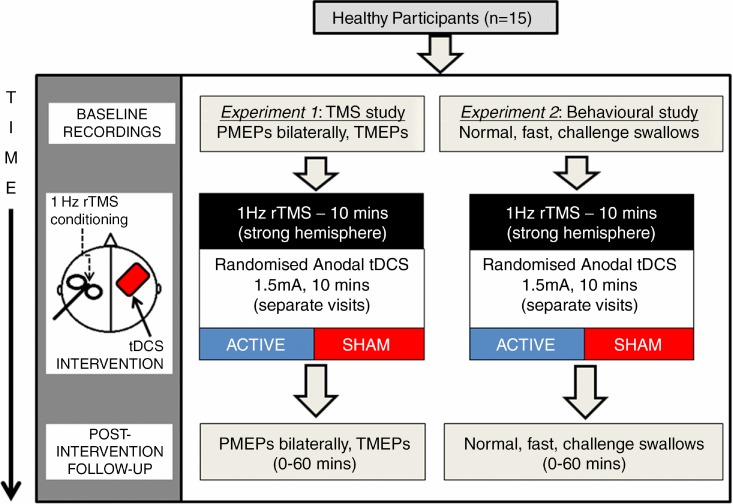
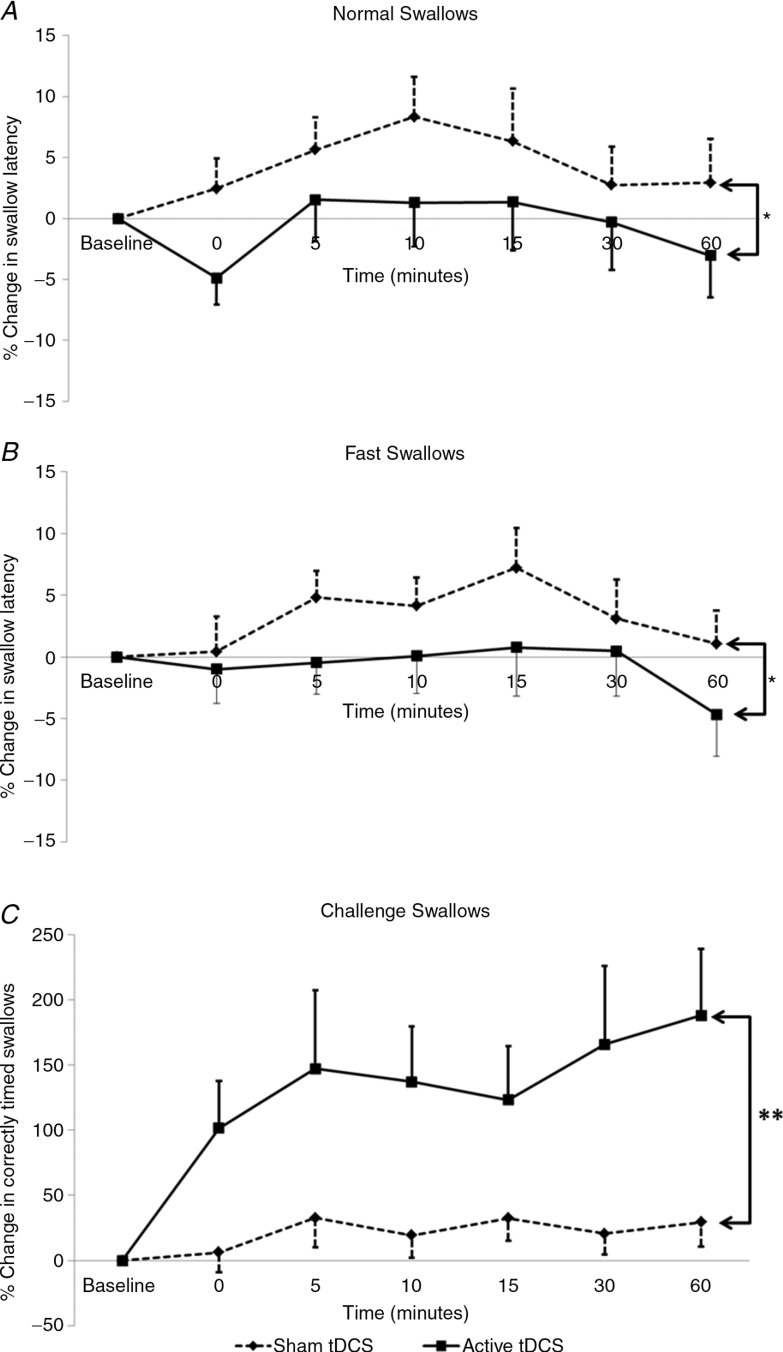
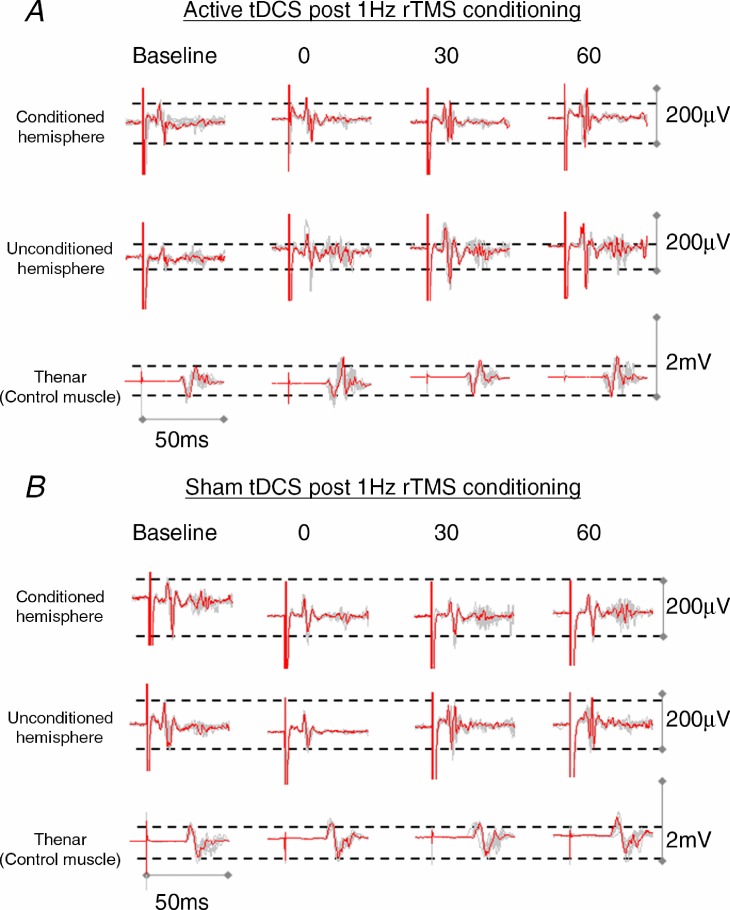
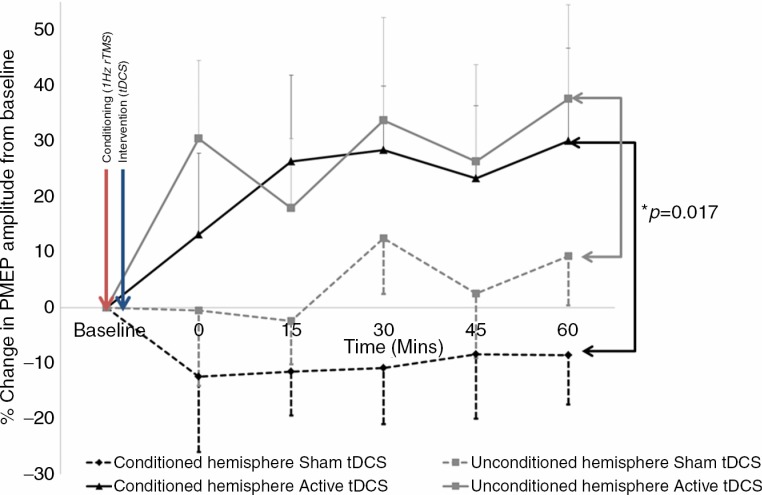
The human cortical swallowing system exhibits bilateral but functionally asymmetric representation in health and disease as evidenced by both focal cortical inhibition (pre-conditioning with 1 Hz repetitive transcranial magnetic stimulation; rTMS) and unilateral stroke, where disruption of the stronger (dominant) pharyngeal projection alters swallowing neurophysiology and behaviour. Moreover, excitatory neurostimulation protocols capable of reversing the disruptive effects of focal cortical inhibition have demonstrated therapeutic promise in post-stroke dysphagia when applied contralaterally. In healthy participants (n = 15, 8 males, mean age (±SEM) 35 ± 9 years), optimal parameters of transcranial direct current stimulation (tDCS) (anodal, 1.5 mA, 10 min) were applied contralaterally after 1 Hz rTMS pre-conditioning to the strongest pharyngeal projection. Swallowing neurophysiology was assessed in both hemispheres by intraluminal recordings of pharyngeal motor-evoked responses (PMEPs) to single-pulse TMS as a measure of cortical excitability. Swallowing behaviour was examined using a pressure-based reaction time protocol. Measurements were made before and for up to 60 min post intervention. Subjects were randomised to active or sham tDCS after 1 Hz rTMS on separate days and data were compared using repeated measures ANOVA. Active tDCS increased PMEPs bilaterally (F1,14 = 7.4, P = 0.017) reversing the inhibitory effects of 1 Hz rTMS in the pre-conditioned hemisphere (F1,14 = 10.1, P = 0.007). Active tDCS also enhanced swallowing behaviour, increasing the number of correctly timed challenge swallows compared to sham (F1,14 = 6.3, P = 0.025). Thus, tDCS to the contralateral pharyngeal motor cortex reverses the neurophysiological and behavioural effects of focal cortical inhibition on swallowing in healthy individuals and has therapeutic potential for dysphagia rehabilitation.
人类皮质吞咽系统在健康和疾病中表现出双侧但功能不对称的表现,这一点既可以通过局灶性皮质抑制(用 1 Hz 重复经颅磁刺激进行预刺激;rTMS),也可以通过单侧中风来证明,在中风中,较强(优势)咽投射的破坏改变了吞咽神经生理学和行为。此外,当应用于对侧时,能够逆转局灶性皮质抑制的破坏性影响的兴奋性神经刺激方案已在中风后吞咽困难的治疗中显示出了有希望的结果。在健康参与者(n = 15,男性 8 名,平均年龄(±SEM)35 ± 9 岁)中,在最强咽投射处进行 1 Hz rTMS 预刺激后,将经颅直流电刺激(tDCS)的最佳参数(阳极,1.5 mA,10 分钟)应用于对侧。通过单脉冲 TMS 对内咽运动诱发反应(PMEPs)的腔内记录来评估双侧的吞咽神经生理学,作为皮质兴奋性的衡量标准。使用基于压力的反应时间方案来检查吞咽行为。在干预前和干预后长达 60 分钟进行测量。在单独的日子里,在 1 Hz rTMS 后,将受试者随机分配到主动或假 tDCS 组,并使用重复测量 ANOVA 比较数据。主动 tDCS 双侧增加了 PMEPs(F1,14 = 7.4,P = 0.017),逆转了 1 Hz rTMS 在预刺激半球的抑制作用(F1,14 = 10.1,P = 0.007)。主动 tDCS 还增强了吞咽行为,与假刺激相比,增加了正确定时挑战吞咽的次数(F1,14 = 6.3,P = 0.025)。因此,对侧咽运动皮质的 tDCS 逆转了健康个体中局灶性皮质抑制对吞咽的神经生理学和行为影响,并且具有吞咽障碍康复的治疗潜力。