Aggarwal Ashish, Salunke Pravin, Singh Harnarayan, Gupta Sunil Kumar, Chhabra Rajesh, Singla Navneet, Sachdeva Ashwani Kumar
Department of Neurosurgery, PGIMER, Chandigarh, India.
J Neurosci Rural Pract. 2013 Jul;4(3):257-61. doi: 10.4103/0976-3147.118762.
Symptomatic vasospasm (SV) is often seen after aneurysmal subarachnoid hemorrhage (aSAH). The pathophysiology suggests that platelets initiate the process and are consumed. This is likely to result in thrombocytopenia. The objective of this study was to find out if thrombocytopenia preceded or followed SV and to analyze the relationship between the two.
The platelet counts of 74 patients were studied on day 1, 3, 5, 7, 9, 11, and 14 following aSAH. Clinical symptoms and raised velocities on transcranial Doppler were studied on the same days to determine SV. The relationship of platelet counts and SV were analyzed.
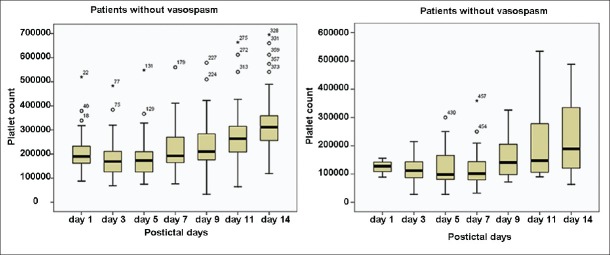
Thirty-nine (52.7%) patients developed SV. Platelet counts dropped on postictal day (PID) 3-7 and SV was commonly seen on PID 5-9. The median platelet counts were significantly lower in patients with SV when compared to those without SV. Platelet count <150,000/mm(3) on PID 1 and 7 had statistically significant association (P < 0.001) with SV. The odds ratio was 5.1, 6.9, and 5.1 on PID 5, 7, and 9, respectively, for patients with relative thrombocytopenia (P < 0.001).
There is a strong correlation between thrombocytopenia and SV. A platelet count < 150,000/mm(3) on PID 1 and 7 predicts presence of SV. The relative risk of developing SV is >5 times for a patient with relative thrombocytopenia especially on PID 5-9. Additionally, it appears that thrombocytopenia precedes vasospasm and may be an independent predictor. However, this requires further studies for validation.
症状性血管痉挛(SV)常见于动脉瘤性蛛网膜下腔出血(aSAH)后。其病理生理学表明血小板启动该过程并被消耗,这很可能导致血小板减少。本研究的目的是确定血小板减少是先于还是后于SV出现,并分析两者之间的关系。
对74例患者在aSAH后的第1、3、5、7、9、11和14天进行血小板计数研究。在同一天研究临床症状和经颅多普勒检查中升高的血流速度以确定SV。分析血小板计数与SV之间的关系。
39例(52.7%)患者发生SV。血小板计数在发作后第3 - 7天下降,SV常见于发作后第5 - 9天。与未发生SV的患者相比,发生SV的患者中位血小板计数显著更低。发作后第1天和第7天血小板计数<150,000/mm³与SV具有统计学显著相关性(P < 0.001)。相对血小板减少的患者在发作后第5、7和9天的比值比分别为5.1、6.9和5.1(P < 0.001)。
血小板减少与SV之间存在强相关性。发作后第1天和第7天血小板计数<150,000/mm³可预测SV的存在。相对血小板减少的患者发生SV的相对风险>5倍,尤其是在发作后第5 - 9天。此外,似乎血小板减少先于血管痉挛,可能是一个独立的预测指标。然而,这需要进一步研究进行验证。